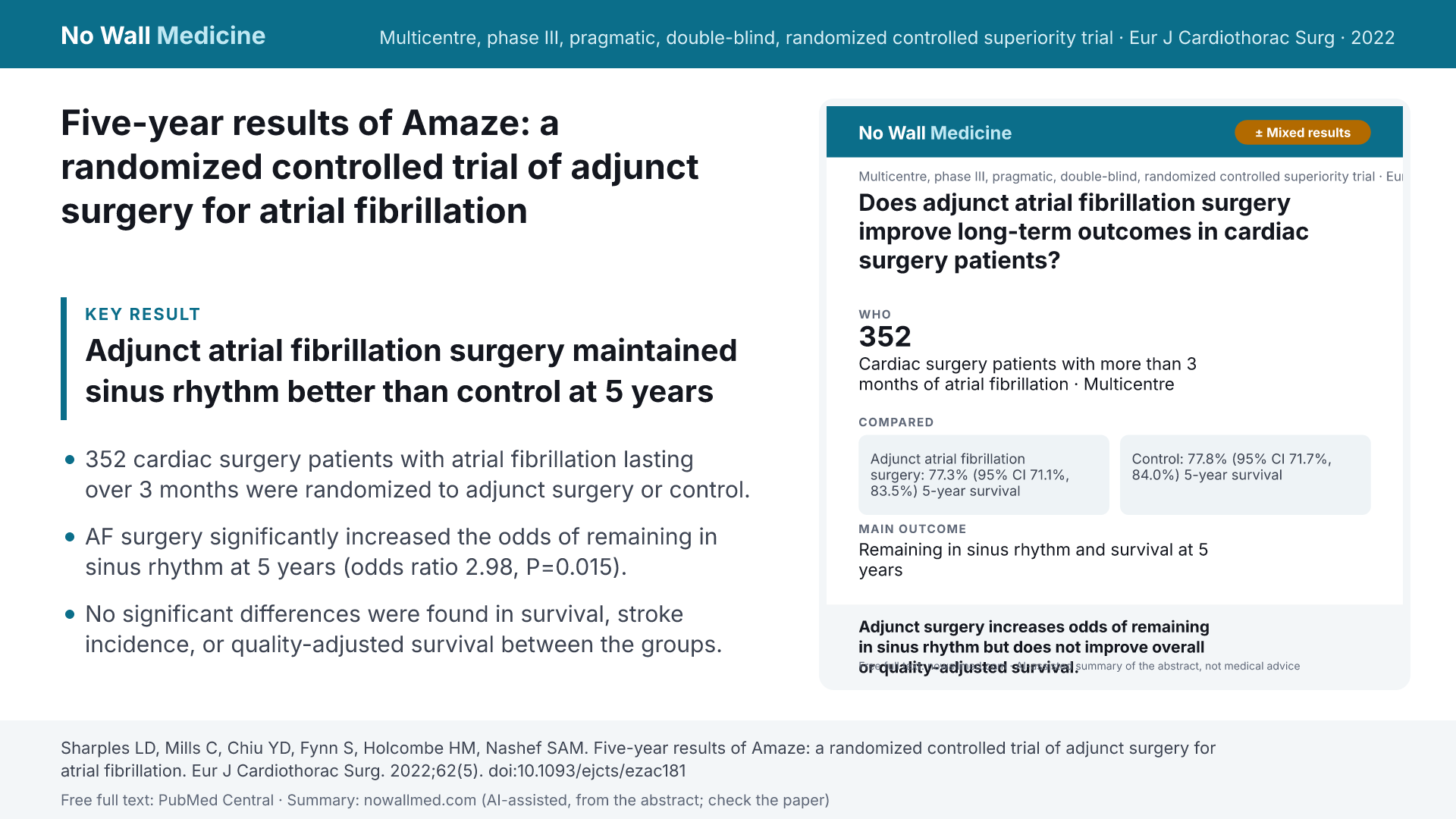
Adjunct atrial fibrillation surgery maintained sinus rhythm better than control at 5 years
Five-year results of Amaze: a randomized controlled trial of adjunct surgery for atrial fibrillation
Multicentre, phase III, pragmatic, double-blind, randomized controlled superiority trialMixed results
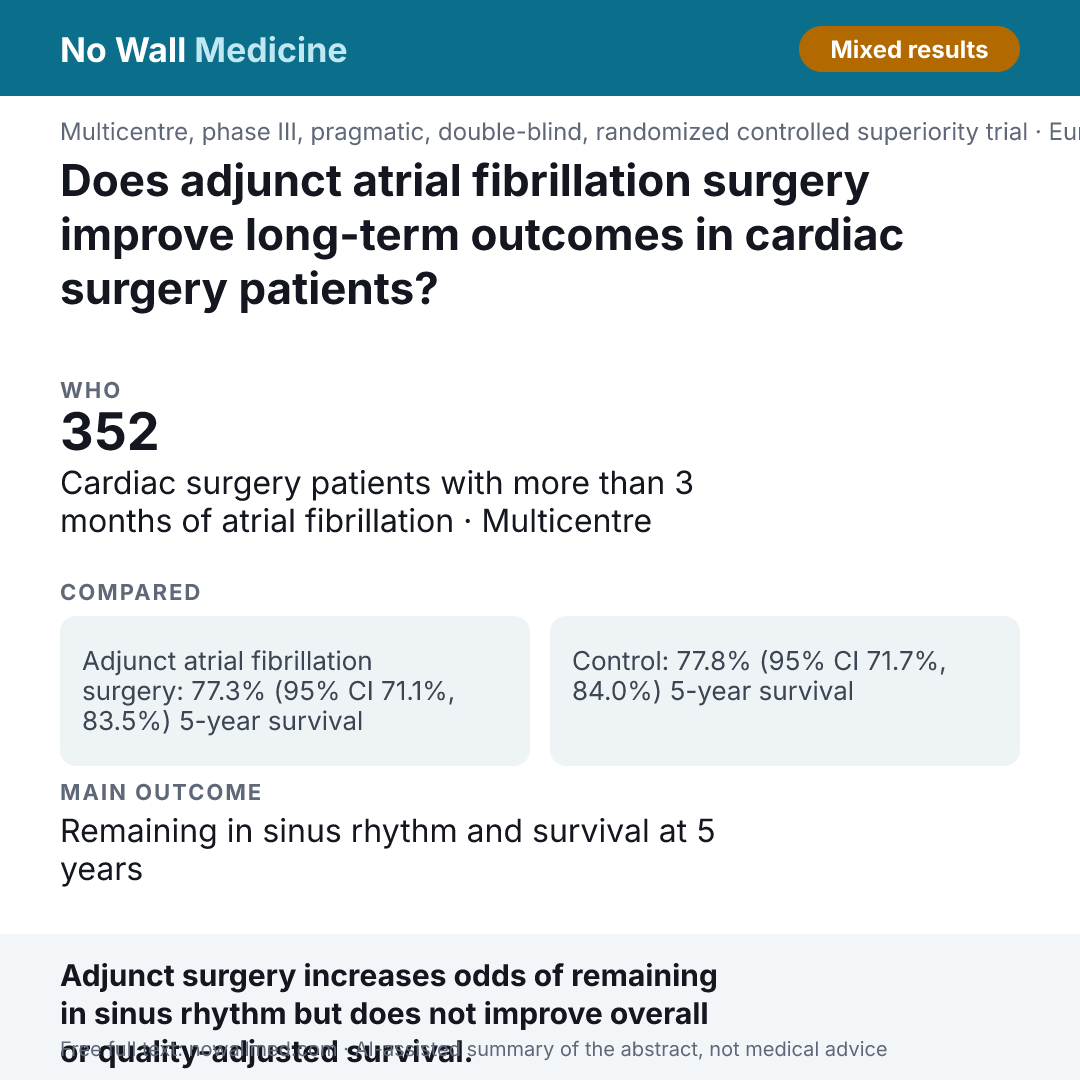
Does adjunct atrial fibrillation surgery improve long-term outcomes in cardiac surgery patients?
Who
352
Cardiac surgery patients with more than 3 months of atrial fibrillation · Multicentre
Compared
Adjunct atrial fibrillation surgery: 77.3% (95% CI 71.1%, 83.5%) 5-year survival
Control: 77.8% (95% CI 71.7%, 84.0%) 5-year survival
Main outcome
Remaining in sinus rhythm and survival at 5 years
Result: odds ratio 2.98 (95% CI 1.23, 7.17)
Bottom line: Adjunct surgery increases odds of remaining in sinus rhythm but does not improve overall or quality-adjusted survival.
Eur J Cardiothorac Surg · 2022-03-30 · Save PNG
Clinical question: Does adjunct atrial fibrillation surgery improve long-term outcomes in cardiac surgery patients?
Key points
- 352 cardiac surgery patients with atrial fibrillation lasting over 3 months were randomized to adjunct surgery or control.
- AF surgery significantly increased the odds of remaining in sinus rhythm at 5 years (odds ratio 2.98, P=0.015).
- No significant differences were found in survival, stroke incidence, or quality-adjusted survival between the groups.
Headline and key points written with AI from the paper’s abstract, with every number checked against it. Read the paper before relying on them.
Was this summary helpful?
Subject terms
Headline, design, result, key points, caveat and citation as plain text.
Cite this article
Sharples LD, Mills C, Chiu YD, Fynn S, Holcombe HM, Nashef SAM. Five-year results of Amaze: a randomized controlled trial of adjunct surgery for atrial fibrillation. Eur J Cardiothorac Surg. 2022;62(5). doi:10.1093/ejcts/ezac181
Spotted a mistake? Suggest a correction