Accelerated renal replacement therapy was associated with lower fluid accumulation but not improved survival
Fluid balance and renal replacement therapy initiation strategy: a secondary analysis of the STARRT-AKI trial
Post hoc analysis of a randomized trialMixed results
Does accelerated renal replacement therapy initiation affect fluid balance and clinical outcomes?
Who
2927
Critically ill patients with acute kidney injury
Compared
Accelerated strategy: 4509 (-728 to 11,698) mL
Standard strategy: 5646 (0 to 13,151) mL
Main outcome
Cumulative fluid balance over 14 days and 90-day survival
Bottom line: Accelerated renal replacement therapy reduced cumulative fluid balance but did not improve 90-day survival.
Crit Care · 2022-11-24Download image
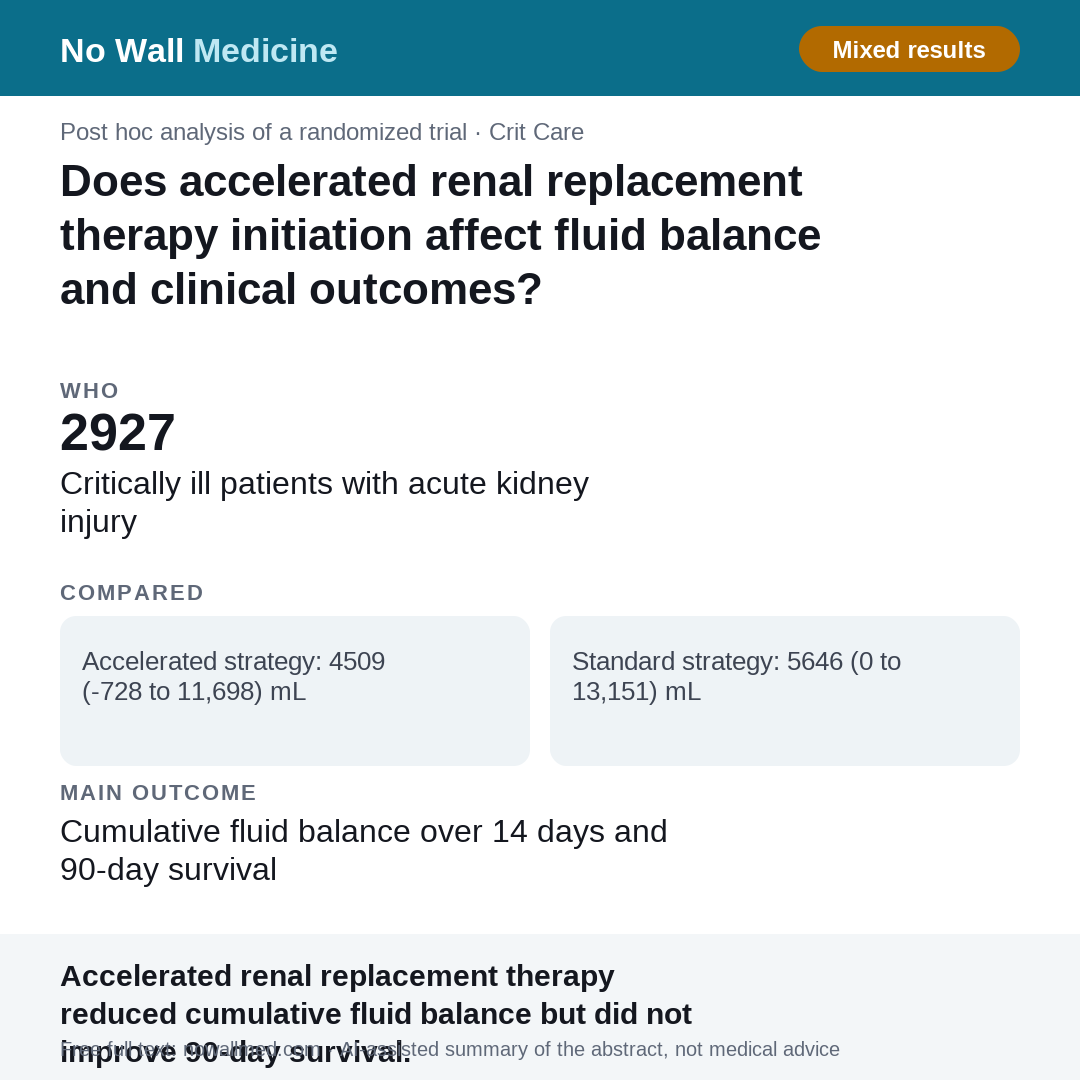
Clinical question: Does accelerated renal replacement therapy initiation affect fluid balance and clinical outcomes?
Why it matters: It was unknown if starting renal replacement therapy earlier in critically ill patients with acute kidney injury would reduce fluid accumulation or improve survival outcomes.
Key points
- Researchers analyzed 2927 patients from the STARRT-AKI trial to compare accelerated versus standard renal replacement therapy, which is a procedure to filter blood when kidneys fail.
- Over 14 days, the accelerated group had a lower cumulative fluid balance of 4509 (-728 to 11,698) mL compared to 5646 (0 to 13,151) mL in the standard group.
- Accelerated initiation did not result in higher 90-day survival rates across any baseline fluid balance quartiles, with a p value for trend of 0.08.
Headline and key points written with AI from the paper’s abstract, with every number checked against it. Read the paper before relying on them.
Was this summary helpful?
Subject terms
Cite this article
Wald R, Kirkham B, daCosta BR, Ghamarian E, Adhikari NKJ, Beaubien-Souligny W. Fluid balance and renal replacement therapy initiation strategy: a secondary analysis of the STARRT-AKI trial. Crit Care. 2022. doi:10.1186/s13054-022-04229-0
Spotted a mistake? Suggest a correction
Top studies every Monday
The week’s key trials and guidelines in your specialties, plus any topics you follow. By email, free.
Get the weekly digest