Food voucher and pantry programs improved treatment completion among food-insecure cancer patients
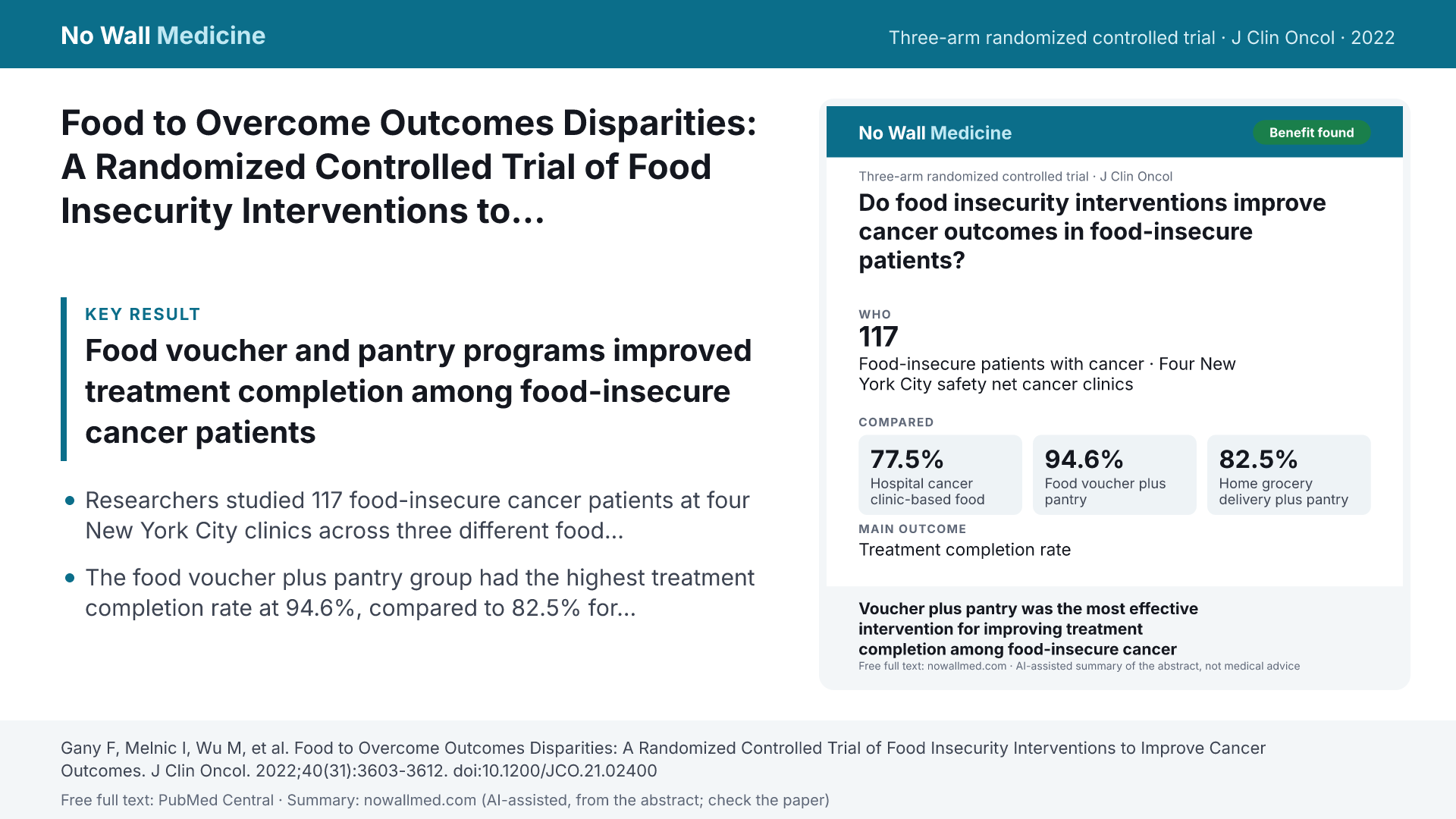
Food to Overcome Outcomes Disparities: A Randomized Controlled Trial of Food Insecurity Interventions to Improve Cancer Outcomes
Three-arm randomized controlled trialBenefit found
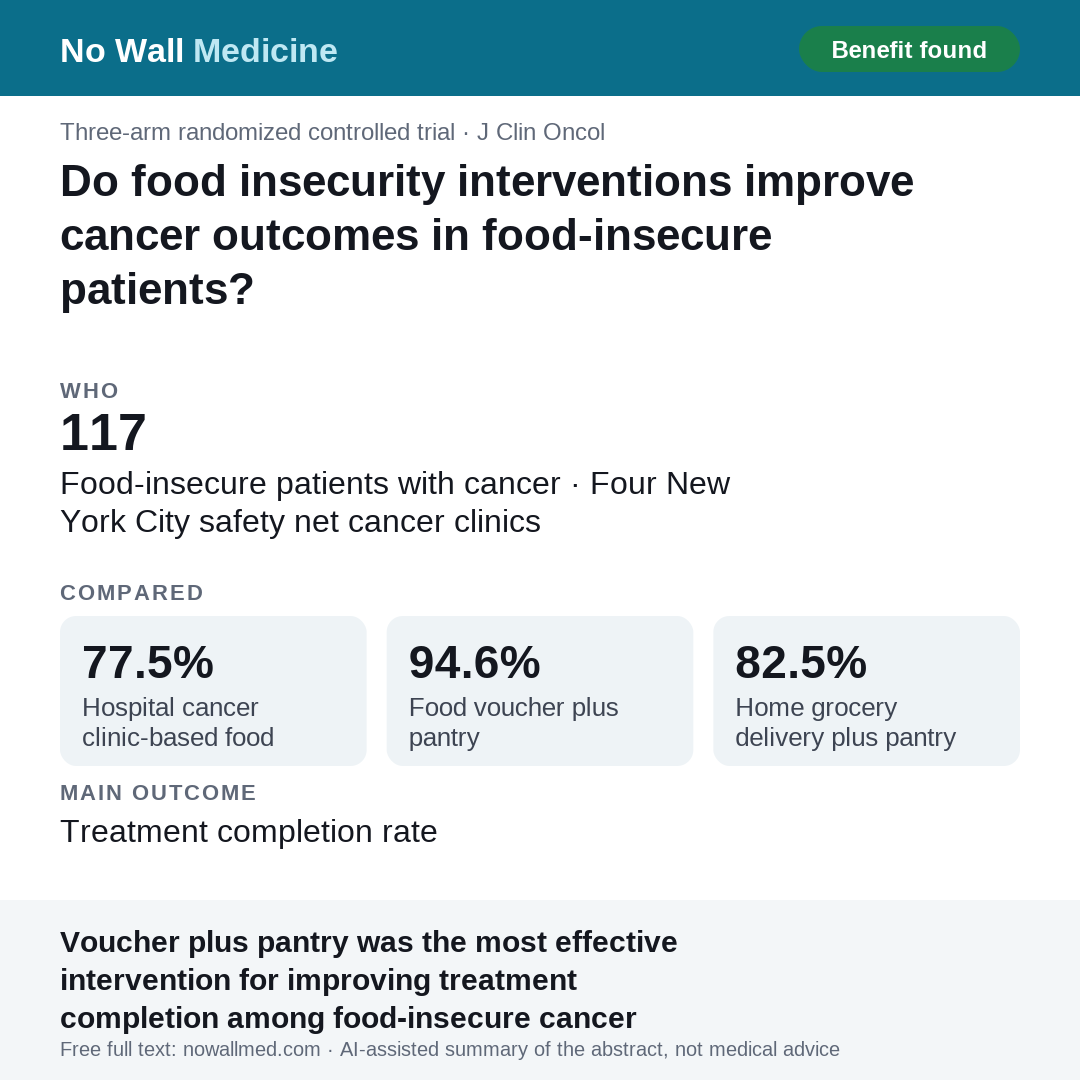
Do food insecurity interventions improve cancer outcomes in food-insecure patients?
Who
117
Food-insecure patients with cancer · Four New York City safety net cancer clinics
Compared
77.5%Hospital cancer clinic-based food pantry
94.6%Food voucher plus pantry
82.5%Home grocery delivery plus pantry
Main outcome
Treatment completion rate
Bottom line: Voucher plus pantry was the most effective intervention for improving treatment completion among food-insecure cancer patients.
J Clin Oncol · 2022-06-16Download image
Clinical question: Do food insecurity interventions improve cancer outcomes in food-insecure patients?
Key points
- Researchers studied 117 food-insecure cancer patients at four New York City clinics across three different food assistance programs.
- The food voucher plus pantry group had the highest treatment completion rate at 94.6%, compared to 82.5% for grocery delivery plus pantry and 77.5% for the pantry alone.
- Food security scores improved in all groups, while depression symptoms and quality-of-life scores improved in the pantry and grocery delivery plus pantry arms.
Headline and key points written with AI from the paper’s abstract, with every number checked against it. Read the paper before relying on them.
Was this summary helpful?
Subject terms
Headline, design, result, key points, caveat and citation as plain text.
Cite this article
Gany F, Melnic I, Wu M, et al. Food to Overcome Outcomes Disparities: A Randomized Controlled Trial of Food Insecurity Interventions to Improve Cancer Outcomes. J Clin Oncol. 2022. doi:10.1200/JCO.21.02400
Spotted a mistake? Suggest a correction