Food to Overcome Outcomes Disparities: A Randomized Controlled Trial of Food Insecurity Interventions to Improve Cancer Outcomes
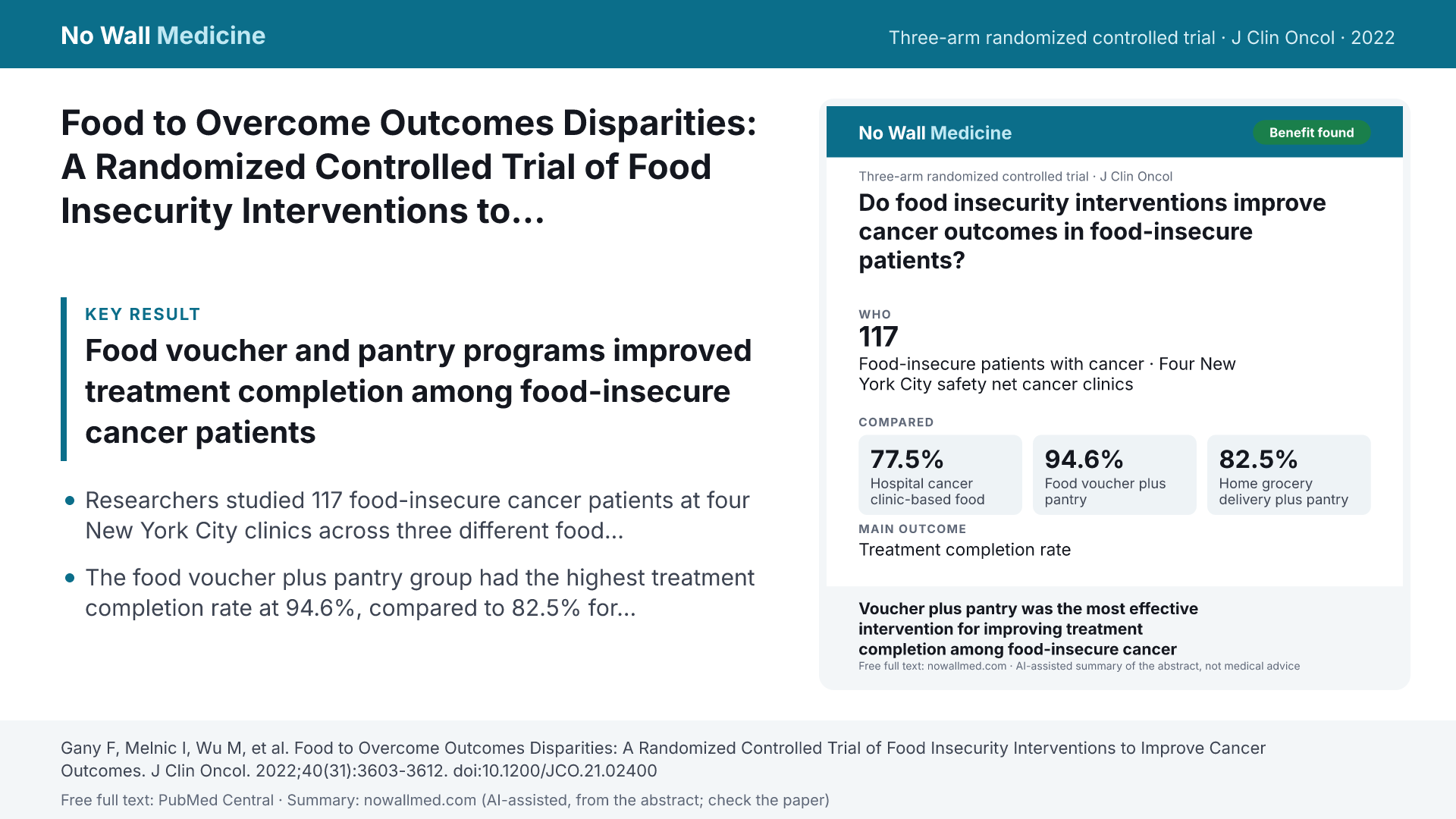
Key result: Food voucher and pantry programs improved treatment completion among food-insecure cancer patients
Three-arm randomized controlled trialBenefit found
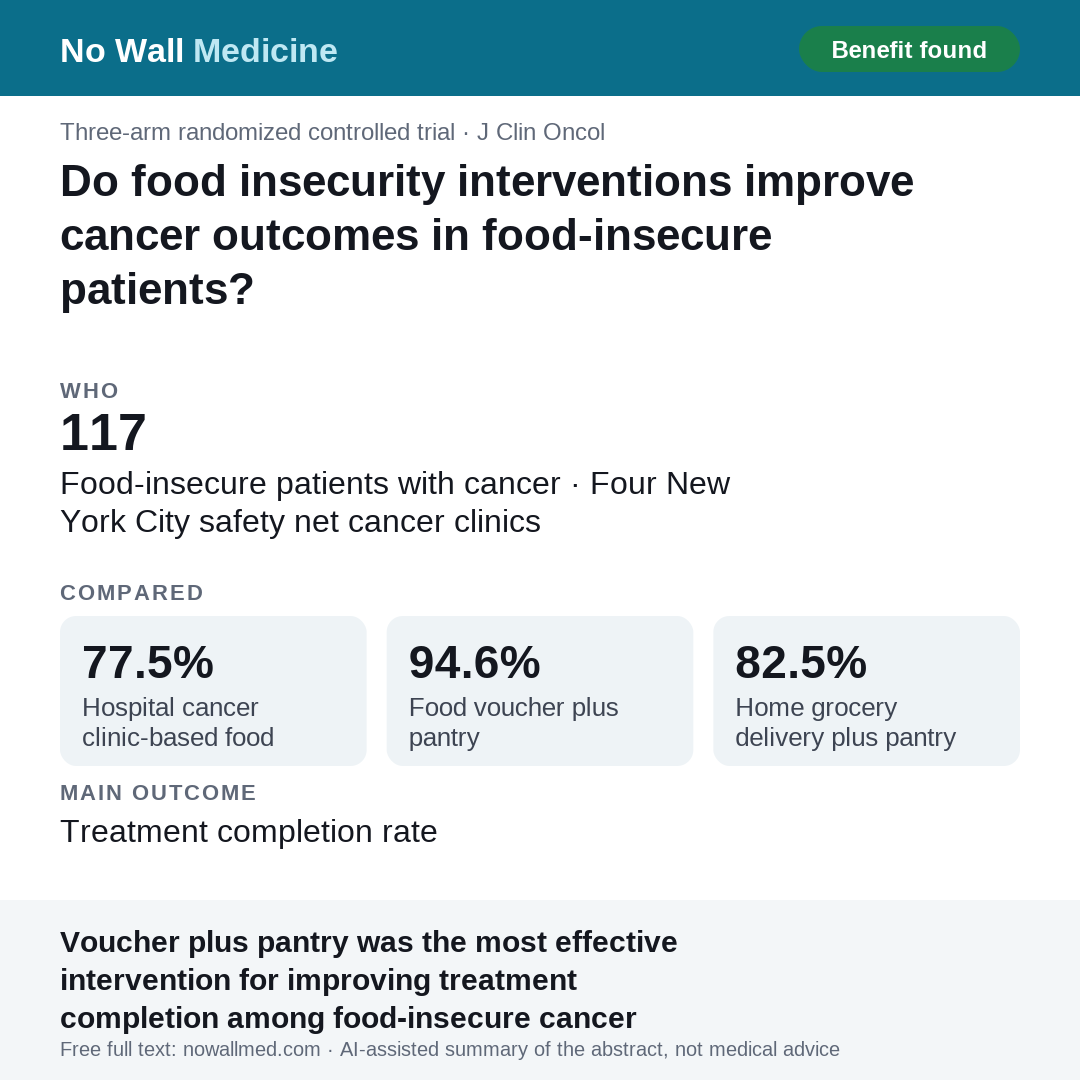
Do food insecurity interventions improve cancer outcomes in food-insecure patients?
Who
117
Food-insecure patients with cancer · Four New York City safety net cancer clinics
Compared
77.5%Hospital cancer clinic-based food pantry
94.6%Food voucher plus pantry
82.5%Home grocery delivery plus pantry
Main outcome
Treatment completion rate
Bottom line: Voucher plus pantry was the most effective intervention for improving treatment completion among food-insecure cancer patients.
J Clin Oncol · 2022-06-16Download image
Key points
- Researchers studied 117 food-insecure cancer patients at four New York City clinics across three different food assistance programs.
- The food voucher plus pantry group had the highest treatment completion rate at 94.6%, compared to 82.5% for grocery delivery plus pantry and 77.5% for the pantry alone.
- Food security scores improved in all groups, while depression symptoms and quality-of-life scores improved in the pantry and grocery delivery plus pantry arms.
Discussion prompts
- Would these patients look like yours? Who was left out?
- Is the main outcome one that matters to patients?
- Is the difference large enough to change what you do?
Cite: Gany F, Melnic I, Wu M, et al. Food to Overcome Outcomes Disparities: A Randomized Controlled Trial of Food Insecurity Interventions to Improve Cancer Outcomes. J Clin Oncol. 2022. doi:10.1200/JCO.21.02400
Free full text: PubMed Central · Summary and visual abstract: nowallmed.com/a/food-to-overcome-outcomes-disparities-a-randomized-controlled-trial-v3mgph/ (AI-assisted from the abstract; check the paper before relying on it).