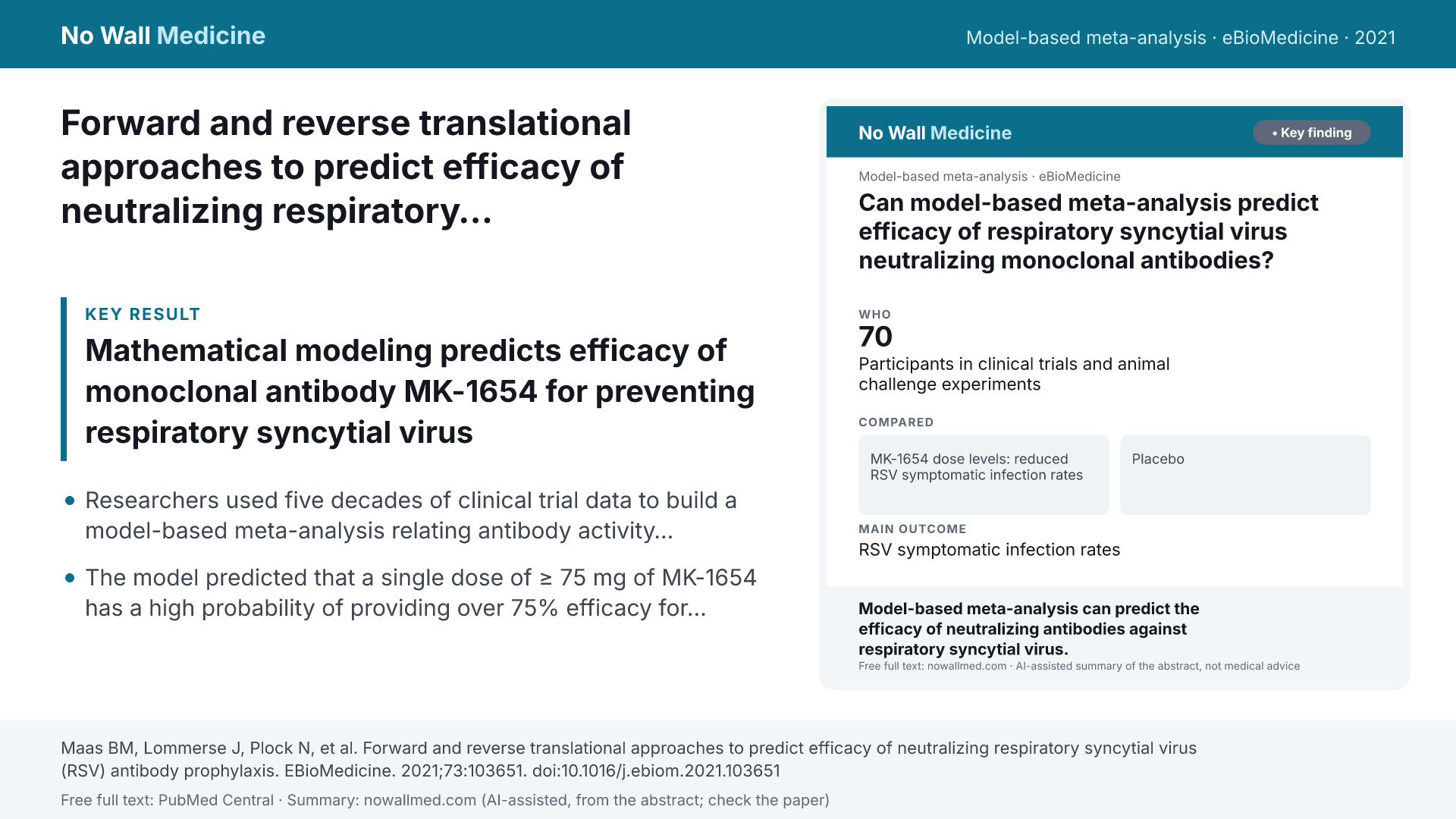
Mathematical modeling predicts efficacy of monoclonal antibody MK-1654 for preventing respiratory syncytial virus
Forward and reverse translational approaches to predict efficacy of neutralizing respiratory syncytial virus (RSV) antibody prophylaxis
Model-based meta-analysisBenefit found
Can model-based meta-analysis predict efficacy of respiratory syncytial virus neutralizing monoclonal antibodies?
Who
70
Participants in clinical trials and animal challenge experiments
Compared
MK-1654 dose levels: reduced RSV symptomatic infection rates
Placebo
Main outcome
RSV symptomatic infection rates
Bottom line: Model-based meta-analysis can predict the efficacy of neutralizing antibodies against respiratory syncytial virus.
eBioMedicine · 2021-11-11Download image
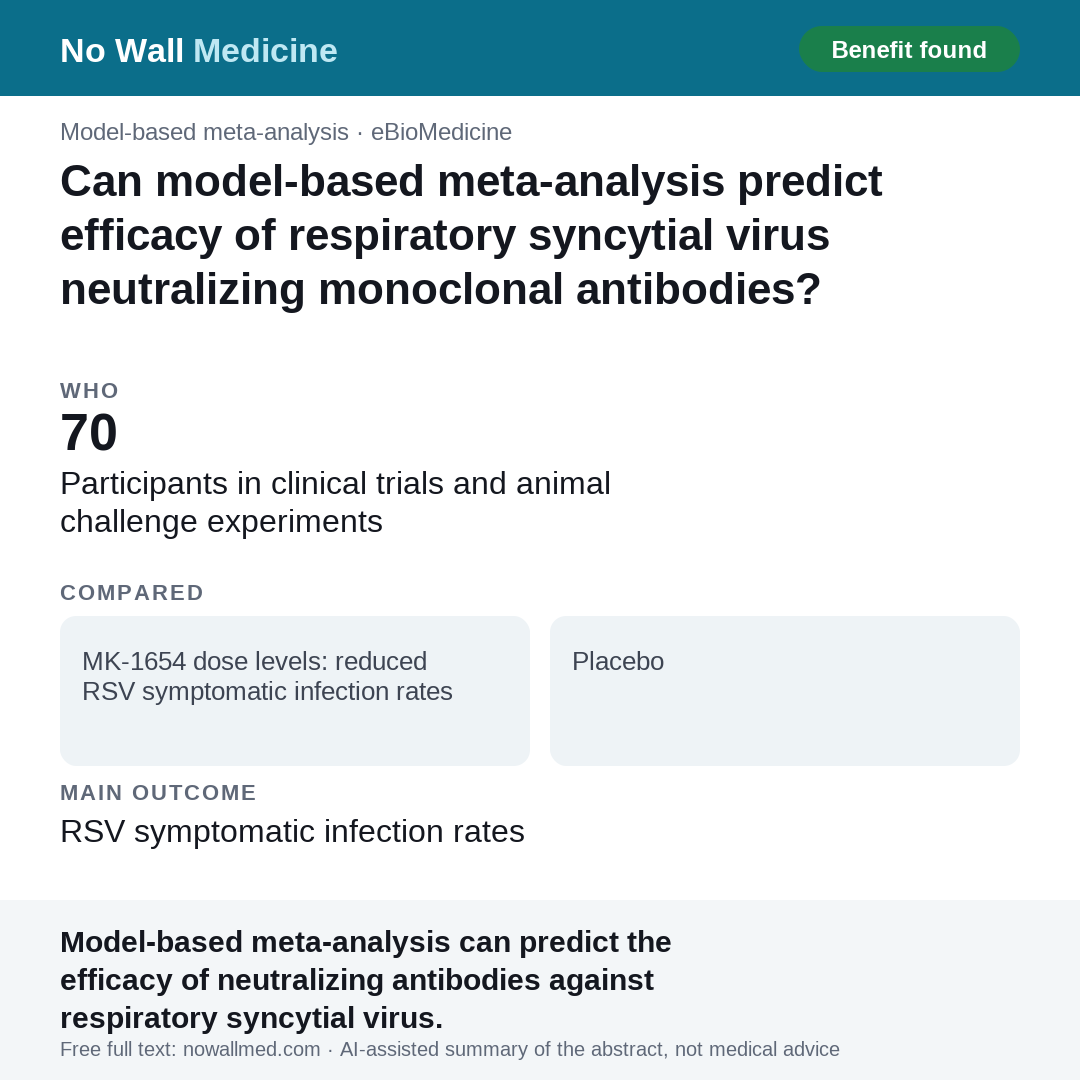
Clinical question: Can model-based meta-analysis predict efficacy of respiratory syncytial virus neutralizing monoclonal antibodies?
Why it matters: It is necessary to develop methods to predict the effective doses of neutralizing antibodies across different populations exposed to seasonal variations in infection.
Key points
- Researchers used five decades of clinical trial data to build a model-based meta-analysis relating antibody activity to clinical outcomes.
- The model predicted that a single dose of ≥ 75 mg of MK-1654 has a high probability of providing over 75% efficacy for 5 months in infants.
- The model's predictions were consistent with animal challenge experiments and a human trial involving 70 participants.
Headline and key points written with AI from the paper’s abstract, with every number checked against it. Read the paper before relying on them.
Was this summary helpful?
Subject terms
Cite this article
Maas BM, Lommerse J, Plock N, Railkar RA, Cheung SYA, Caro L. Forward and reverse translational approaches to predict efficacy of neutralizing respiratory syncytial virus (RSV) antibody prophylaxis. eBioMedicine. 2021. doi:10.1016/j.ebiom.2021.103651
Spotted a mistake? Suggest a correction