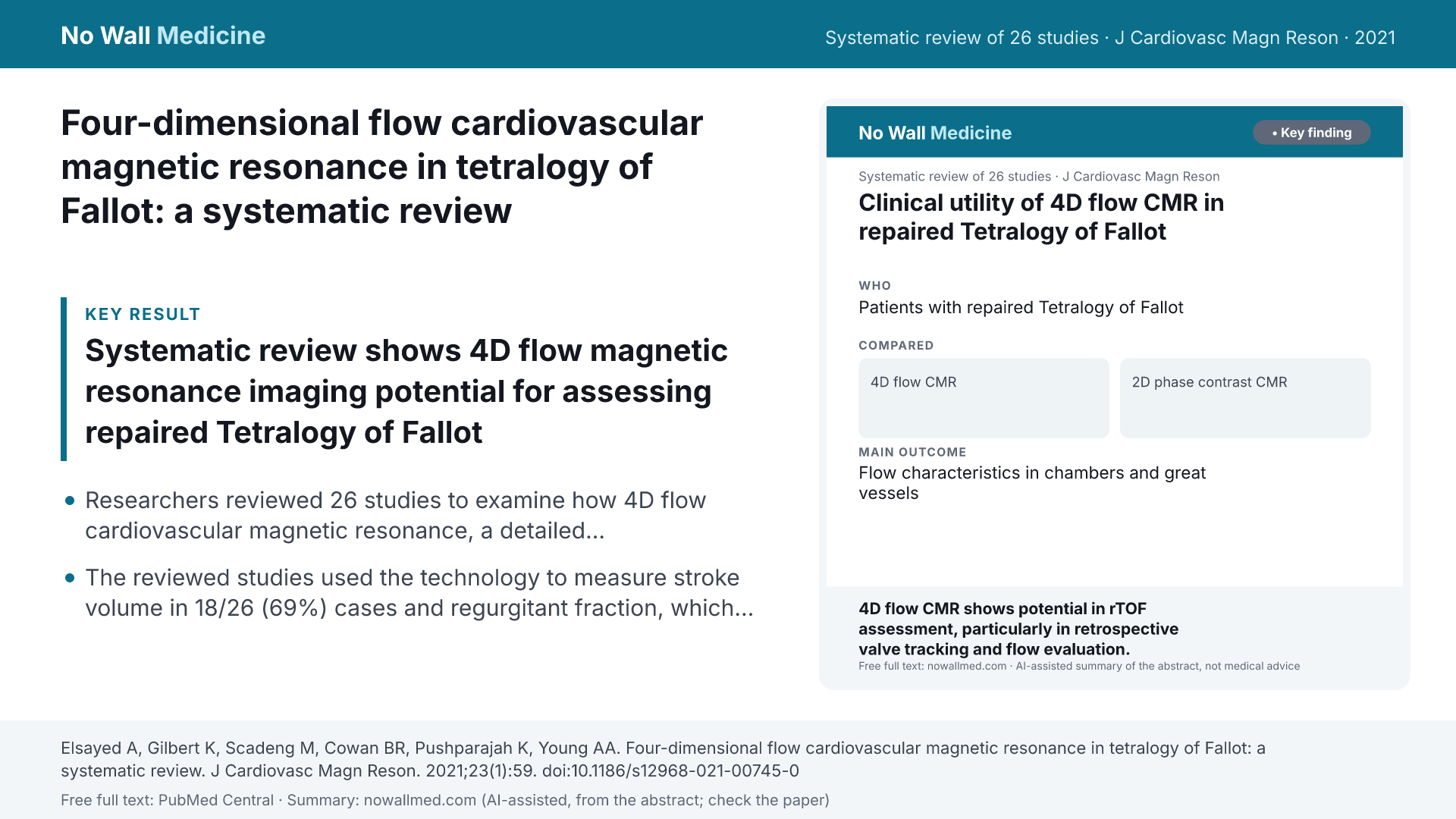
Systematic review shows 4D flow magnetic resonance imaging potential for assessing repaired Tetralogy of Fallot
Four-dimensional flow cardiovascular magnetic resonance in tetralogy of Fallot: a systematic review
Key points
- Researchers reviewed 26 studies to examine how 4D flow cardiovascular magnetic resonance, a detailed imaging technique, can be used in patients with repaired Tetralogy of Fallot.
- The reviewed studies used the technology to measure stroke volume in 18/26 (69%) cases and regurgitant fraction, which is the amount of blood flowing backward, in 16/26 (62%) cases.
- Other measurements included systolic peak velocity in 9/26 (35%) studies and kinetic energy, which is the energy of moving blood, in 5/26 (19%) studies.
Limitation the authors note: Prospective, randomized, multi-centered studies are required to validate these new characteristics and establish their clinical use.
Headline and key points written with AI from the paper’s abstract, with every number checked against it. Read the paper before relying on them.
Was this summary helpful?
Subject terms
Cite this article
Elsayed A, Gilbert K, Scadeng M, Cowan BR, Pushparajah K, Young AA. Four-dimensional flow cardiovascular magnetic resonance in tetralogy of Fallot: a systematic review. J Cardiovasc Magn Reson. 2021;23(1):59. doi:10.1186/s12968-021-00745-0
Spotted a mistake? Suggest a correction