Studies on pulmonary valve intervention in tetralogy of Fallot patients show inconsistent reporting methods
High variability in reporting of right ventricle contouring technique and body surface area methodology in cardiac magnetic resonance studies of patients with repaired tetralogy of Fallot: A systematic review
Systematic reviewUnclear result
How are right ventricle contouring and body surface area methodologies reported in cardiac magnetic resonance studies?
Who
27
Adults with repaired tetralogy of Fallot · Electronic databases Embase and MEDLINE
Compared
Included studies: 81% (22/27) did not specify right ventricle contouring technique
Included studies: none defined the right ventricle basal slice
Included studies: No studies reported the formula used to calculate actual body surface area
Main outcome
Reporting of right ventricle contouring and body surface area methodology
Bottom line: Reporting of right ventricle contouring and body surface area methodology in cardiac magnetic resonance studies is poor and lacks standardization.
Limitation: All studies were of only level III or level IV levels of evidence.
J Cardiovasc Magn Reson · 2025-08-13Download image
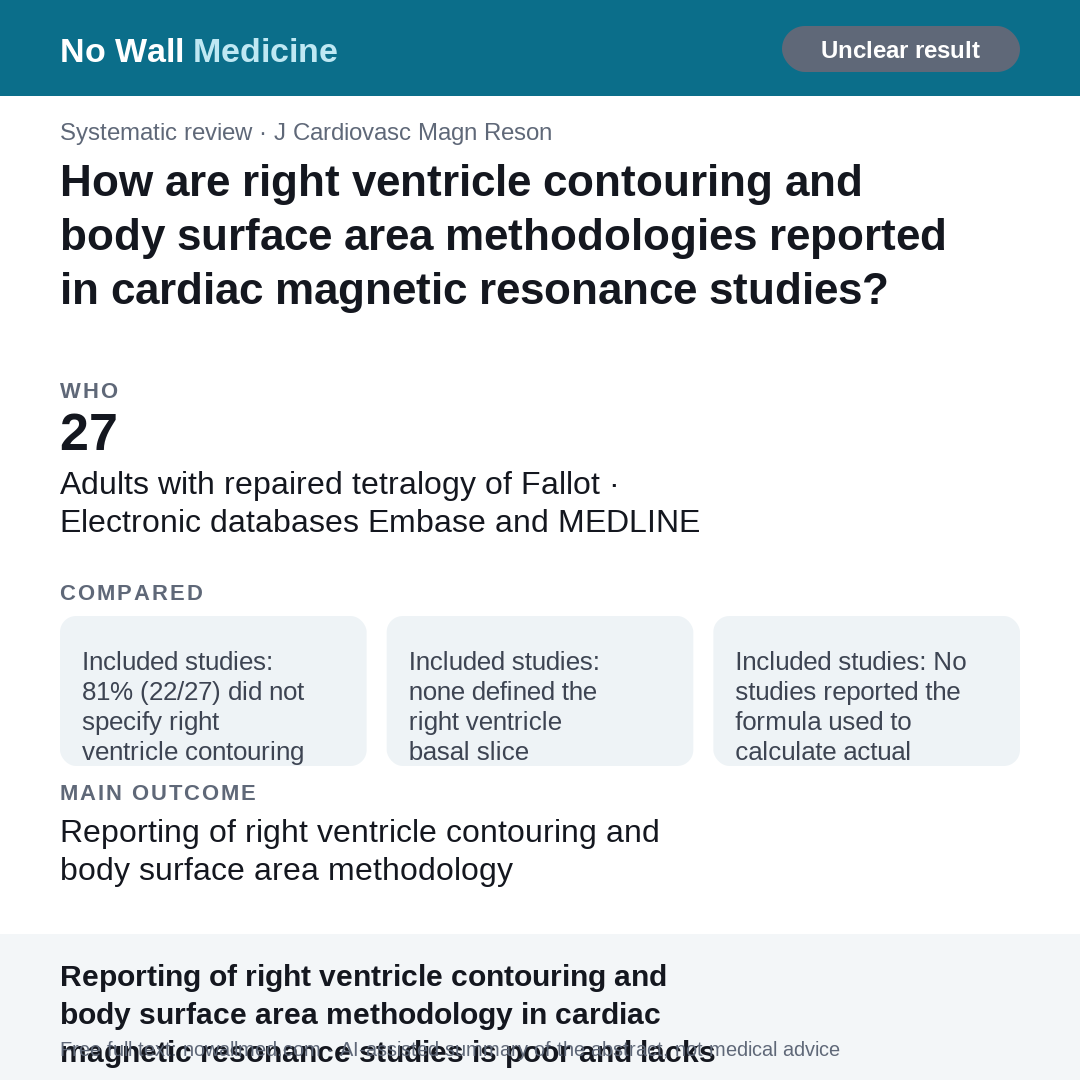
Clinical question: How are right ventricle contouring and body surface area methodologies reported in cardiac magnetic resonance studies?
Why it matters: Clinical decisions for pulmonary valve intervention depend on right ventricle volume measurements indexed to body surface area, but reporting of these methods varies significantly.
Key points
- Researchers reviewed 27 studies published between February 28, 2010 and February 28, 2025 that assessed adults with repaired tetralogy of Fallot using cardiac magnetic resonance.
- Most studies, 81% or 22/27, did not specify the right ventricle contouring technique, which is the method used to outline the heart chamber for volume measurement.
- None of the included studies reported the formula used to calculate body surface area, and none defined the right ventricle basal slice.
Headline and key points written with AI from the paper’s abstract, with every number checked against it. Read the paper before relying on them.
Topics
Cite this article
Grbac AJ, Naimo PS, Russo JJ, Fogarty SJ, Wilson WM, Zentner D. High variability in reporting of right ventricle contouring technique and body surface area methodology in cardiac magnetic resonance studies of patients with repaired tetralogy of Fallot: A systematic review. J Cardiovasc Magn Reson. 2025. doi:10.1016/j.jocmr.2025.101942
Spotted a mistake? Suggest a correction
Top studies every Monday
The week’s key trials and guidelines in your specialties, plus any topics you follow. By email, free.
Get the weekly digest