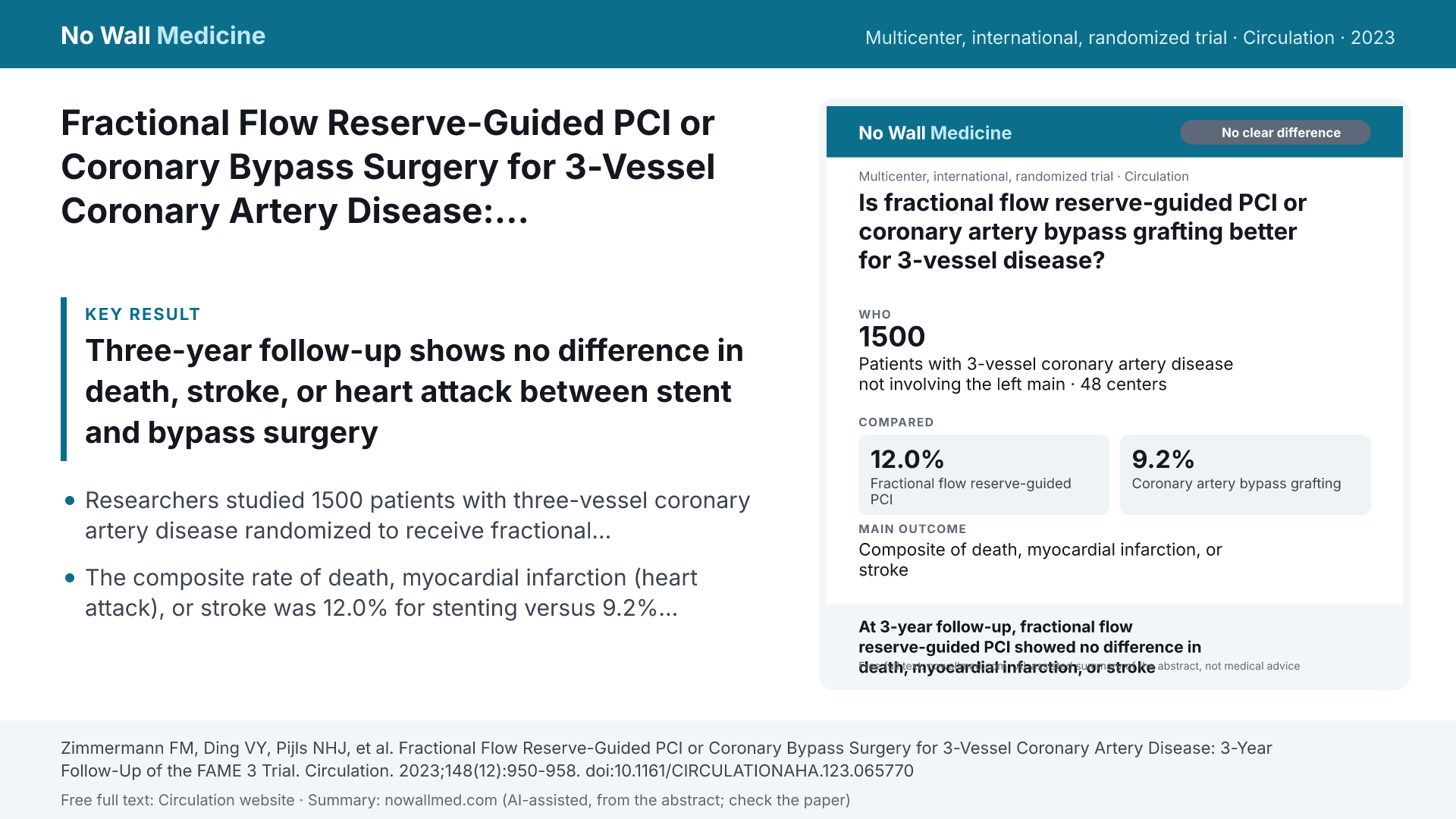
Three-year follow-up shows no difference in death, stroke, or heart attack between stent and bypass surgery
Fractional Flow Reserve-Guided PCI or Coronary Bypass Surgery for 3-Vessel Coronary Artery Disease: 3-Year Follow-Up of the FAME 3 Trial
Multicenter, international, randomized trialNo clear difference
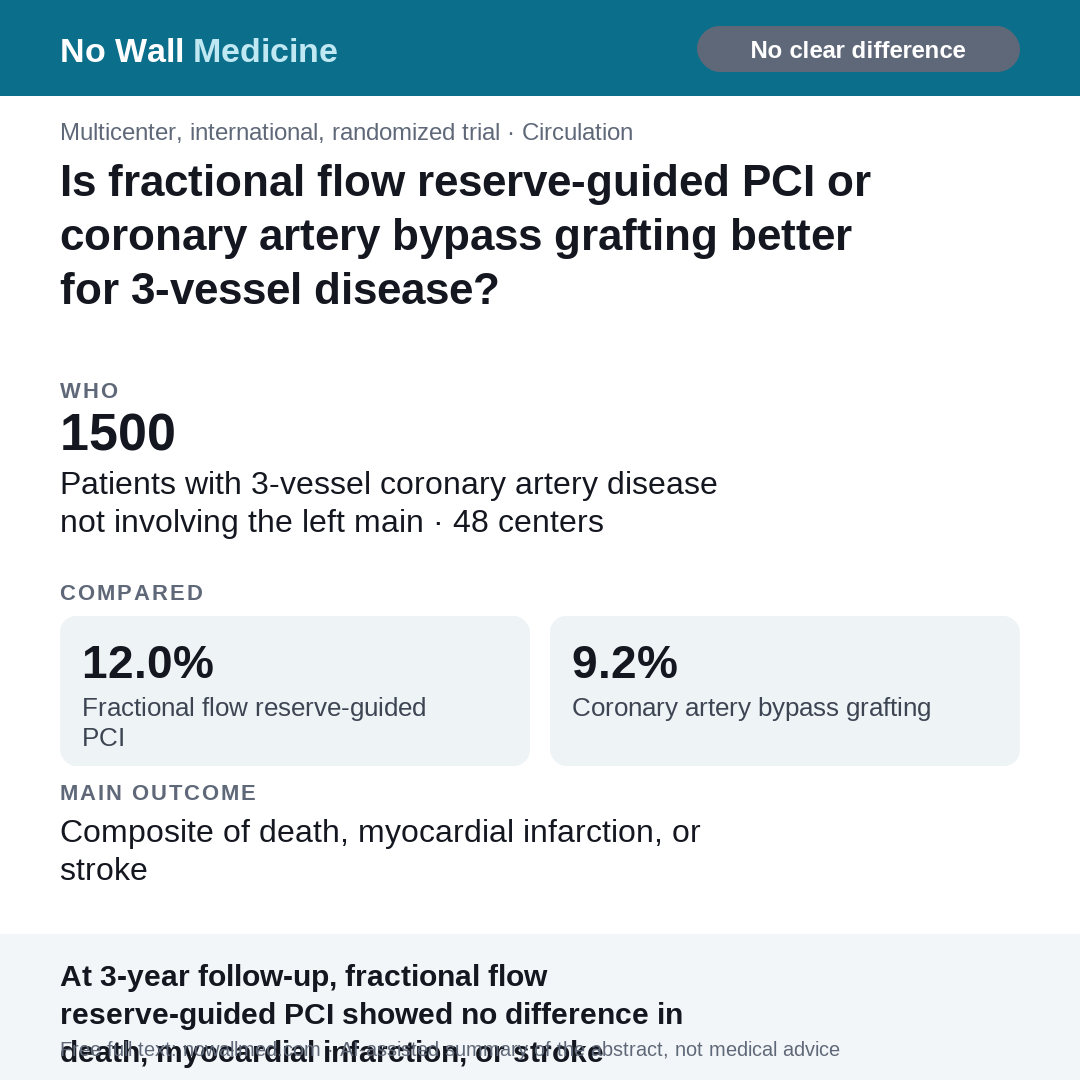
Is fractional flow reserve-guided PCI or coronary artery bypass grafting better for 3-vessel disease?
Who
1500
Patients with 3-vessel coronary artery disease not involving the left main · 48 centers worldwide
Compared
12.0%Fractional flow reserve-guided PCI
9.2%Coronary artery bypass grafting
Main outcome
Composite of death, myocardial infarction, or stroke
Result: hazard ratio 1.3 (95% CI 0.98-1.83)
Bottom line: At 3-year follow-up, fractional flow reserve-guided PCI showed no difference in death, myocardial infarction, or stroke compared to bypass surgery.
Circulation · 2023-08-21Download image
Clinical question: Is fractional flow reserve-guided PCI or coronary artery bypass grafting better for 3-vessel disease?
Why it matters: It was unknown if current-generation drug-eluting stents and fractional flow reserve, a pressure-based measurement, would change the outcomes of stenting compared to bypass surgery.
Key points
- Researchers studied 1500 patients with three-vessel coronary artery disease randomized to receive fractional flow reserve-guided percutaneous coronary intervention (stenting) or coronary artery bypass surgery.
- The composite rate of death, myocardial infarction (heart attack), or stroke was 12.0% for stenting versus 9.2% for bypass surgery, which was not a statistically significant difference.
- Myocardial infarction occurred more frequently in the stenting group at 7.0% compared to 4.2% in the bypass surgery group.
Headline and key points written with AI from the paper’s abstract, with every number checked against it. Read the paper before relying on them.
Was this summary helpful?
Subject terms
Cite this article
Zimmermann FM, Ding VY, Pijls NHJ, Piroth Z, van Straten AHM, Szekely L. Fractional Flow Reserve-Guided PCI or Coronary Bypass Surgery for 3-Vessel Coronary Artery Disease: 3-Year Follow-Up of the FAME 3 Trial. Circulation. 2023. doi:10.1161/CIRCULATIONAHA.123.065770
Spotted a mistake? Suggest a correction
Top studies every Monday
The week’s key trials and guidelines in your specialties, plus any topics you follow. By email, free.
Get the weekly digest