Prostate cancer screening was associated with fewer advanced tumors and less secondary treatment over 21 years
From Screening to Mortality Reduction: An Overview of Empirical Data on the Patient Journey in European Randomized Study of Screening for Prostate Cancer Rotterdam After 21 Years of Follow-up and a Reflection on Quality of Life
Randomized trialMixed results
What is the effect of prostate-specific antigen-based screening on prostate cancer outcomes?
Who
Men in the European Randomized Study of Screening for Prostate Cancer · Rotterdam
Compared
PSA-based screening: 12% advanced tumour stages
Control: 23% advanced tumour stages
Main outcome
Advanced tumour stages, disease progression, and secondary treatment
Result: relative risk 0.50 (95% CI 0.44-0.57) for advanced stages
Bottom line: Prostate-specific antigen screening reduces advanced cancer stages and treatments but increases overdiagnosis and potential overtreatment.
Limitation: The screening results in more overdiagnosis and probably more overtreatment.
Eur Urol Oncol · 2023-09-09Download image
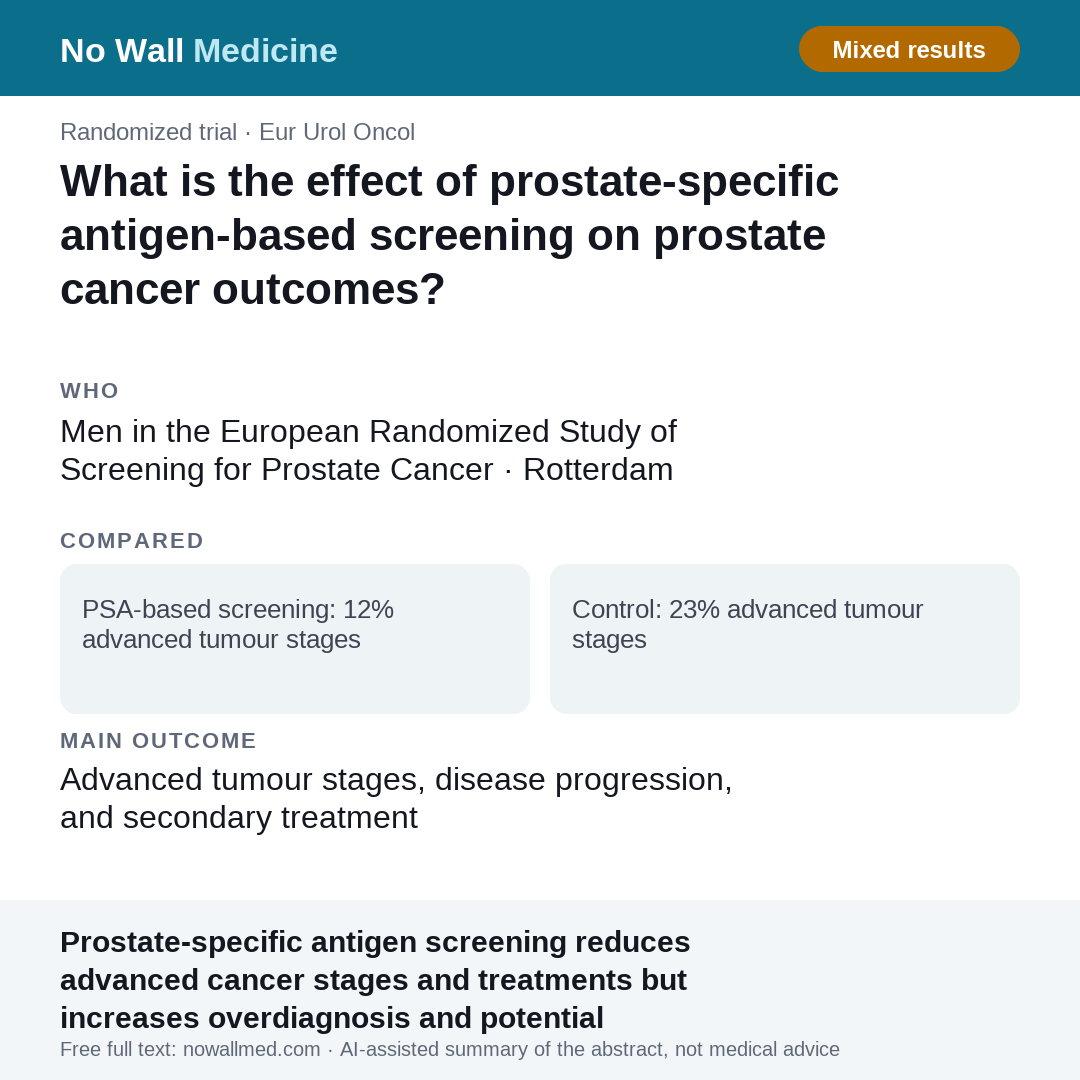
Clinical question: What is the effect of prostate-specific antigen-based screening on prostate cancer outcomes?
Why it matters: It was unknown how 21 years of long-term empirical data would affect tumor characteristics, treatments, and disease progression compared to previous 11-year extrapolated models.
Key points
- Men in the European Randomized Study of Screening for Prostate Cancer were randomized to either prostate-specific antigen (PSA) screening or a control group.
- The screening group had fewer advanced tumor stages (12% vs 23%; relative risk = 0.50) and less secondary treatment (30% vs 48%; relative risk = 0.61) compared to the control group.
- The screening approach was associated with more overdiagnosis and likely more overtreatment.
Headline and key points written with AI from the paper’s abstract, with every number checked against it. Read the paper before relying on them.
Was this summary helpful?
Abstract
Background
Previous research quantified the effect of prostate-specific antigen (PSA)-based prostate cancer (PCa) screening on quality-adjusted life years using 11-yr follow-up data from the European Randomized Study of Screening for Prostate Cancer (ERSPC) extrapolated by the Microsimulation Screening Analysis (MISCAN). ERSPC data now matured to 21 yr of follow-up.Objective
To provide an overview of the effect of PSA-based screening on tumour characteristics and PCa treatment using long-term, detailed, empirical ERSPC data.Design, setting, and participants
Men were included from the ERSPC Rotterdam who were randomised to a PSA-based screening (S) or control (C) arm.Outcome measurements and statistical analysis
We assessed the effects of PSA-based screening on the number of PCa diagnoses, tumour characteristics, treatments, and cumulative incidence of disease progression. We also evaluated the changes in tumour characteristics and treatments over time for both study arms.Results and limitations
Among PCa patients in the S-arm, fewer patients were diagnosed with advanced tumour stages (T3/T4: 12% vs 23%; relative risk [RR] = 0.50; 95% confidence interval [CI] 0.44-0.57), less disease progression was observed, and less secondary treatment (30% vs 48%; RR = 0.61; 95% CI 0.57-0.66; p Conclusions
After 21 yr of follow-up, empirical data of the ERSPC showed that PSA-based screening reduces advanced PCa stages, disease progression, and extensive treatments at the cost of more overdiagnosis and probably more overtreatment. Our data showed reduced local treatments and increased expectant management strategies over time.Patient summary
Prostate-specific antigen-based screening reduces the number of invasive prostate cancer treatments needed, however, at the cost of more overdiagnosis and probably more overtreatment. Limiting these costs remains crucial to benefit optimally from prostate cancer screening.
Abstract reproduced under the article’s CC BY licence.
Subject terms
Cite this article
Hogenhout R, Remmers S, van Slooten-Midderigh ME, de Vos II, Roobol MJ, ERSPC Rotterdam Study Group. From Screening to Mortality Reduction: An Overview of Empirical Data on the Patient Journey in European Randomized Study of Screening for Prostate Cancer Rotterdam After 21 Years of Follow-up and a Reflection on Quality of Life. Eur Urol Oncol. 2023. doi:10.1016/j.euo.2023.08.011
Spotted a mistake? Suggest a correction
Top studies every Monday
The week’s key trials and guidelines in your specialties, plus any topics you follow. By email, free.
Get the weekly digest