Genomic data and artificial intelligence showed higher accuracy than clinical parameters for childhood cancer prognosis
From simple factors to artificial intelligence: evolution of prognosis prediction in childhood cancer: a systematic review and meta-analysis
Systematic review and meta-analysisBenefit found
How accurate are traditional versus advanced prognostic models in childhood cancer?
Who
Children with haematological malignancies, central nervous system, or non-central nervous system solid tumours
Compared
0.75Clinical parameters (95% CI: 0.72-0.79)
0.85Genomic-transcriptomic data (95% CI: 0.82-0.88)
0.82Artificial intelligence (95% CI: 0.77-0.88)
Main outcome
Area under the receiver operating characteristic curve
Bottom line: Genomic-transcriptomic and artificial intelligence models show improved accuracy over clinical parameters for non-central nervous system solid tumours.
Limitation: Internal validation studies showed significantly better performance than external validation, highlighting high risk of bias.
eClinicalMedicine · 2024-11-21Download image
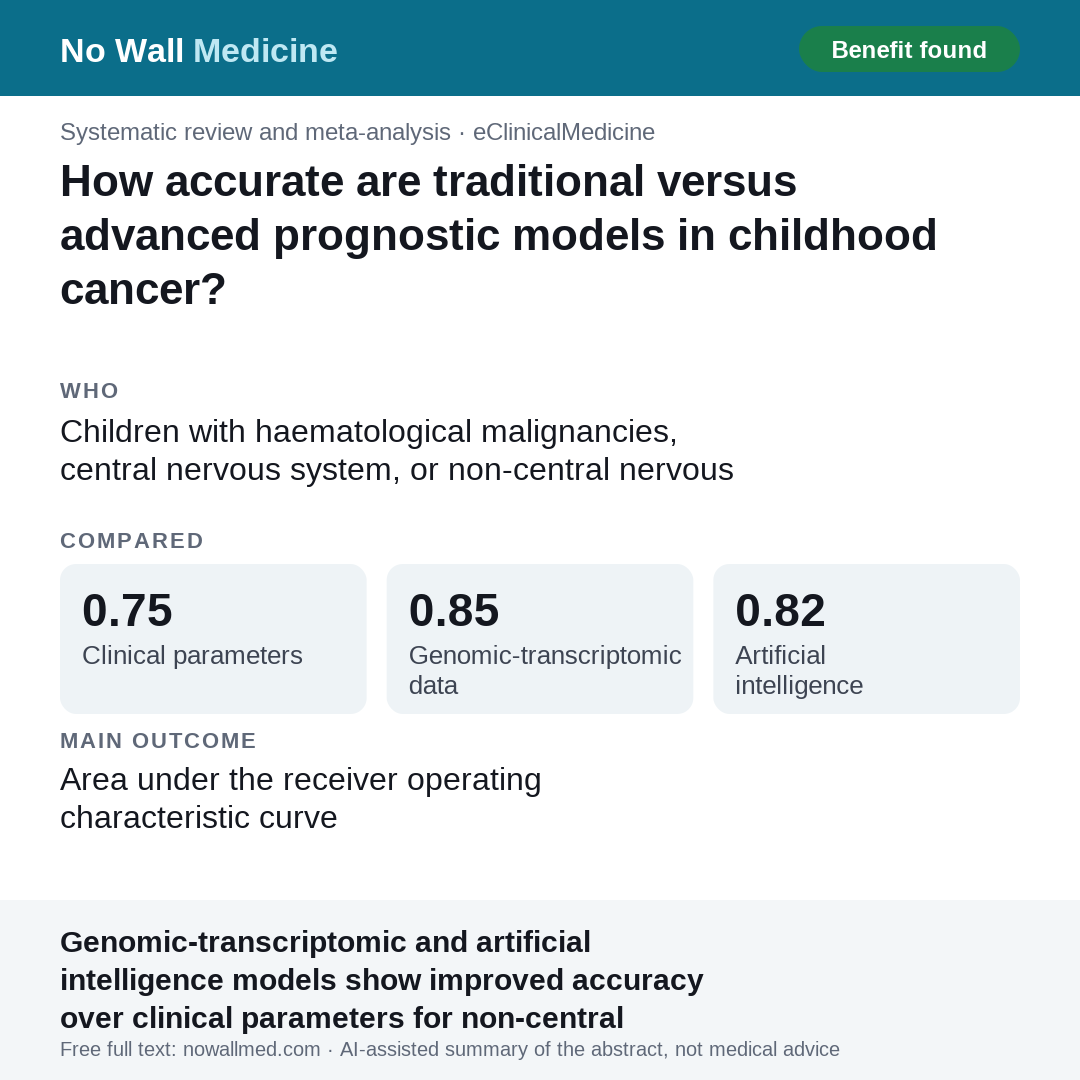
Clinical question: How accurate are traditional versus advanced prognostic models in childhood cancer?
Why it matters: The performance, composition, and limitations of contemporary prognostic models for personalized stratification in pediatric cancer care are currently lacking.
Key points
- Researchers analyzed 358 studies to compare the accuracy of clinical parameters, genomic-transcriptomic data, and artificial intelligence in predicting childhood cancer outcomes.
- For non-central nervous system solid tumours at 5-year overall survival, genomic data (0.85 CI: 0.82-0.88) was more accurate than clinical parameters (0.75 CI: 0.72-0.79).
- There was no statistically significant difference in accuracy between genomic-transcriptomic data and artificial intelligence models (0.82 CI: 0.77-0.88).
Limitation the authors note: Internal validation studies showed significantly better performance than external validation, highlighting a high risk of bias in outcomes and statistical analysis.
Headline and key points written with AI from the paper’s abstract, with every number checked against it. Read the paper before relying on them.
Cite this article
Varga P, Obeidat M, Máté V, Kói T, Kiss-Dala S, Major GS. From simple factors to artificial intelligence: evolution of prognosis prediction in childhood cancer: a systematic review and meta-analysis. eClinicalMedicine. 2024. doi:10.1016/j.eclinm.2024.102902
Spotted a mistake? Suggest a correction
Top studies every Monday
The week’s key trials and guidelines in your specialties, by email. Free.
Get the weekly digest