Collaborative artificial intelligence workflows improved diagnostic accuracy for clinicians in a randomized controlled trial
From tool to teammate in a randomized controlled trial of clinician-AI collaborative workflows for diagnosis
Randomized controlled trialKey finding
How do different clinician-AI collaborative workflows affect diagnostic accuracy?
Who
70
Clinicians
Compared
85%AI as first opinion
82%AI as second opinion
75%Conventional resources
90%AI alone
Main outcome
Clinician diagnostic accuracy
Bottom line: Collaborative AI workflows improve clinician diagnostic accuracy compared to conventional resources.
NPJ Digit Med · 2026-03-18 · Save PNG
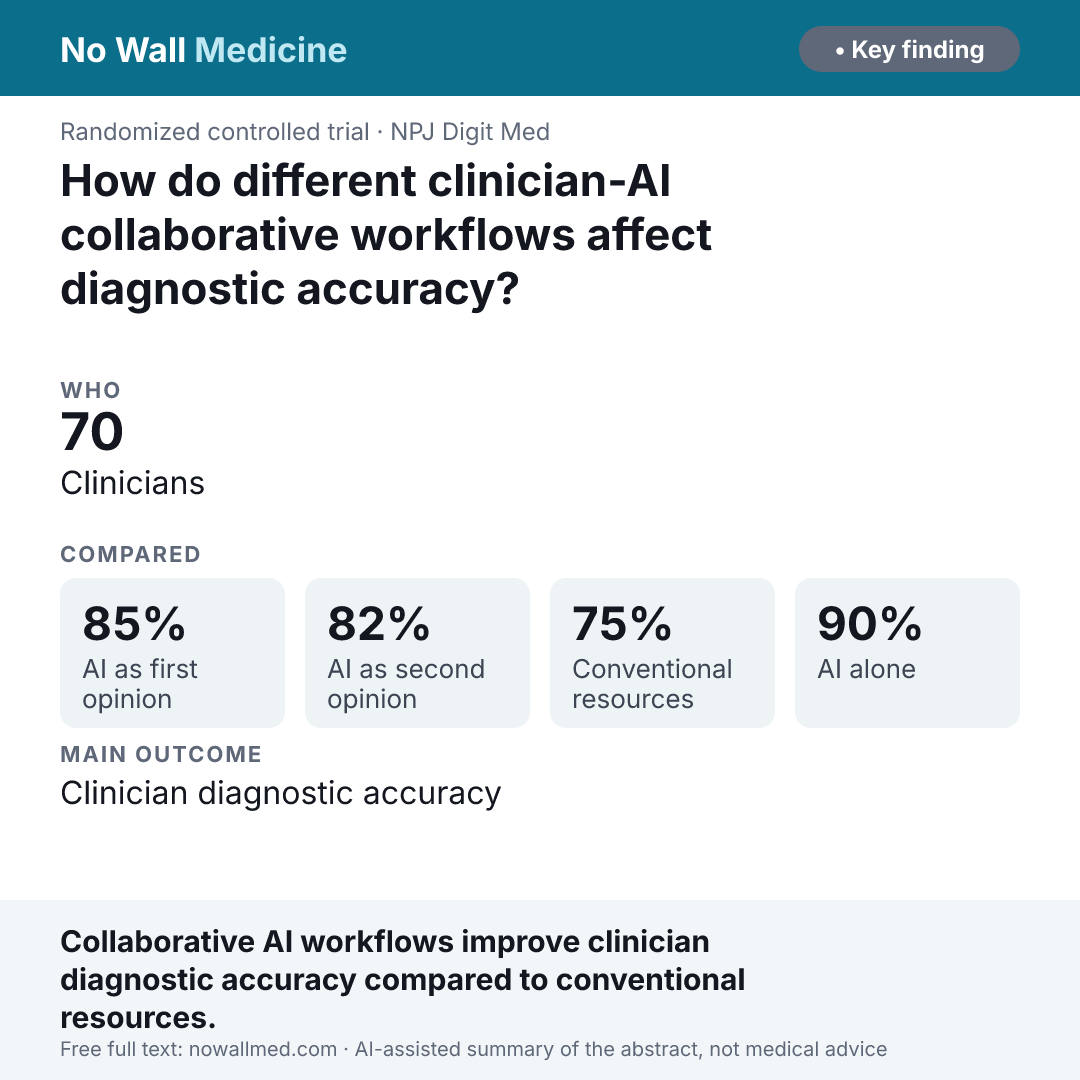
Clinical question: How do different clinician-AI collaborative workflows affect diagnostic accuracy?
Why it matters: Research is shifting from whether artificial intelligence can provide valuable suggestions to how it integrates into the diagnostic workflows of physicians.
Key points
- Researchers conducted a randomized controlled trial with 70 clinicians to compare two workflows where artificial intelligence acted as a collaborator rather than just a tool.
- Clinician diagnostic accuracy improved to 85% when using AI as a first opinion and 82% when using AI as a second opinion, compared to 75% with conventional resources.
- The accuracy for both collaborative workflows was comparable and not statistically different from the 90% accuracy achieved by the artificial intelligence alone.
Headline and key points written with AI from the paper’s abstract, with every number checked against it. Read the paper before relying on them.
Was this summary helpful?
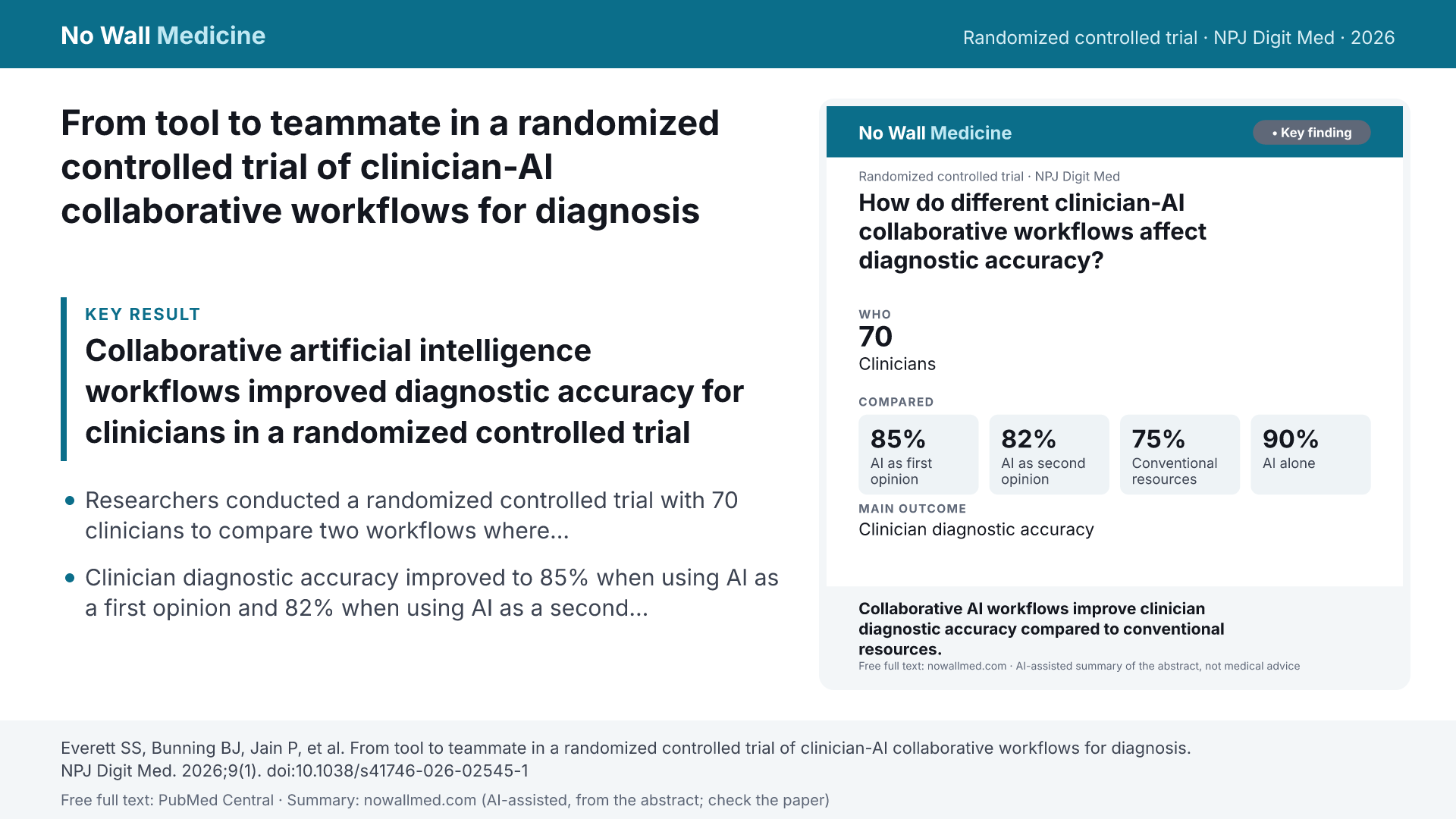
Headline, design, result, key points, caveat and citation as plain text.
Cite this article
Everett SS, Bunning BJ, Jain P, et al. From tool to teammate in a randomized controlled trial of clinician-AI collaborative workflows for diagnosis. NPJ Digit Med. 2026;9(1). doi:10.1038/s41746-026-02545-1
Spotted a mistake? Suggest a correction