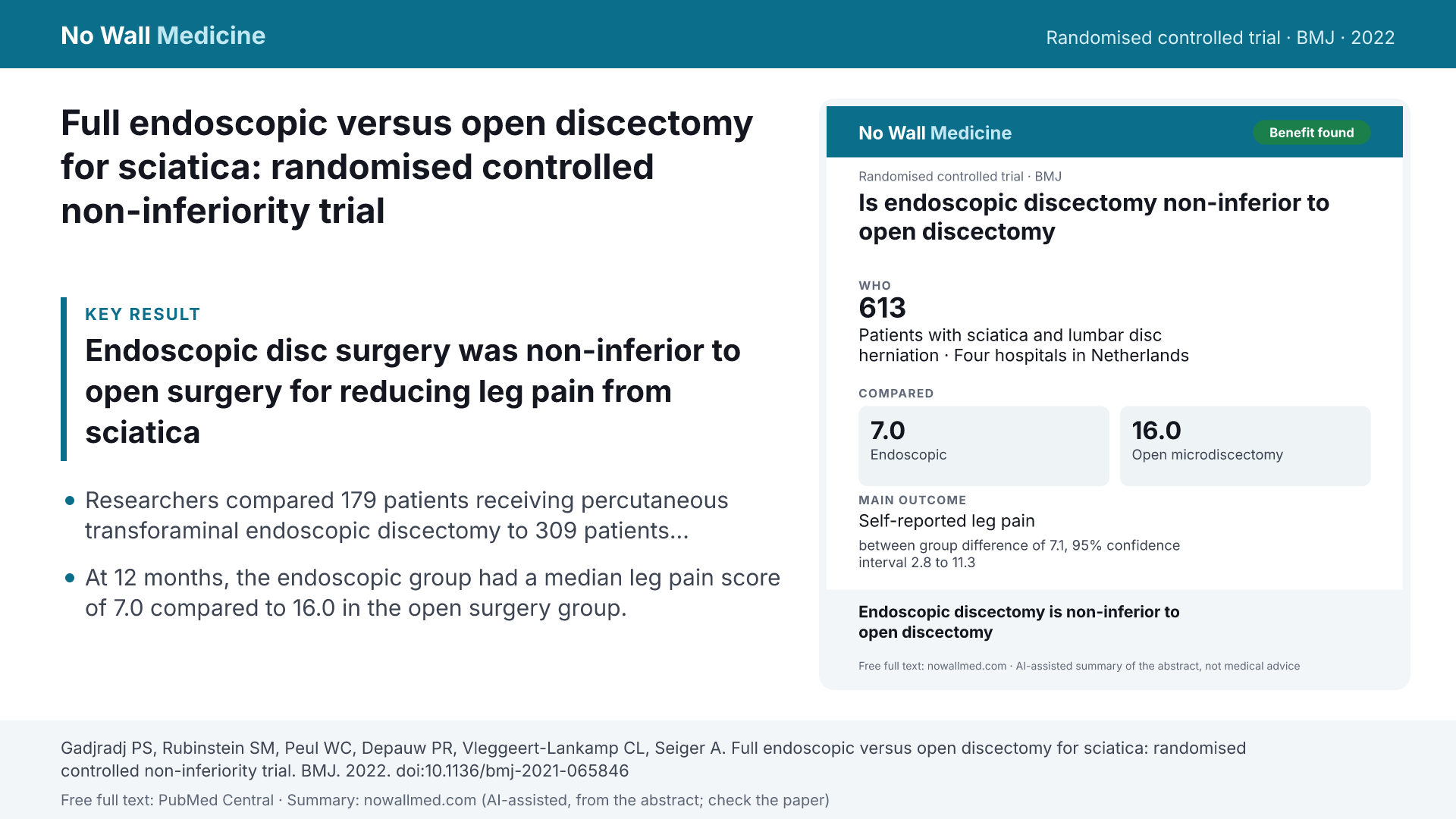
Endoscopic disc surgery was non-inferior to open surgery for reducing leg pain from sciatica
Full endoscopic versus open discectomy for sciatica: randomised controlled non-inferiority trial
Randomised controlled trialBenefit found
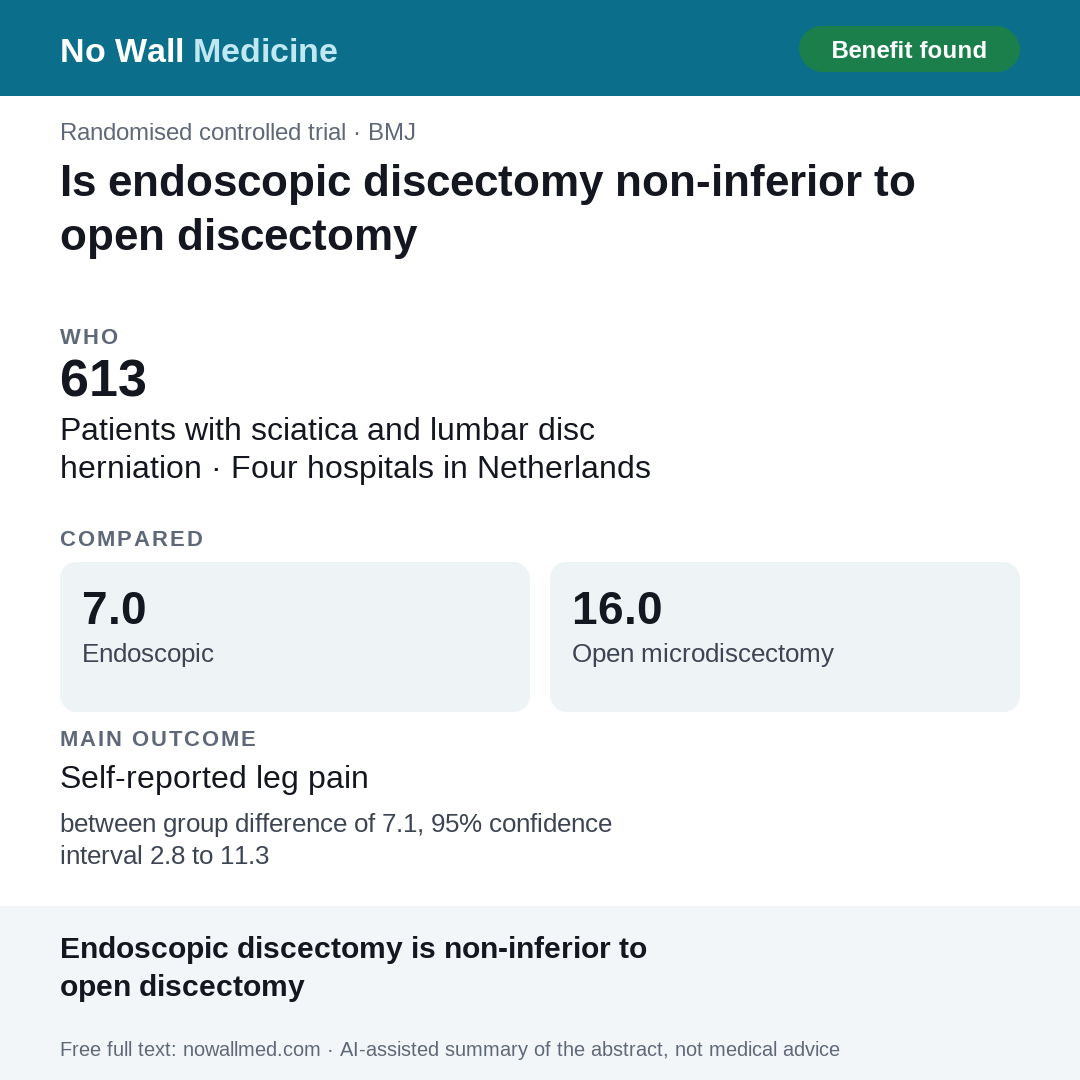
Is endoscopic discectomy non-inferior to open discectomy
Who
613
Patients with sciatica and lumbar disc herniation · Four hospitals in Netherlands
Compared
7.0Endoscopic
16.0Open microdiscectomy
Main outcome
Self-reported leg pain
Result: between group difference of 7.1, 95% confidence interval 2.8 to 11.3
Bottom line: Endoscopic discectomy is non-inferior to open discectomy
Limitation: small differences may not reach clinical relevance
BMJ · 2022-02-21Download image
Why it matters: It was unknown if percutaneous transforaminal endoscopic discectomy is as effective as conventional open microdiscectomy for reducing leg pain caused by lumbar disc herniation.
Key points
- Researchers compared 179 patients receiving percutaneous transforaminal endoscopic discectomy to 309 patients receiving open microdiscectomy for leg pain caused by lumbar disc herniation.
- At 12 months, the endoscopic group had a median leg pain score of 7.0 compared to 16.0 in the open surgery group.
- The endoscopic group had less blood loss, shorter hospital stays, and earlier postoperative movement than the open surgery group.
Limitation the authors note: The authors noted that the differences in patient-reported outcomes were small and may not reach clinical relevance.
Headline and key points written with AI from the paper’s abstract, with every number checked against it. Read the paper before relying on them.
Was this summary helpful?
Abstract
Objective
To assess whether percutaneous transforaminal endoscopic discectomy (PTED) is non-inferior to conventional open microdiscectomy in reduction of leg pain caused by lumbar disc herniation. Design
Multicentre randomised controlled trial with non-inferiority design. Setting
Four hospitals in the Netherlands. Participants
613 patients aged 18-70 years with at least six weeks of radiating leg pain caused by lumbar disc herniation. The trial included a predetermined set of 125 patients receiving PTED who were the learning curve cases performed by surgeons who did not do PTED before the trial. Interventions
PTED (n=179) compared with open microdiscectomy (n=309). Main outcome measures
The primary outcome was self-reported leg pain measured by a 0-100 visual analogue scale at 12 months, assuming a non-inferiority margin of 5.0. Secondary outcomes included complications, reoperations, self-reported functional status as measured with the Oswestry Disability Index, visual analogue scale for back pain, health related quality of life, and self-perceived recovery. Outcomes were measured until one year after surgery and were longitudinally analysed according to the intention-to-treat principle. Patients belonging to the PTED learning curve were omitted from the primary analyses. Results
At 12 months, patients who were randomised to PTED had a statistically significantly lower visual analogue scale score for leg pain (median 7.0, interquartile range 1.0-30.0) compared with patients randomised to open microdiscectomy (16.0, 2.0-53.5) (between group difference of 7.1, 95% confidence interval 2.8 to 11.3). Blood loss was less, length of hospital admission was shorter, and timing of postoperative mobilisation was earlier in the PTED group than in the open microdiscectomy group. Secondary patient reported outcomes such as the Oswestry Disability Index, visual analogue scale for back pain, health related quality of life, and self-perceived recovery, were similarly in favour of PTED. Within one year, nine (5%) in the PTED group compared with 14 (6%) in the open microdiscectomy group had repeated surgery. Per protocol analysis and sensitivity analyses including the patients of the learning curve resulted in similar outcomes to the primary analysis. Conclusions
PTED was non-inferior to open microdiscectomy in reduction of leg pain. PTED resulted in more favourable results for self-reported leg pain, back pain, functional status, quality of life, and recovery. These differences, however, were small and may not reach clinical relevance. PTED can be considered as an effective alternative to open microdiscectomy in treating sciatica. Trial registration
NCT02602093ClinicalTrials.gov NCT02602093.
Abstract reproduced under the article’s CC BY NC licence.
Subject terms
Cite this article
Gadjradj PS, Rubinstein SM, Peul WC, Depauw PR, Vleggeert-Lankamp CL, Seiger A. Full endoscopic versus open discectomy for sciatica: randomised controlled non-inferiority trial. BMJ. 2022. doi:10.1136/bmj-2021-065846
Spotted a mistake? Suggest a correction
Top studies every Monday
The week’s key trials and guidelines in your specialties, plus any topics you follow. By email, free.
Get the weekly digest