Electrical stimulation assisted cycling did not improve physical function in survivors of intensive care
Functional electrical stimulation-assisted cycle ergometry-based progressive mobility programme for mechanically ventilated patients: randomised controlled trial with 6 months follow-up
Assessor-blinded single centre randomised controlled trialNo clear difference
Does functional electrical stimulation-assisted cycle ergometry improve physical function in critical care survivors?
Who
150
Mechanically ventilated adults estimated to need more than 7 days intensive care · Single centre
Compared
50Functional electrical stimulation-assisted cycle ergometry (IQR 21-69)
49Standard rehabilitation (IQR 26-77)
Main outcome
Physical Component Summary of SF-36 at 6 months
Bottom line: Early functional electrical stimulation-assisted cycle ergometry does not improve physical functioning at 6 months in survivors.
Thorax · 2021-04-30Download image
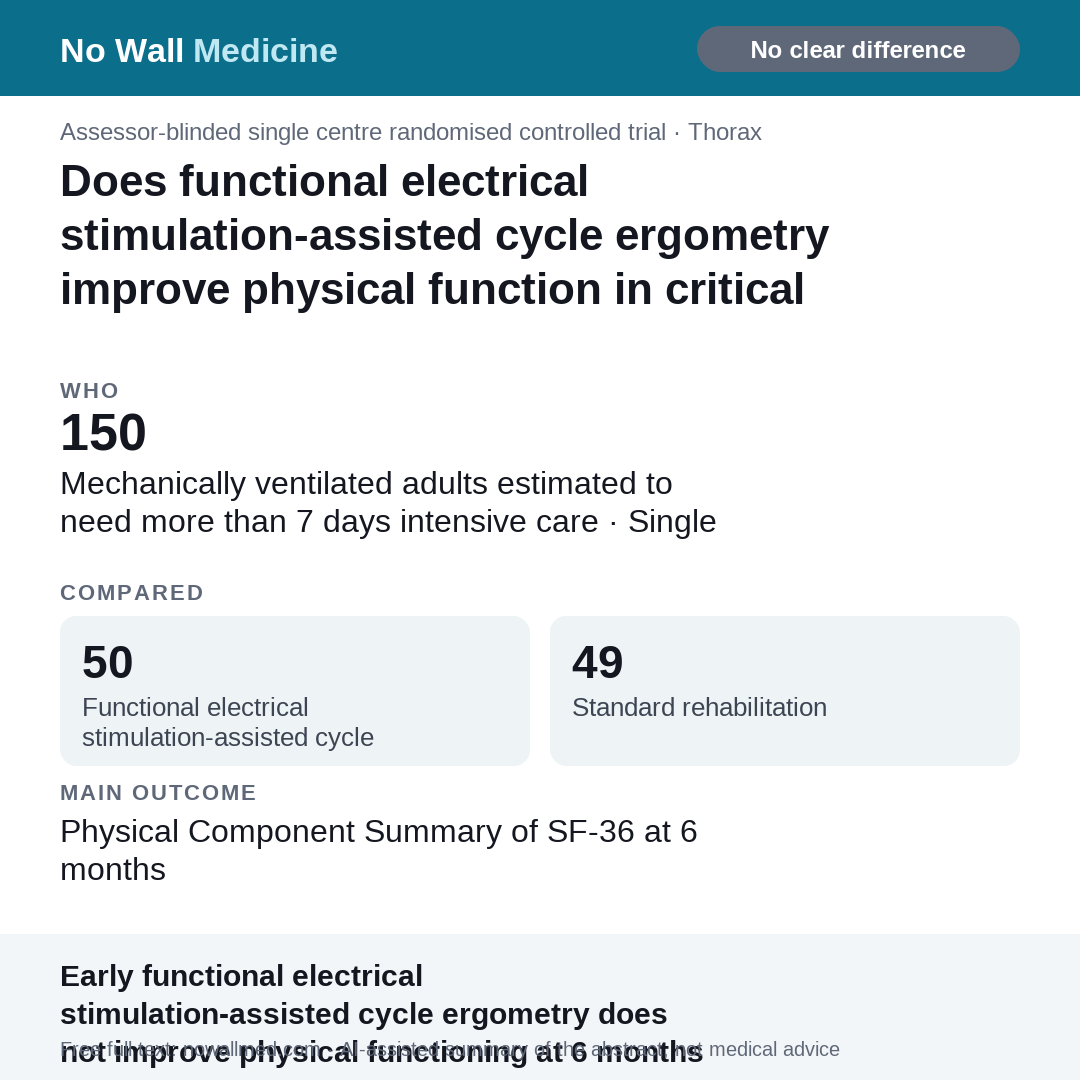
Clinical question: Does functional electrical stimulation-assisted cycle ergometry improve physical function in critical care survivors?
Why it matters: It was unknown if early use of functional electrical stimulation-assisted cycle ergometry improves physical function in survivors of critical care after 6 months.
Key points
- Researchers randomized 150 mechanically ventilated adults to receive either a functional electrical stimulation-assisted cycle ergometry program or standard rehabilitation.
- At 6 months, the physical component summary score of the SF-36 health survey was not different between the intervention group (50) and the control group (49).
- There were no differences at intensive care unit discharge in length of stay, functional performance, muscle diameter, or muscle power.
Limitation the authors note: The study was an assessor-blinded single centre randomized controlled trial with 81.5% of the prespecified sample size available at follow-up.
Headline and key points written with AI from the paper’s abstract, with every number checked against it. Read the paper before relying on them.
Was this summary helpful?
Abstract
Purpose
Functional electrical stimulation-assisted cycle ergometry (FESCE) enables in-bed leg exercise independently of patients' volition. We hypothesised that early use of FESCE-based progressive mobility programme improves physical function in survivors of critical care after 6 months. Methods
We enrolled mechanically ventilated adults estimated to need >7 days of intensive care unit (ICU) stay into an assessor-blinded single centre randomised controlled trial to receive either FESCE-based protocolised or standard rehabilitation that continued up to day 28 or ICU discharge. Results
We randomised in 1:1 ratio 150 patients (age 61±15 years, Acute Physiology and Chronic Health Evaluation II 21±7) at a median of 21 (IQR 19-43) hours after admission to ICU. Mean rehabilitation duration of rehabilitation delivered to intervention versus control group was 82 (IQR 66-97) versus 53 (IQR 50-57) min per treatment day, p<0.001. At 6 months 42 (56%) and 46 (61%) patients in interventional and control groups, respectively, were alive and available to follow-up (81.5% of prespecified sample size). Their Physical Component Summary of SF-36 (primary outcome) was not different at 6 months (50 (IQR 21-69) vs 49 (IQR 26-77); p=0.26). At ICU discharge, there were no differences in the ICU length of stay, functional performance, rectus femoris cross-sectional diameter or muscle power despite the daily nitrogen balance was being 0.6 (95% CI 0.2 to 1.0; p=0.004) gN/m2 less negative in the intervention group. Conclusion
Early delivery of FESCE-based protocolised rehabilitation to ICU patients does not improve physical functioning at 6 months in survivors. Trial registration number
NCT02864745.
Abstract reproduced under the article’s CC BY NC licence.
Subject terms
Cite this article
Waldauf P, Hrušková N, Blahutova B, Gojda J, Urban T, Krajčová A. Functional electrical stimulation-assisted cycle ergometry-based progressive mobility programme for mechanically ventilated patients: randomised controlled trial with 6 months follow-up. Thorax. 2021. doi:10.1136/thoraxjnl-2020-215755
Spotted a mistake? Suggest a correction
Top studies every Monday
The week’s key trials and guidelines in your specialties, plus any topics you follow. By email, free.
Get the weekly digest