Large gastric residual volumes were associated with higher mortality in mechanically ventilated intensive care patients
Gastrointestinal dysfunction during enteral nutrition delivery in intensive care unit (ICU) patients: Risk factors, natural history, and clinical implications. A post-hoc analysis of The Augmented versus Routine approach to Giving Energy Trial (TARGET)
Post-hoc analysis of a randomized trialHarm found
What are the incidence, risk factors, and clinical implications of large gastric residual volumes?
Who
3876
Mechanically ventilated adults with at least one recorded gastric residual volume
Compared
52%Energy-dense enteral nutrition
40%Standard enteral nutrition
Main outcome
Incidence, risk factors, duration, and timing of large gastric residual volumes
Result: RR = 1.27 (95% CI: 1.19, 1.36)
Bottom line: Energy-dense enteral nutrition is associated with more frequent large gastric residual volumes and increased 90-day mortality.
Am J Clin Nutr · 2022-04-27Download image
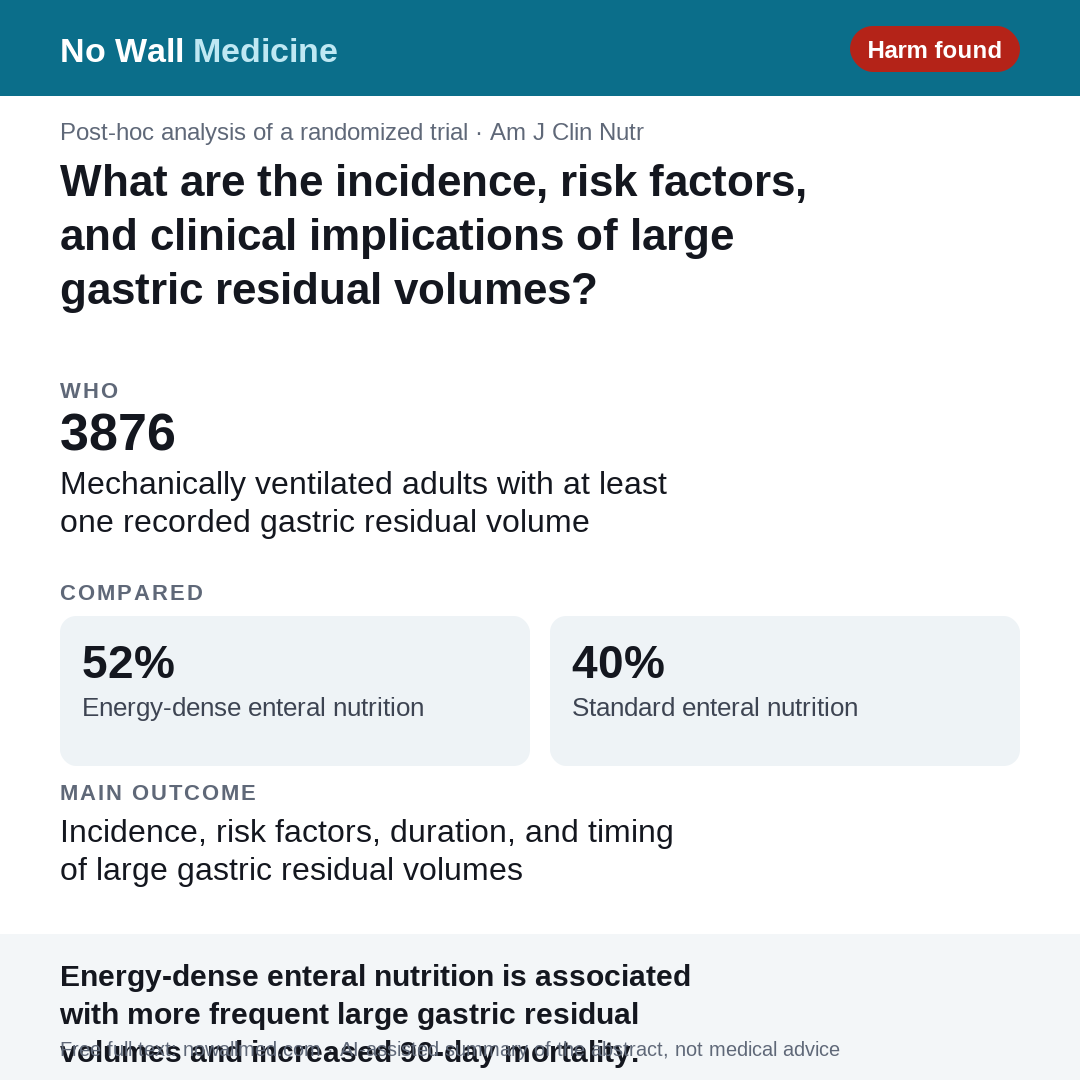
Clinical question: What are the incidence, risk factors, and clinical implications of large gastric residual volumes?
Why it matters: It was unknown how the incidence, risk factors, and duration of large gastric residual volumes relate to clinical outcomes in mechanically ventilated adults.
Key points
- In a post-hoc analysis of 3876 patients, 1777 (46%) had at least one gastric residual volume of 250 mL or more.
- Large gastric residual volumes were associated with energy-dense nutrition (52% compared with 40%), male sex (50% compared with 39%), and a 90-day mortality of 29% compared with 23%.
- Large gastric residual volumes were also associated with vasopressor use, positive blood cultures, and shorter ventilator-free, hospital-free, and intensive care unit-free days.
Headline and key points written with AI from the paper’s abstract, with every number checked against it. Read the paper before relying on them.
Was this summary helpful?
Subject terms
Cite this article
Arunachala Murthy T, Chapple LS, Lange K, Marathe CS, Horowitz M, Peake SL. Gastrointestinal dysfunction during enteral nutrition delivery in intensive care unit (ICU) patients: Risk factors, natural history, and clinical implications. A post-hoc analysis of The Augmented versus Routine approach to Giving Energy Trial (TARGET). Am J Clin Nutr. 2022. doi:10.1093/ajcn/nqac113
Spotted a mistake? Suggest a correction
Top studies every Monday
The week’s key trials and guidelines in your specialties, plus any topics you follow. By email, free.
Get the weekly digest