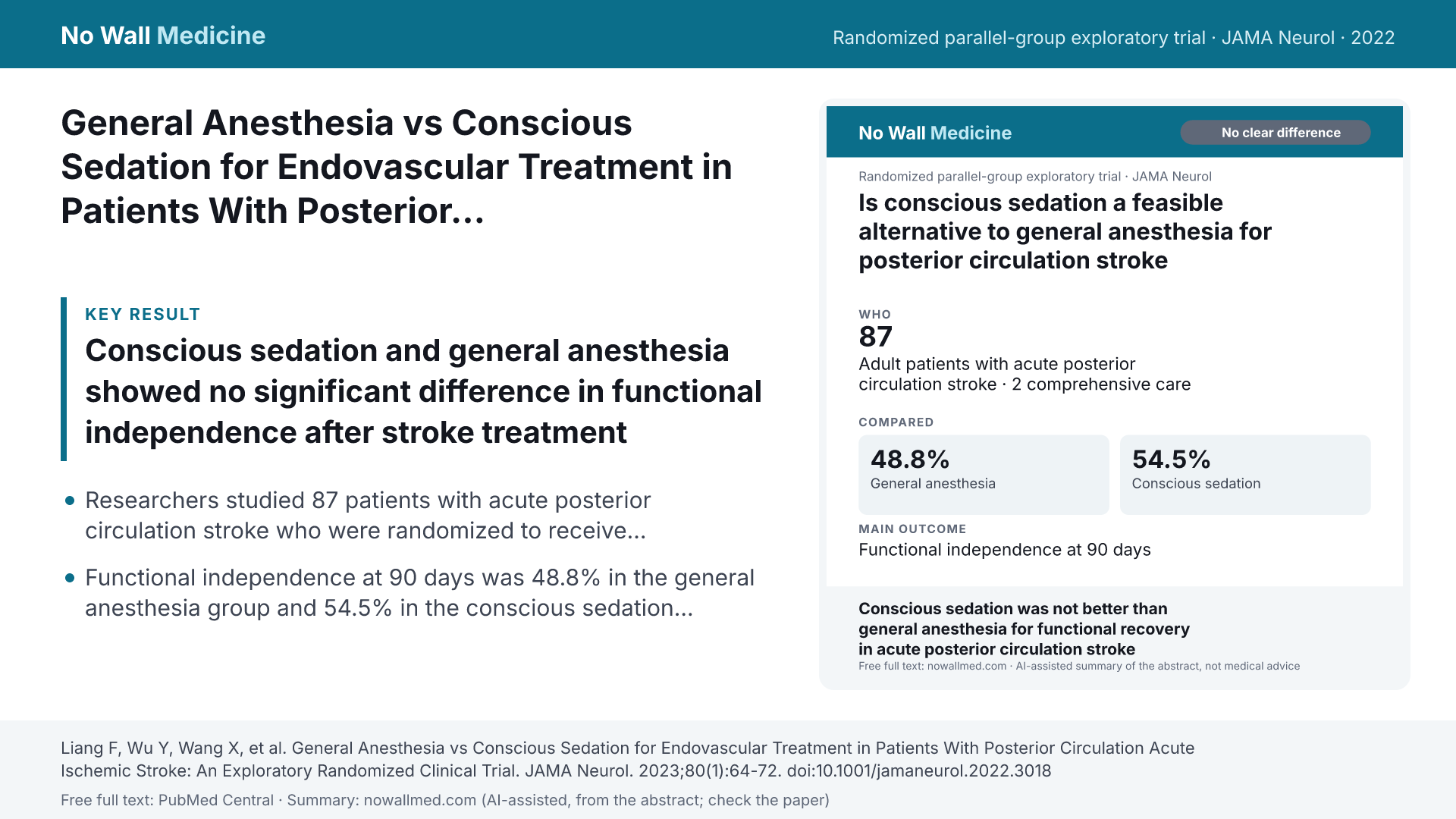
Conscious sedation and general anesthesia showed no significant difference in functional independence after stroke treatment
General Anesthesia vs Conscious Sedation for Endovascular Treatment in Patients With Posterior Circulation Acute Ischemic Stroke: An Exploratory Randomized Clinical Trial
Randomized parallel-group exploratory trialNo clear difference
Is conscious sedation a feasible alternative to general anesthesia for posterior circulation stroke endovascular treatment?
Who
87
Adult patients with acute posterior circulation stroke · 2 comprehensive care hospitals in China
Compared
48.8%General anesthesia
54.5%Conscious sedation
Main outcome
Functional independence at 90 days
Result: risk ratio 0.89 (95% CI 0.58-1.38)
Bottom line: Conscious sedation was not better than general anesthesia for functional recovery in acute posterior circulation stroke patients.
Limitation: This was an exploratory trial.
JAMA Neurol · 2022-09-27Download image
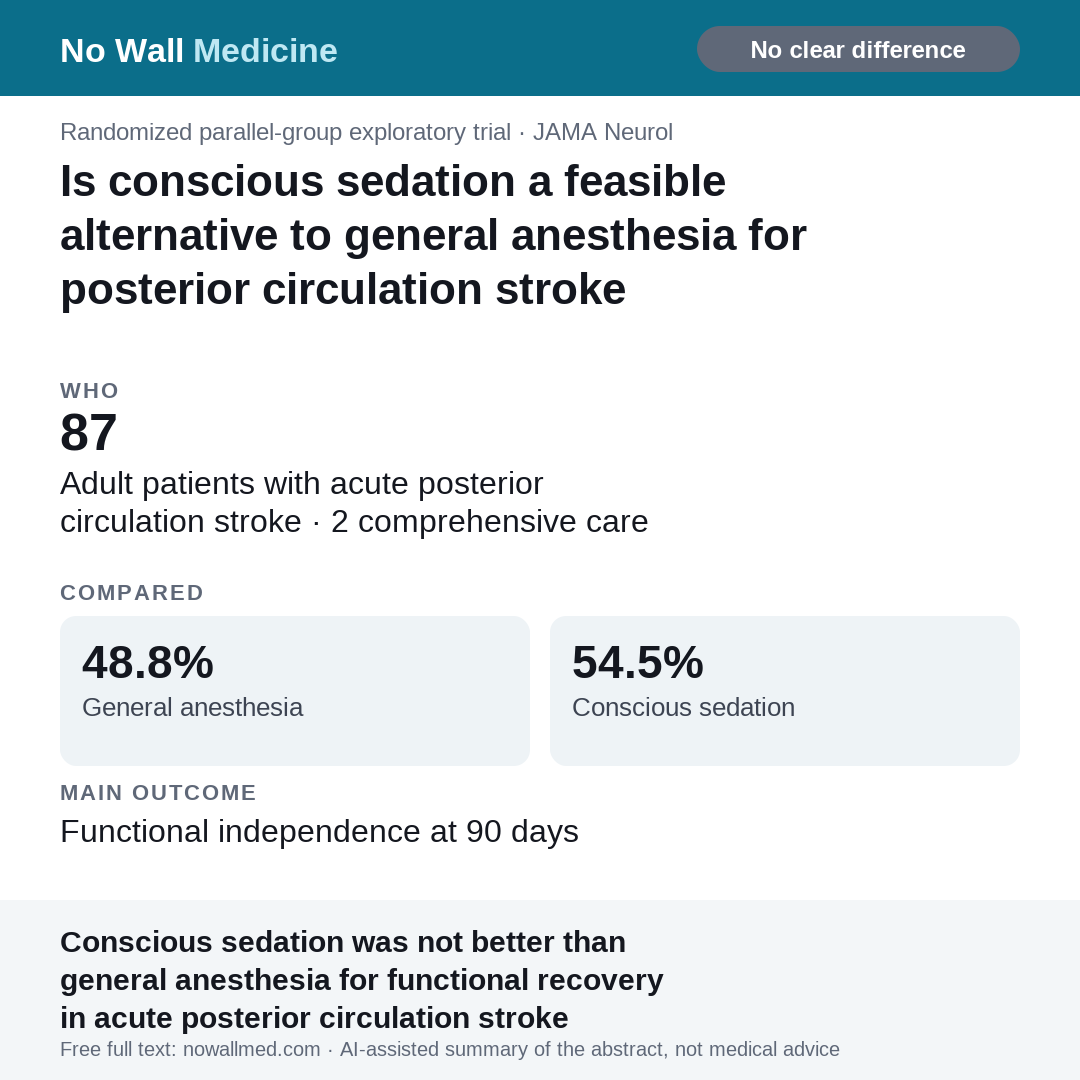
Clinical question: Is conscious sedation a feasible alternative to general anesthesia for posterior circulation stroke endovascular treatment?
Key points
- Researchers studied 87 patients with acute posterior circulation stroke who were randomized to receive either general anesthesia or conscious sedation during endovascular treatment.
- Functional independence at 90 days was 48.8% in the general anesthesia group and 54.5% in the conscious sedation group, which was not a statistically significant difference.
- Successful reperfusion, or restoring blood flow to the brain, was 95.3% for general anesthesia compared to 77.3% for conscious sedation.
Headline and key points written with AI from the paper’s abstract, with every number checked against it. Read the paper before relying on them.
Was this summary helpful?
Subject terms
Cite this article
Liang F, Wu Y, Wang X, et al. General Anesthesia vs Conscious Sedation for Endovascular Treatment in Patients With Posterior Circulation Acute Ischemic Stroke: An Exploratory Randomized Clinical Trial. JAMA Neurol. 2022. doi:10.1001/jamaneurol.2022.3018
Spotted a mistake? Suggest a correction