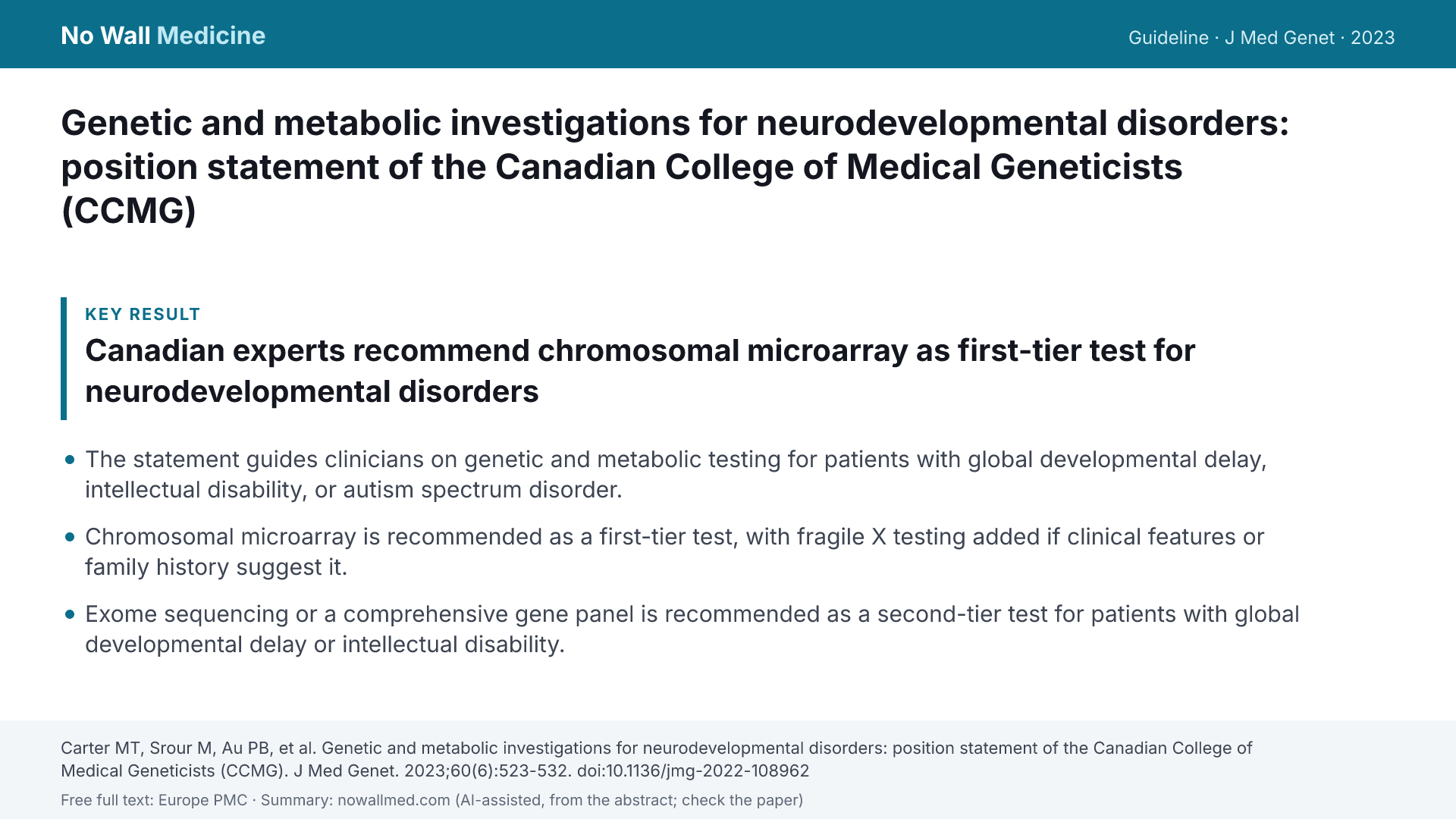
Canadian experts recommend chromosomal microarray as first-tier test for neurodevelopmental disorders
Genetic and metabolic investigations for neurodevelopmental disorders: position statement of the Canadian College of Medical Geneticists (CCMG)
No newer version found (checked 2026-11-27). PubMed lists no update or withdrawal of this guideline. Issuing bodies sometimes publish updates elsewhere, so check their website before relying on it.
Why it matters: Clinicians needed clear guidance on which genetic and metabolic tests to order for patients with neurodevelopmental disorders while awaiting specialist consultation.
Key points
- The statement guides clinicians on genetic and metabolic testing for patients with global developmental delay, intellectual disability, or autism spectrum disorder.
- Chromosomal microarray is recommended as a first-tier test, with fragile X testing added if clinical features or family history suggest it.
- Exome sequencing or a comprehensive gene panel is recommended as a second-tier test for patients with global developmental delay or intellectual disability.
Headline and key points written with AI from the paper’s abstract, with every number checked against it. Read the paper before relying on them.
Was this summary helpful?
Abstract
Purpose and scope
The aim of this position statement is to provide recommendations for clinicians regarding the use of genetic and metabolic investigations for patients with neurodevelopmental disorders (NDDs), specifically, patients with global developmental delay (GDD), intellectual disability (ID) and/or autism spectrum disorder (ASD). This document also provides guidance for primary care and non-genetics specialists caring for these patients while awaiting consultation with a clinical geneticist or metabolic specialist.Methods of statement development
A multidisciplinary group reviewed existing literature and guidelines on the use of genetic and metabolic investigations for the diagnosis of NDDs and synthesised the evidence to make recommendations relevant to the Canadian context. The statement was circulated for comment to the Canadian College of Medical Geneticists (CCMG) membership-at-large and to the Canadian Pediatric Society (Mental Health and Developmental Disabilities Committee); following incorporation of feedback, it was approved by the CCMG Board of Directors on 1 September 2022.Results and conclusions
Chromosomal microarray is recommended as a first-tier test for patients with GDD, ID or ASD. Fragile X testing should also be done as a first-tier test when there are suggestive clinical features or family history. Metabolic investigations should be done if there are clinical features suggestive of an inherited metabolic disease, while the patient awaits consultation with a metabolic physician. Exome sequencing or a comprehensive gene panel is recommended as a second-tier test for patients with GDD or ID. Genetic testing is not recommended for patients with NDDs in the absence of GDD, ID or ASD, unless accompanied by clinical features suggestive of a syndromic aetiology or inherited metabolic disease.
Abstract reproduced under the article’s CC BY-NC licence.
Subject terms
Headline, design, result, key points, caveat and citation as plain text.
Cite this article
Carter MT, Srour M, Au PB, et al. Genetic and metabolic investigations for neurodevelopmental disorders: position statement of the Canadian College of Medical Geneticists (CCMG). J Med Genet. 2023;60(6):523-532. doi:10.1136/jmg-2022-108962
Spotted a mistake? Suggest a correction