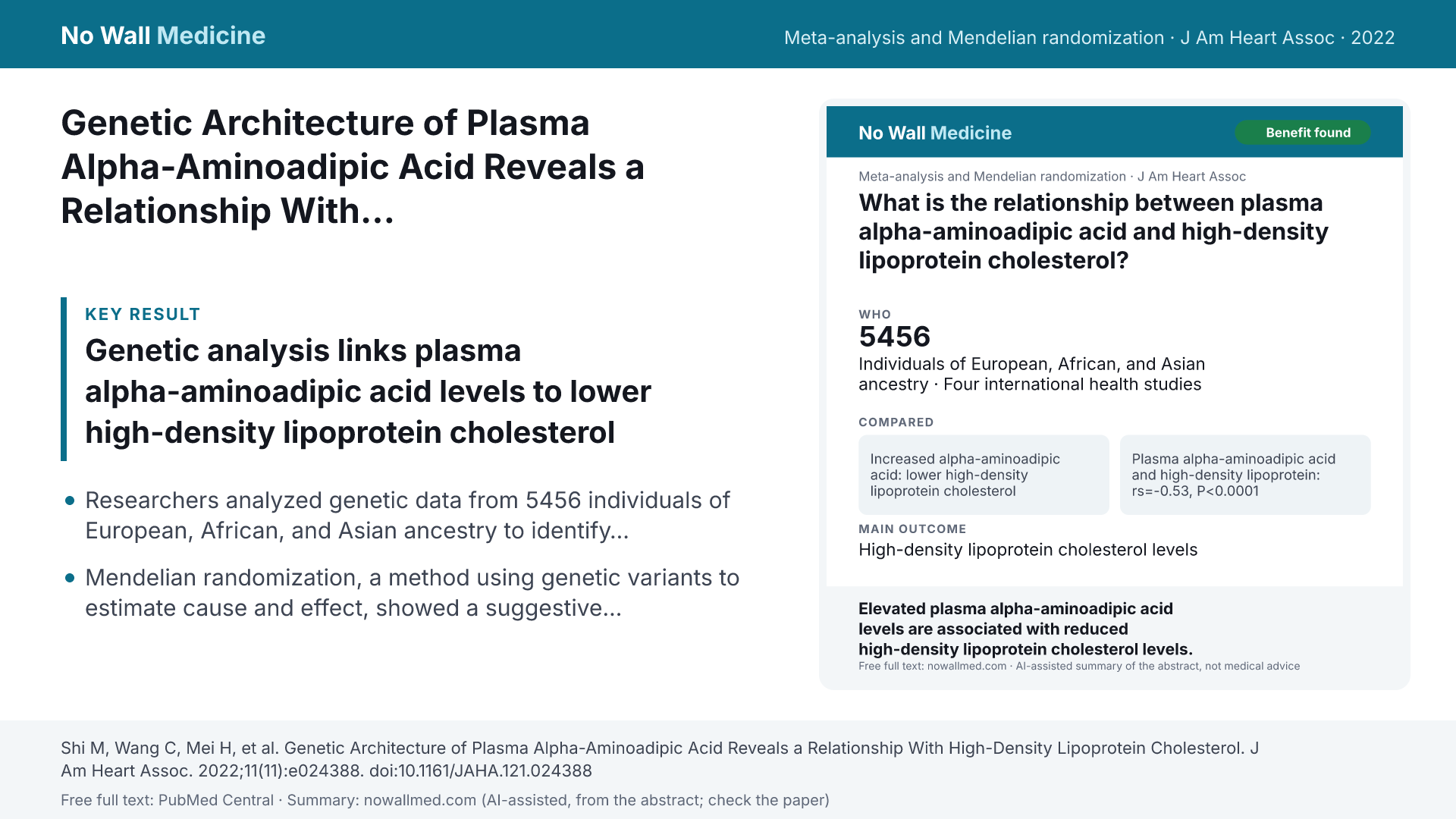
Genetic analysis links plasma alpha-aminoadipic acid levels to lower high-density lipoprotein cholesterol
Genetic Architecture of Plasma Alpha-Aminoadipic Acid Reveals a Relationship With High-Density Lipoprotein Cholesterol
Meta-analysis and Mendelian randomizationBenefit found
What is the relationship between plasma alpha-aminoadipic acid and high-density lipoprotein cholesterol?
Who
5456
Individuals of European, African, and Asian ancestry · Four international health studies
Compared
Increased alpha-aminoadipic acid: lower high-density lipoprotein cholesterol
Plasma alpha-aminoadipic acid and high-density lipoprotein: rs=-0.53, P<0.0001
Main outcome
High-density lipoprotein cholesterol levels
Result: rs=-0.53, P<0.0001
Bottom line: Elevated plasma alpha-aminoadipic acid levels are associated with reduced high-density lipoprotein cholesterol levels.
Limitation: Further mechanistic studies are required to probe the possible mechanism.
J Am Heart Assoc · 2022-05-27 · Save PNG
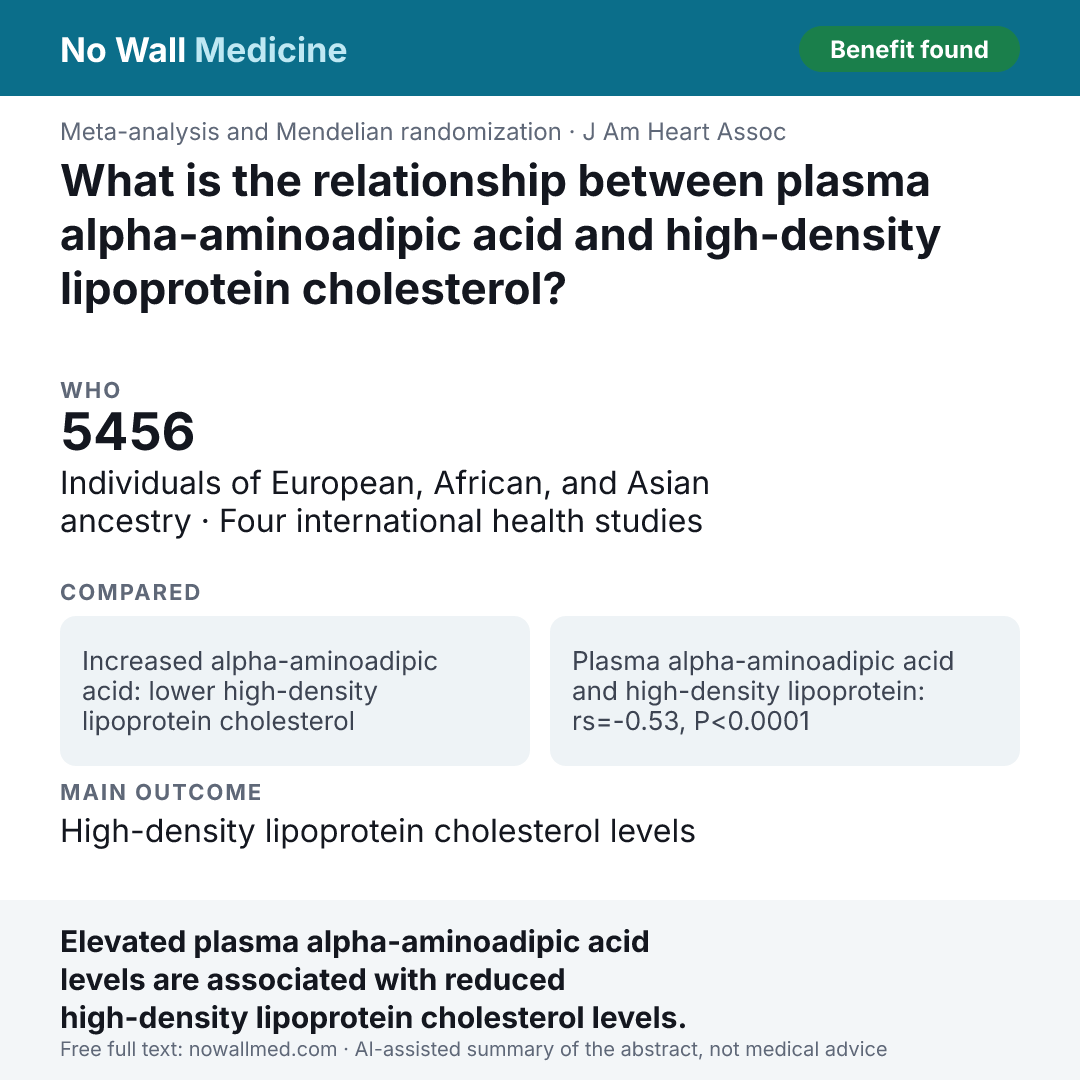
Clinical question: What is the relationship between plasma alpha-aminoadipic acid and high-density lipoprotein cholesterol?
Key points
- Researchers analyzed genetic data from 5456 individuals of European, African, and Asian ancestry to identify genetic determinants of plasma alpha-aminoadipic acid.
- Mendelian randomization, a method using genetic variants to estimate cause and effect, showed a suggestive inverse association between increased alpha-aminoadipic acid and lower high-density lipoprotein cholesterol (P=0.005).
- In a separate sample of 98 individuals, a significant negative correlation was confirmed between alpha-aminoadipic acid and high-density lipoprotein (rs=-0.53, P<0.0001).
Headline and key points written with AI from the paper’s abstract, with every number checked against it. Read the paper before relying on them.
Was this summary helpful?
Subject terms
Headline, design, result, key points, caveat and citation as plain text.
Cite this article
Shi M, Wang C, Mei H, et al. Genetic Architecture of Plasma Alpha-Aminoadipic Acid Reveals a Relationship With High-Density Lipoprotein Cholesterol. J Am Heart Assoc. 2022;11(11):e024388. doi:10.1161/JAHA.121.024388
Spotted a mistake? Suggest a correction