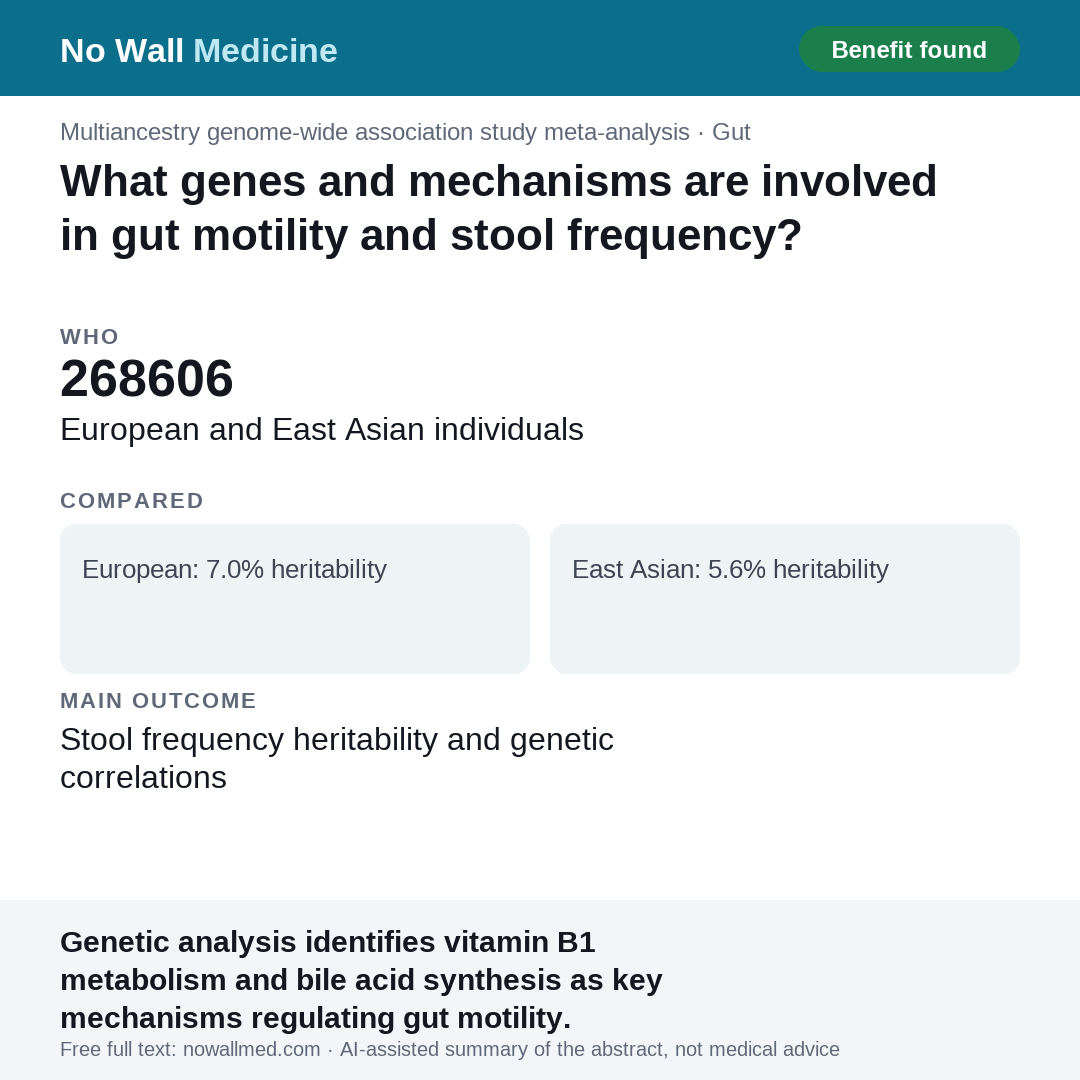
Clinical question: What genes and mechanisms are involved in gut motility and stool frequency?
Why it matters: Genetic studies of stool frequency may reveal pathways that could be used to treat irritable bowel syndrome and other gut motility disorders.
Key points
Researchers performed a meta-analysis of 268,606 European and East Asian individuals to identify genes influencing stool frequency.
The study identified 21 independent genetic locations, including 10 new signals related to bile acid synthesis and cholinergic signaling.
In 98,449 participants, higher thiamine (vitamin B1) intake was positively associated with stool frequency.
Headline and key points written with AI from the paper’s abstract, with every number checked against it. Read the paper before relying on them.
Background
Genetic studies of stool frequency (SF), an indirect proxy for gastrointestinal transit, may reveal therapeutically tractable pathways relevant to IBS and other dysmotility disorders. Objective
To identify genes and mechanisms involved in gut motility, providing a foundation for clinical translation. Design
We performed a multiancestry genome-wide association study (GWAS) meta-analysis of SF in 268 606 European and East Asian individuals. Heritability and genetic correlations with other traits were estimated, and Mendelian randomisation was used to test causal relationships. GWAS signals were fine-mapped and functionally annotated to prioritise candidate genes and pathways. Findings implicating thiamine metabolism were followed-up with dietary interaction analyses in UK Biobank (UKB). Results
SF heritability was comparable in Europeans (7.0%) and East Asians (5.6%). We observed strong genetic correlations with gastrointestinal and psychiatric disorders (rg=0.18-0.47), and causal effects on IBS. Novel correlations with cardiovascular traits (rg=0.12-0.14) were supported by drug signature enrichment analyses. We identified 21 independent loci, including 10 novel signals implicating bile acid synthesis (KLB) and cholinergic signalling (COLQ). Fine-mapping converged on vitamin B1 metabolism, highlighting single-variant causal effects at SLC35F3 (a thiamine transporter) and XPR1 (phosphate exporter essential for thiamine activation). In 98 449 UKB participants, thiamine intake was positively associated with SF (pConclusions
We identify therapeutically tractable mechanisms involved in the control of gut motility, including a previously unrecognised role for vitamin B1. These findings warrant mechanistic and clinical studies to evaluate their translational potential in IBS and other dysmotility syndromes.
Abstract reproduced under the article’s CC BY NC licence.
Topics
Female; Humans; Male; East Asian People; European People; Gastrointestinal Motility; Genetic Predisposition to Disease; Genome-Wide Association Study; Irritable Bowel Syndrome; Polymorphism, Single Nucleotide; Thiamine; White People
Comparative risk of hepatocellular carcinoma among people with chronic hepatitis B treated with tenofovir or entecavir: A population-based linkage study