Genome-Wide Association Study of CKD Progression
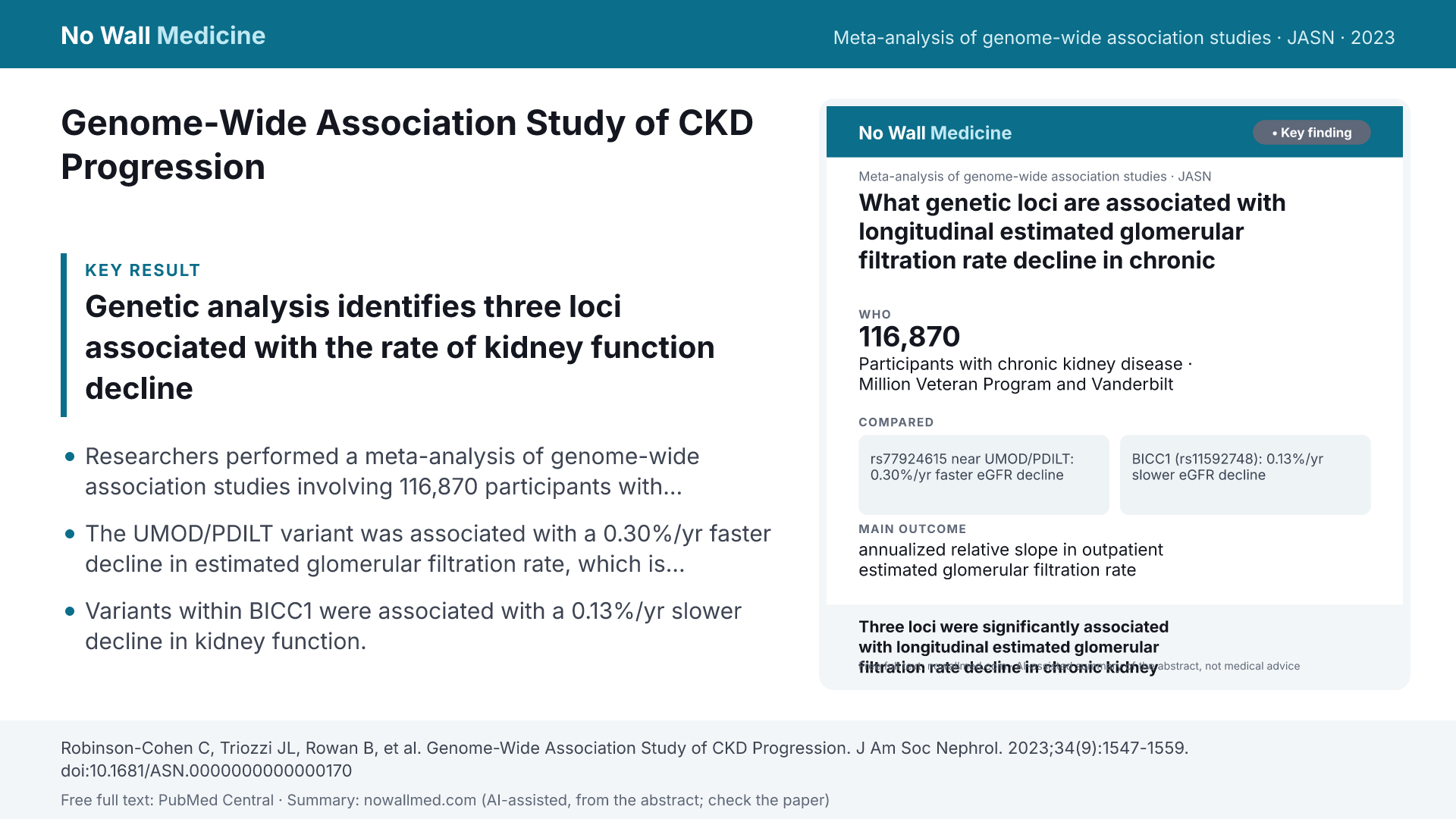
Key result: Genetic analysis identifies three loci associated with the rate of kidney function decline
Meta-analysis of genome-wide association studiesKey finding
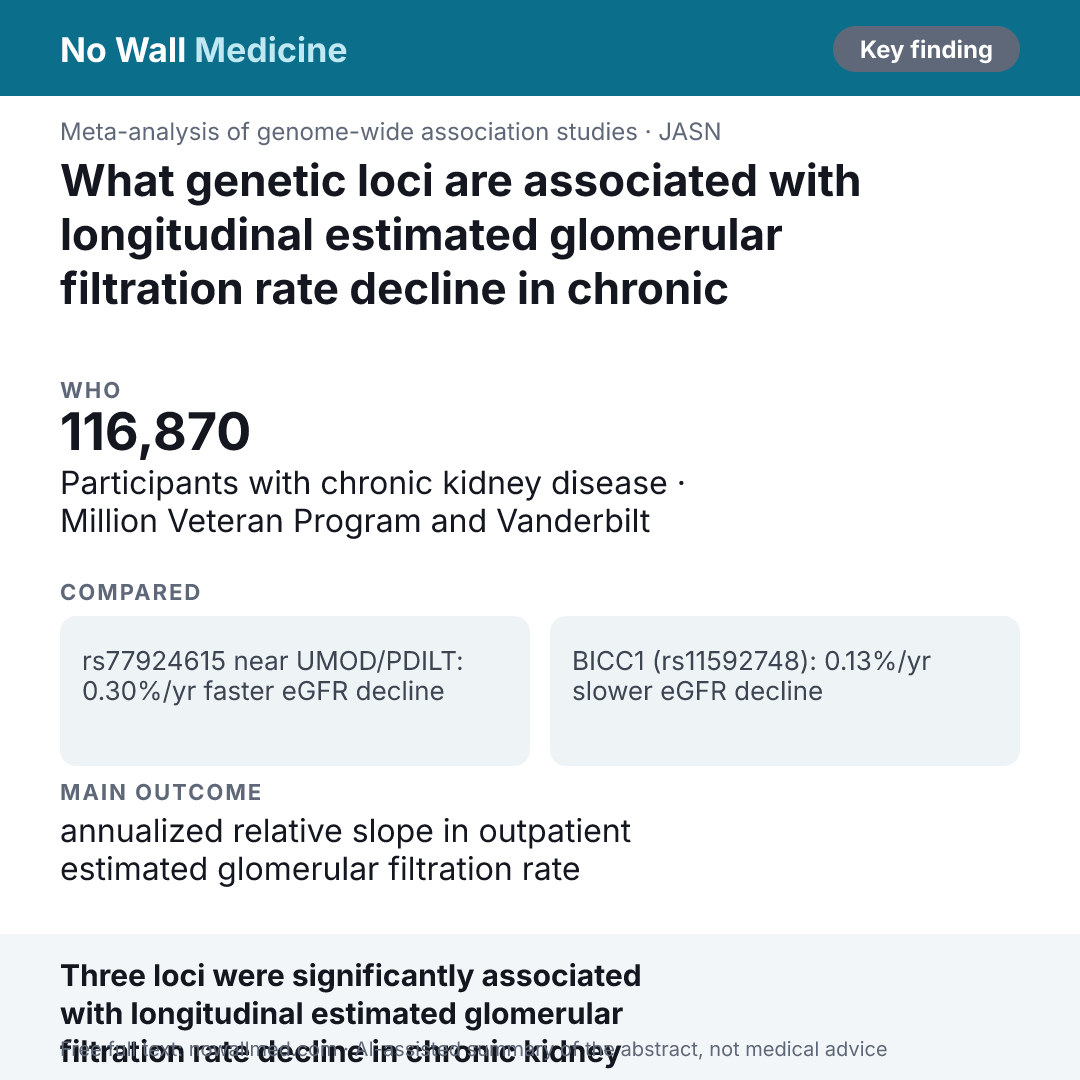
What genetic loci are associated with longitudinal estimated glomerular filtration rate decline in chronic kidney disease?
Who
116,870
Participants with chronic kidney disease · Million Veteran Program and Vanderbilt University Medical Center
Compared
rs77924615 near UMOD/PDILT: 0.30%/yr faster eGFR decline
BICC1 (rs11592748): 0.13%/yr slower eGFR decline
Main outcome
annualized relative slope in outpatient estimated glomerular filtration rate
Bottom line: Three loci were significantly associated with longitudinal estimated glomerular filtration rate decline in chronic kidney disease.
JASN · 2023-06-01 · Save PNG
Key points
- Researchers performed a meta-analysis of genome-wide association studies involving 116,870 participants with chronic kidney disease.
- The UMOD/PDILT variant was associated with a 0.30%/yr faster decline in estimated glomerular filtration rate, which is a measure of kidney function.
- Variants within BICC1 were associated with a 0.13%/yr slower decline in kidney function.
Why it matters: Most previous studies on genetic factors for kidney function used cross-sectional data rather than longitudinal data to track how kidney function changes over time.
Discussion prompts
- Would these patients look like yours? Who was left out?
- Is the main outcome one that matters to patients?
- Is the difference large enough to change what you do?
Cite: Robinson-Cohen C, Triozzi JL, Rowan B, et al. Genome-Wide Association Study of CKD Progression. J Am Soc Nephrol. 2023;34(9):1547-1559. doi:10.1681/ASN.0000000000000170
Free full text: PubMed Central · Summary and visual abstract: nowallmed.com/a/genome-wide-association-study-of-ckd-1izwxgj/ (AI-assisted from the abstract; check the paper before relying on it).