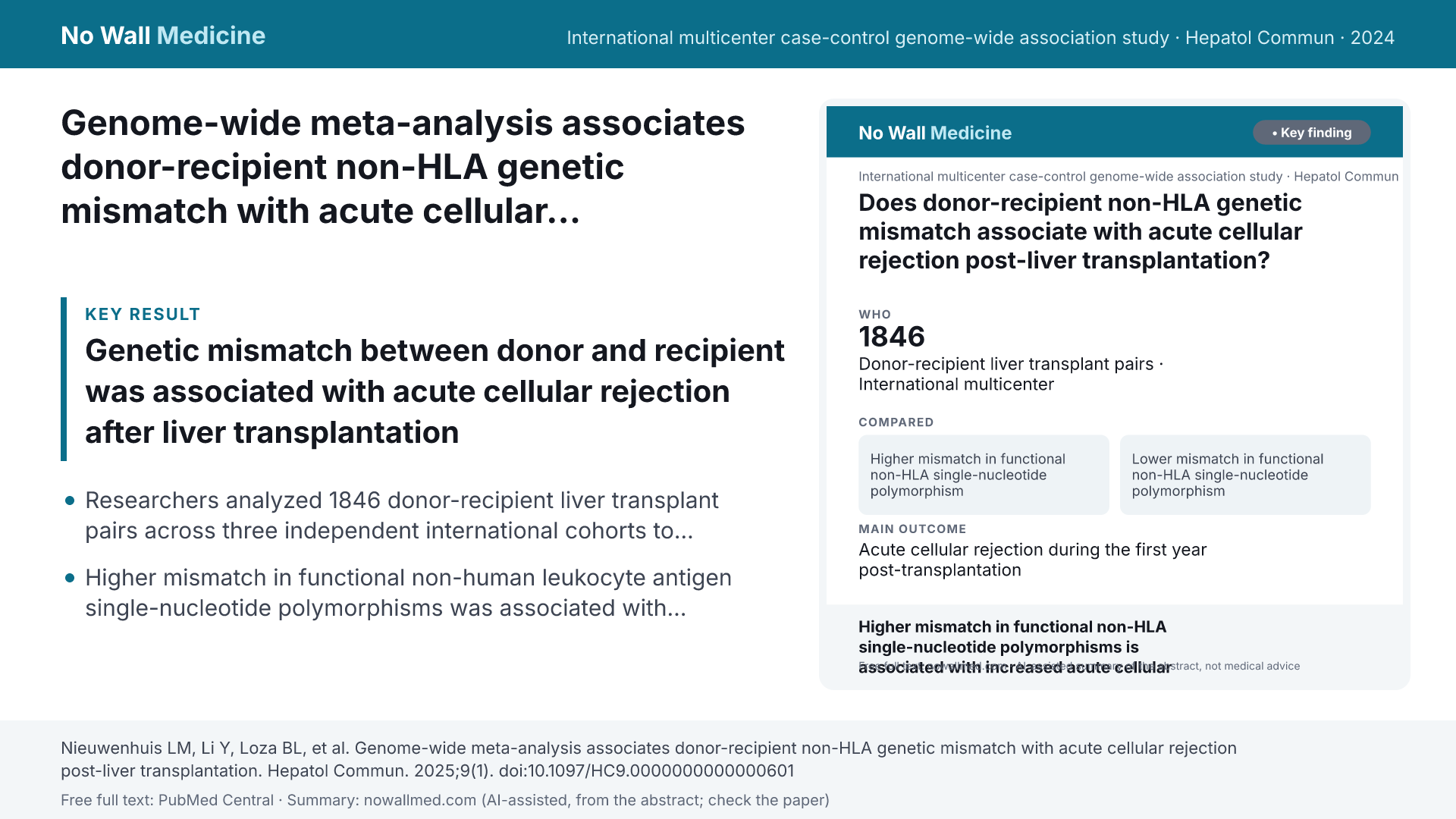
Genetic mismatch between donor and recipient was associated with acute cellular rejection after liver transplantation
Genome-wide meta-analysis associates donor-recipient non-HLA genetic mismatch with acute cellular rejection post-liver transplantation
International multicenter case-control genome-wide association studyKey finding
Does donor-recipient non-HLA genetic mismatch associate with acute cellular rejection post-liver transplantation?
Who
1846
Donor-recipient liver transplant pairs · International multicenter
Compared
Higher mismatch in functional non-HLA single-nucleotide polymorphism
Lower mismatch in functional non-HLA single-nucleotide polymorphism
Main outcome
Acute cellular rejection during the first year post-transplantation
Result: hazard ratio 5.99 (95% CI 1.39-20.08)
Bottom line: Higher mismatch in functional non-HLA single-nucleotide polymorphisms is associated with increased acute cellular rejection after liver transplantation.
Limitation: Future studies are needed to validate findings using a genotyped human leukocyte antigen cohort.
Hepatol Commun · 2024-12-11 · Save PNG
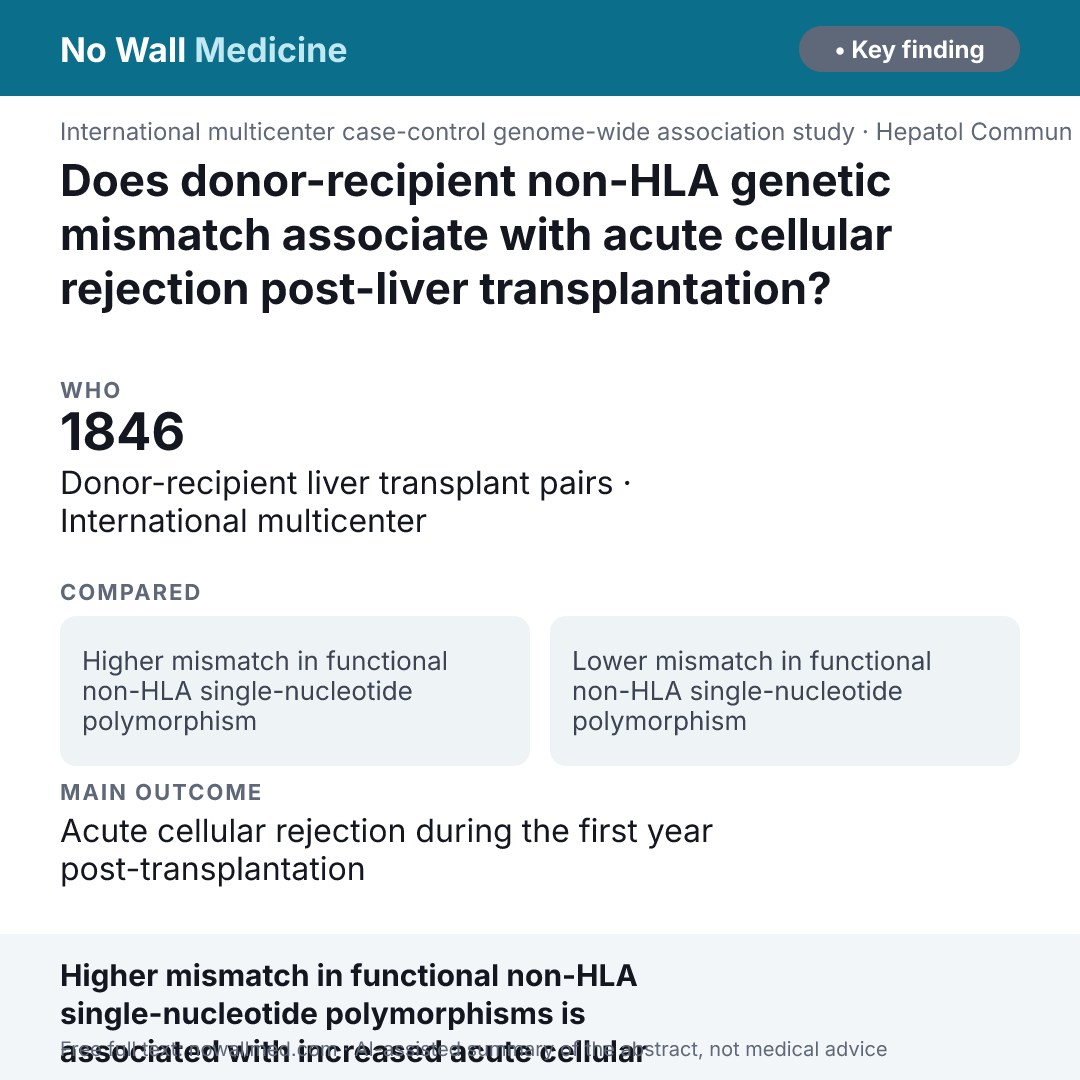
Clinical question: Does donor-recipient non-HLA genetic mismatch associate with acute cellular rejection post-liver transplantation?
Key points
- Researchers analyzed 1846 donor-recipient liver transplant pairs across three independent international cohorts to measure the impact of non-human leukocyte antigen genetic mismatches.
- Higher mismatch in functional non-human leukocyte antigen single-nucleotide polymorphisms was associated with an increased incidence of acute cellular rejection (HR 5.99; 95% CI: 1.39-20.08; p=0.011).
- A larger effect was seen with mismatches in single-nucleotide polymorphisms coding for transmembrane or secreted proteins (HR 7.54; 95% CI 1.95-28.79; p=0.003).
Headline and key points written with AI from the paper’s abstract, with every number checked against it. Read the paper before relying on them.
Was this summary helpful?
Subject terms
Headline, design, result, key points, caveat and citation as plain text.
Cite this article
Nieuwenhuis LM, Li Y, Loza BL, et al. Genome-wide meta-analysis associates donor-recipient non-HLA genetic mismatch with acute cellular rejection post-liver transplantation. Hepatol Commun. 2025;9(1). doi:10.1097/HC9.0000000000000601
Spotted a mistake? Suggest a correction