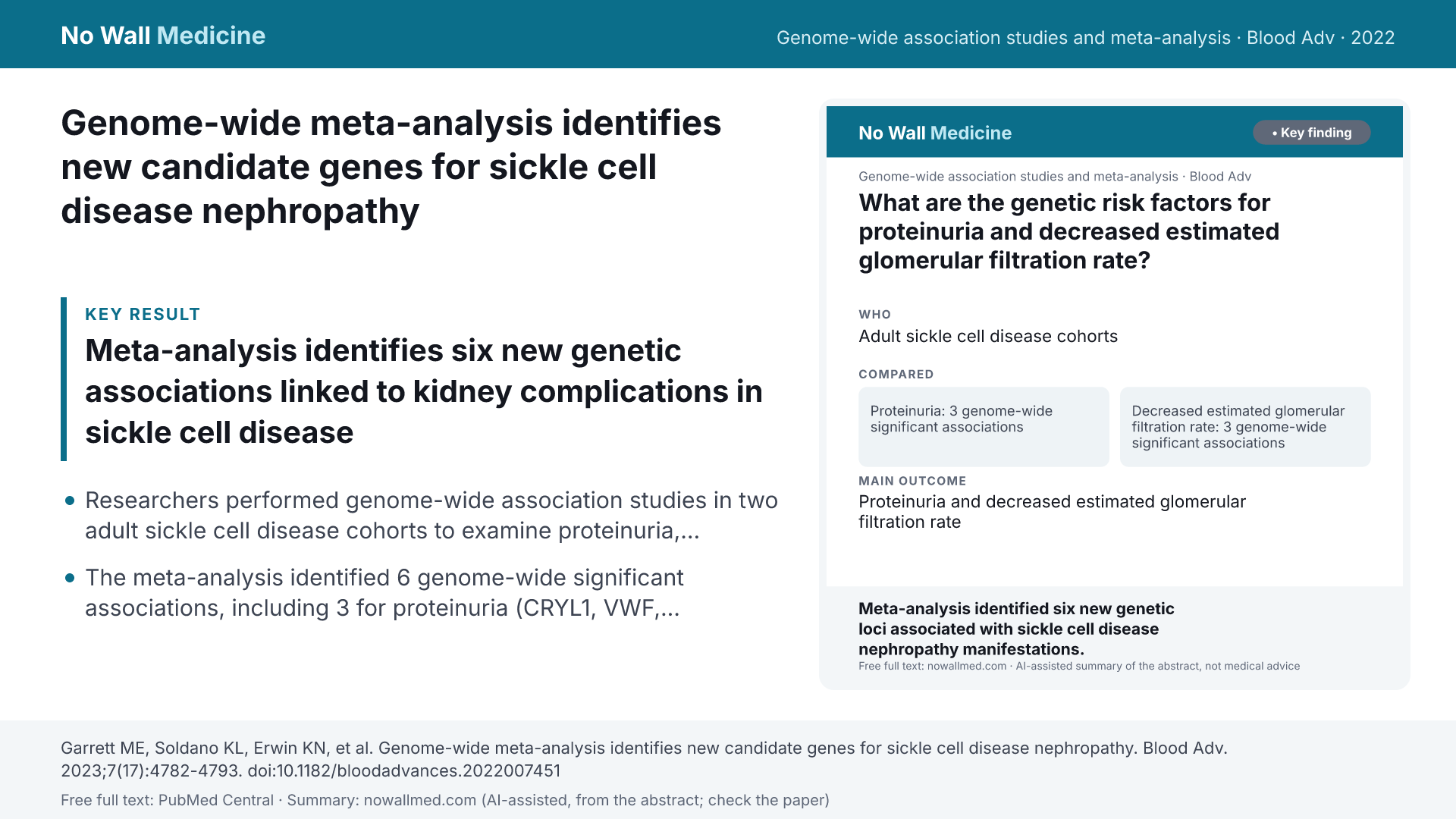
Meta-analysis identifies six new genetic associations linked to kidney complications in sickle cell disease
Genome-wide meta-analysis identifies new candidate genes for sickle cell disease nephropathy
Genome-wide association studies and meta-analysisBenefit found
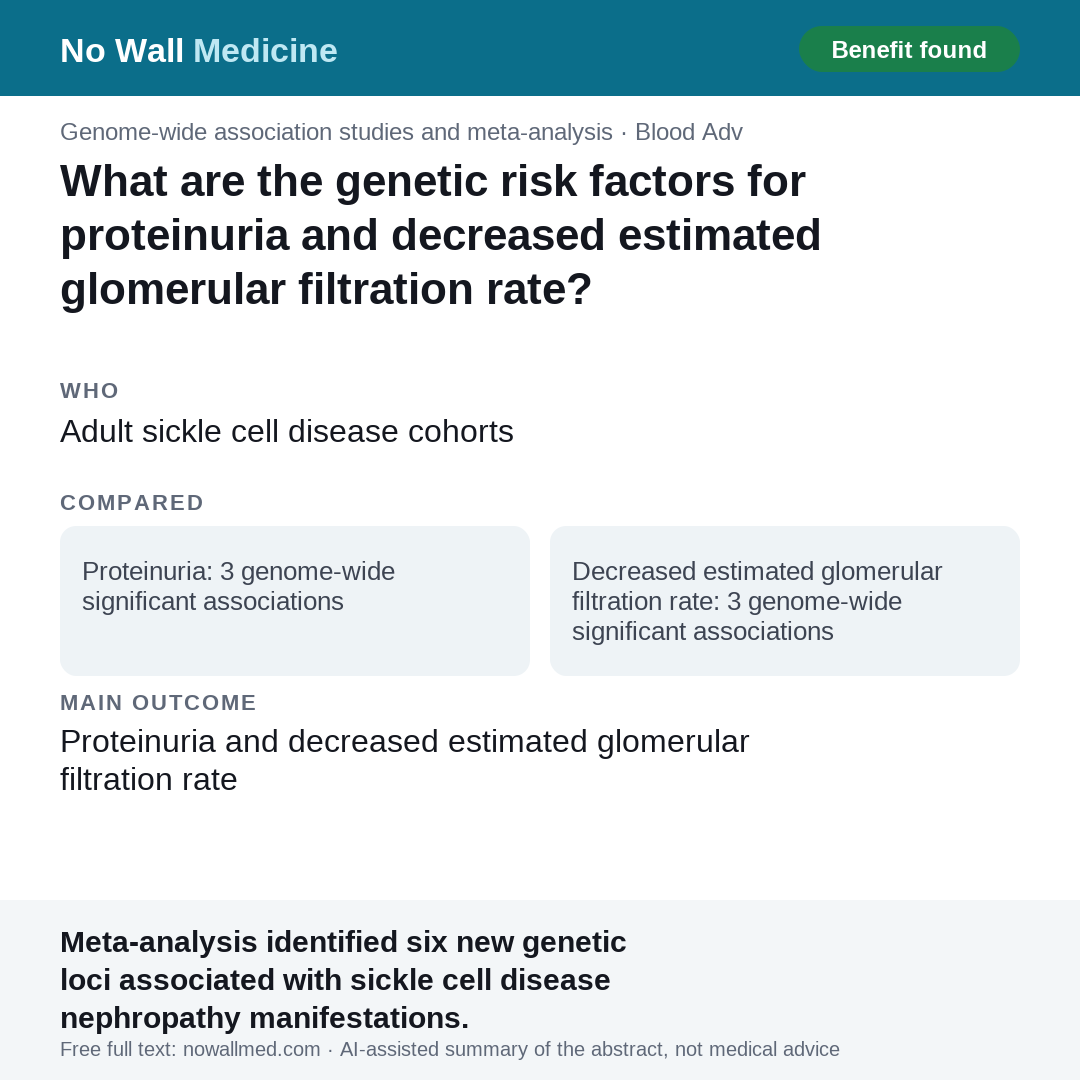
What are the genetic risk factors for proteinuria and decreased estimated glomerular filtration rate?
Who
Adult sickle cell disease cohorts
Compared
Proteinuria: 3 genome-wide significant associations
Decreased estimated glomerular filtration rate: 3 genome-wide significant associations
Main outcome
Proteinuria and decreased estimated glomerular filtration rate
Bottom line: Meta-analysis identified six new genetic loci associated with sickle cell disease nephropathy manifestations.
Blood Adv · 2022-11-19Download image
Clinical question: What are the genetic risk factors for proteinuria and decreased estimated glomerular filtration rate?
Why it matters: Existing polygenic risk scores for kidney function showed poor model fit in sickle cell disease, suggesting unique genetic risk factors may exist for this specific complication.
Key points
- Researchers performed genome-wide association studies in two adult sickle cell disease cohorts to examine proteinuria, which is excess protein in the urine, and decreased estimated glomerular filtration rate, a measure of kidney function.
- The meta-analysis identified 6 genome-wide significant associations, including 3 for proteinuria (CRYL1, VWF, and ADAMTS7) and 3 for decreased kidney filtration (LRP1B, linc02288, and FPGT-TNNI3K/TNNI3K).
- These genetic associations were independent of APOL1 risk and were linked to gene expression in the kidney and pathways important to both kidney function and sickle cell disease biology.
Headline and key points written with AI from the paper’s abstract, with every number checked against it. Read the paper before relying on them.
Was this summary helpful?
Abstract
Sickle cell disease nephropathy (SCDN), a common SCD complication, is strongly associated with mortality. Polygenic risk scores calculated from recent transethnic meta-analyses of urinary albumin-to-creatinine ratio and estimated glomerular filtration rate (eGFR) trended toward association with proteinuria and eGFR in SCD but the model fit was poor (R2 < 0.01), suggesting that there are likely unique genetic risk factors for SCDN. Therefore, we performed genome-wide association studies (GWAS) for 2 critical manifestations of SCDN, proteinuria and decreased eGFR, in 2 well-characterized adult SCD cohorts, representing, to the best of our knowledge, the largest SCDN sample to date. Meta-analysis identified 6 genome-wide significant associations (false discovery rate, q ≤ 0.05): 3 for proteinuria (CRYL1, VWF, and ADAMTS7) and 3 for eGFR (LRP1B, linc02288, and FPGT-TNNI3K/TNNI3K). These associations are independent of APOL1 risk and represent novel SCDN loci, many with evidence for regulatory function. Moreover, GWAS SNPs in CRYL1, VWF, ADAMTS7, and linc02288 are associated with gene expression in kidney and pathways important to both renal function and SCD biology, supporting the hypothesis that SCDN pathophysiology is distinct from other forms of kidney disease. Together, these findings provide new targets for functional follow-up that could be tested prospectively and potentially used to identify patients with SCD who are at risk, before onset of kidney dysfunction.
Abstract reproduced under the article’s CC BY NC ND licence.
Subject terms
Cite this article
Garrett ME, Soldano KL, Erwin KN, Zhang Y, Gordeuk VR, Gladwin MT. Genome-wide meta-analysis identifies new candidate genes for sickle cell disease nephropathy. Blood Adv. 2022. doi:10.1182/bloodadvances.2022007451
Spotted a mistake? Suggest a correction