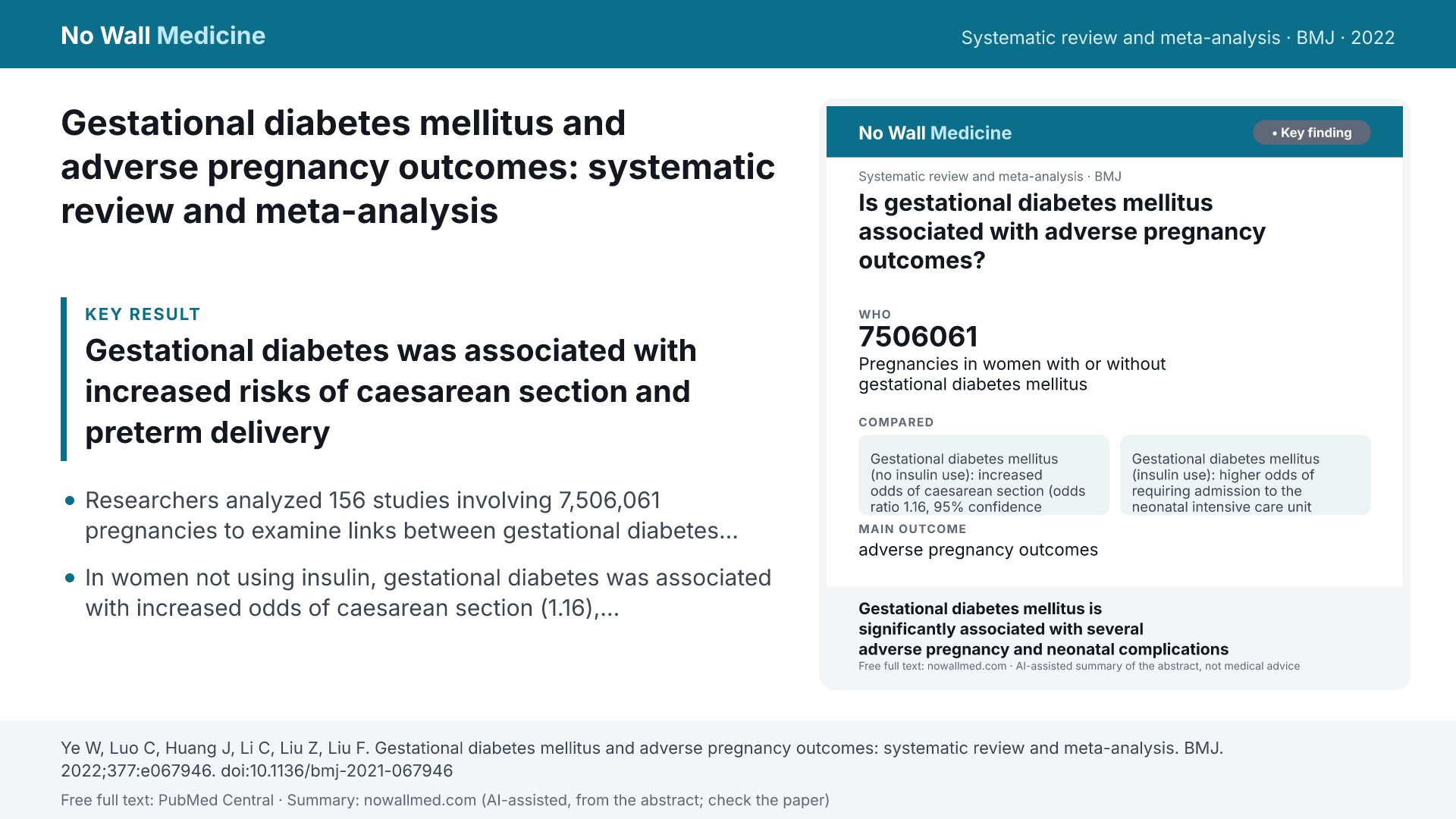
Gestational diabetes was associated with increased risks of caesarean section and preterm delivery
Gestational diabetes mellitus and adverse pregnancy outcomes: systematic review and meta-analysis
Systematic review and meta-analysisKey finding
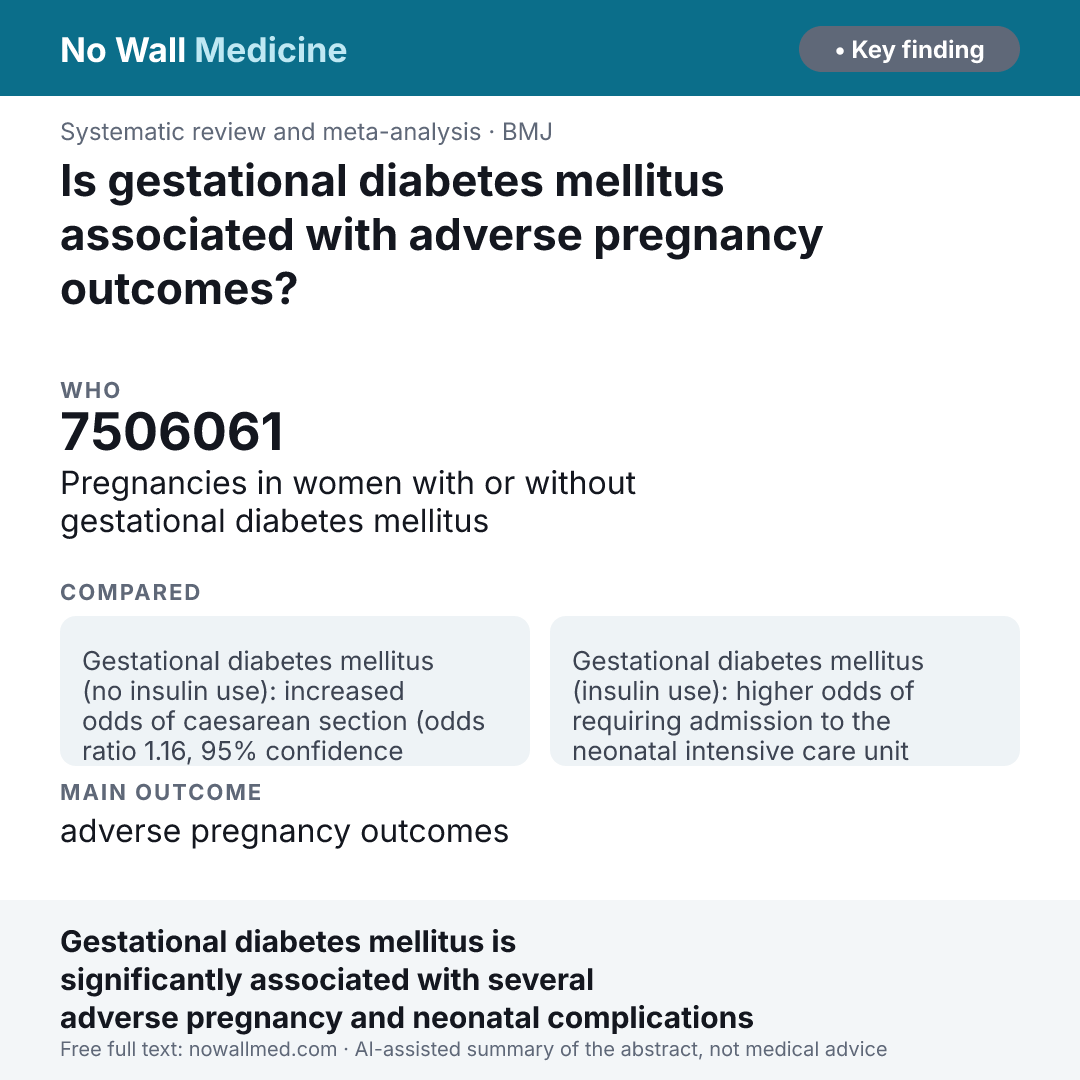
Is gestational diabetes mellitus associated with adverse pregnancy outcomes?
Who
7506061
Pregnancies in women with or without gestational diabetes mellitus
Compared
Gestational diabetes mellitus (no insulin use): increased odds of caesarean section (odds ratio 1.16, 95% confidence interval 1.03 to 1.32)
Gestational diabetes mellitus (insulin use): higher odds of requiring admission to the neonatal intensive care unit (2.29, 1.59 to 3.31)
Main outcome
adverse pregnancy outcomes
Bottom line: Gestational diabetes mellitus is significantly associated with several adverse pregnancy and neonatal complications after adjusting for confounders.
Limitation: Country status, body mass index, and screening methods contributed to heterogeneity between studies.
BMJ · 2022-05-25 · Save PNG
Why it matters: The association between gestational diabetes and specific pregnancy complications remains unclear after adjusting for various confounding factors.
Headline and visual abstract written with AI from the paper’s abstract, with every number checked against it. Read the paper before relying on them.
Was this summary helpful?
Abstract
Objective
To investigate the association between gestational diabetes mellitus and adverse outcomes of pregnancy after adjustment for at least minimal confounding factors. Design
Systematic review and meta-analysis. Data sources
Web of Science, PubMed, Medline, and Cochrane Database of Systematic Reviews, from 1 January 1990 to 1 November 2021. Review methods
Cohort studies and control arms of trials reporting complications of pregnancy in women with gestational diabetes mellitus were eligible for inclusion. Based on the use of insulin, studies were divided into three subgroups: no insulin use (patients never used insulin during the course of the disease), insulin use (different proportions of patients were treated with insulin), and insulin use not reported. Subgroup analyses were performed based on the status of the country (developed or developing), quality of the study, diagnostic criteria, and screening method. Meta-regression models were applied based on the proportion of patients who had received insulin. Results
156 studies with 7 506 061 pregnancies were included, and 50 (32.1%) showed a low or medium risk of bias. In studies with no insulin use, when adjusted for confounders, women with gestational diabetes mellitus had increased odds of caesarean section (odds ratio 1.16, 95% confidence interval 1.03 to 1.32), preterm delivery (1.51, 1.26 to 1.80), low one minute Apgar score (1.43, 1.01 to 2.03), macrosomia (1.70, 1.23 to 2.36), and infant born large for gestational age (1.57, 1.25 to 1.97). In studies with insulin use, when adjusted for confounders, the odds of having an infant large for gestational age (odds ratio 1.61, 1.09 to 2.37), or with respiratory distress syndrome (1.57, 1.19 to 2.08) or neonatal jaundice (1.28, 1.02 to 1.62), or requiring admission to the neonatal intensive care unit (2.29, 1.59 to 3.31), were higher in women with gestational diabetes mellitus than in those without diabetes. No clear evidence was found for differences in the odds of instrumental delivery, shoulder dystocia, postpartum haemorrhage, stillbirth, neonatal death, low five minute Apgar score, low birth weight, and small for gestational age between women with and without gestational diabetes mellitus after adjusting for confounders. Country status, adjustment for body mass index, and screening methods significantly contributed to heterogeneity between studies for several adverse outcomes of pregnancy. Conclusions
When adjusted for confounders, gestational diabetes mellitus was significantly associated with pregnancy complications. The findings contribute to a more comprehensive understanding of the adverse outcomes of pregnancy related to gestational diabetes mellitus. Future primary studies should routinely consider adjusting for a more complete set of prognostic factors. Review registration
PROSPERO CRD42021265837.
Abstract reproduced under the article’s CC BY NC licence.
Subject terms
Headline, design, result, bottom line, caveat and citation as plain text.
Cite this article
Ye W, Luo C, Huang J, Li C, Liu Z, Liu F. Gestational diabetes mellitus and adverse pregnancy outcomes: systematic review and meta-analysis. BMJ. 2022;377:e067946. doi:10.1136/bmj-2021-067946
Spotted a mistake? Suggest a correction