Different screening methods for gestational diabetes affect risks of large birth weight and intensive care
Various screening and diagnosis approaches for gestational diabetes mellitus and adverse pregnancy outcomes: a secondary analysis of a randomized non-inferiority field trial
Randomized trialMixed results
Which screening approach reduces adverse pregnancy outcomes
Who
35430
Pregnant women in Iran · Iran
Compared
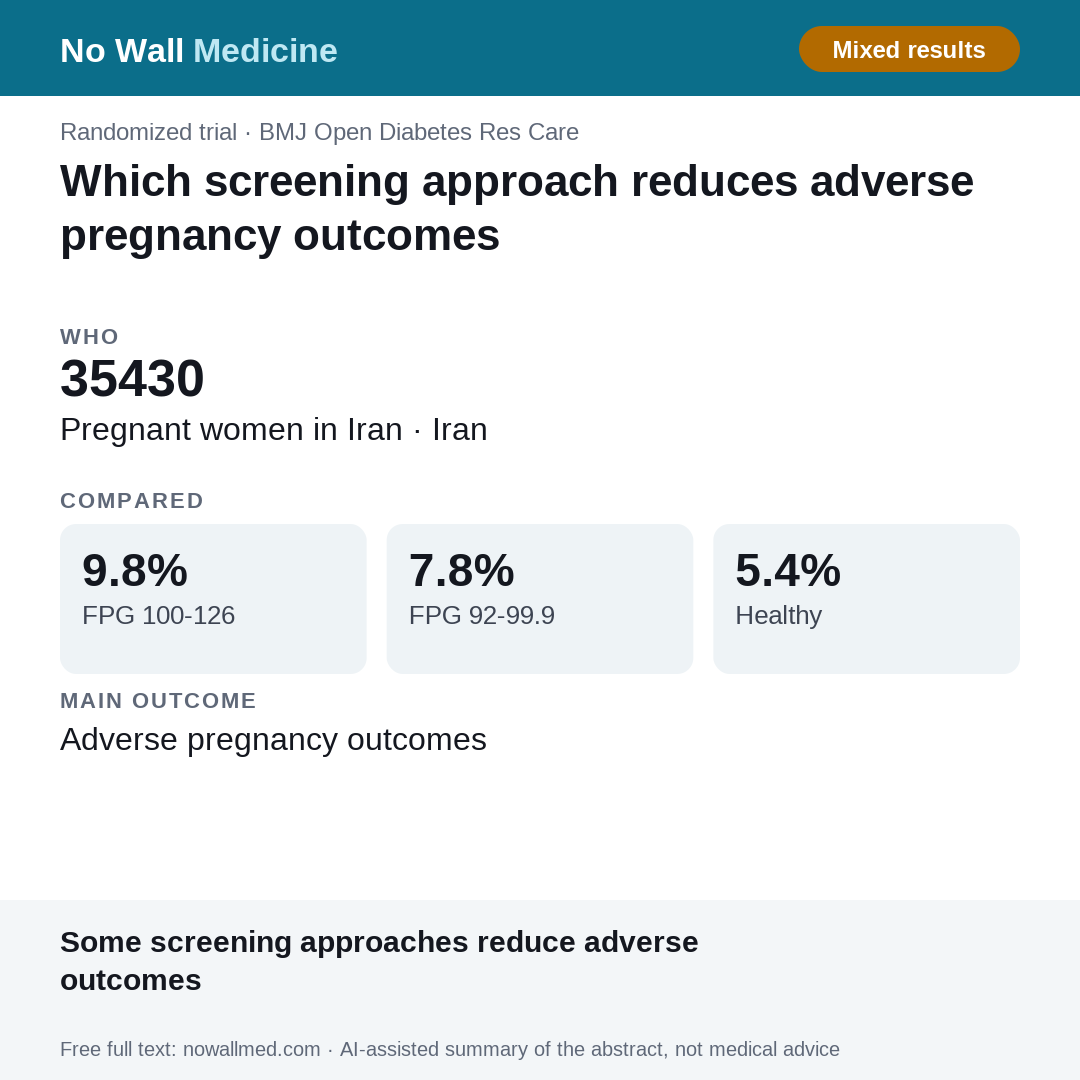
9.8%FPG 100-126 (macrosomia)
7.8%FPG 92-99.9 (macrosomia)
5.4%Healthy (macrosomia)
Main outcome
Adverse pregnancy outcomes
Bottom line: Some screening approaches reduce adverse outcomes
BMJ Open Diabetes Res Care · 2023-12-12Download image
Why it matters: It is unknown which screening and diagnostic approach for gestational diabetes mellitus results in the greatest reduction in adverse pregnancy outcomes.
Key points
- Researchers analyzed 35,430 pregnant women randomly assigned to five different gestational diabetes mellitus screening protocols in Iran.
- Compared to healthy women, those diagnosed with gestational diabetes had a significant increase in the risk of neonatal intensive care unit admission.
- In women with first-trimester fasting plasma glucose of 92-99.9 mg/dL, those diagnosed with gestational diabetes had an increased risk of macrosomia, or large birth weight, compared to those diagnosed later.
Headline and key points written with AI from the paper’s abstract, with every number checked against it. Read the paper before relying on them.
Was this summary helpful?
Abstract
Introduction
We evaluate which screening and diagnostic approach resulted in the greatest reduction in adverse pregnancy outcomes due to increased treatment. Research design and methods
This study presents a secondary analysis of a randomized community non-inferiority trial conducted among pregnant women participating in the GULF Study in Iran. A total of 35 430 pregnant women were randomly assigned to one of the five prespecified gestational diabetes mellitus (GDM) screening protocols. The screening methods included fasting plasma glucose (FPG) in the first trimester and either a one-step or a two-step screening method in the second trimester of pregnancy. According to the results, participants were classified into 6 groups (1) First-trimester FPG: 100-126 mg/dL, GDM diagnosed at first trimester; (2) First trimester FPG: 92-99.9 mg/dL, GDM diagnosed at first trimester; (3) First trimester FPG: 92-99.9 mg/dL, GDM diagnosed at second trimester; (4) First trimester FPG: 92-99.9 mg/dL, healthy at second trimester; (5) First trimester FPG<92 mg/dL, GDM diagnosed at second trimester; (6) First trimester FPG<92 mg/dL, healthy at second trimester. For our analysis, we initially used group 6, as the reference and repeated the analysis using group 2, as the reference group. The main outcome of the study was major adverse maternal and neonatal outcomes. Results
Macrosomia and primary caesarean section occurred in 9.8% and 21.0% in group 1, 7.8% and 19.8% in group 2, 5.4% and 18.6% in group 3, 6.6% and 21.5% in group 4, 8.3% and 24.0% in group 5, and 5.4% and 20.0% in group 6, respectively. Compared with group 6 as the reference, there was a significant increase in the adjusted risk of neonatal intensive care unit (NICU) admission in groups 1, 3, and 5 and an increased risk of macrosomia in groups 1, 2, and 5. Compared with group 2 as the reference, there was a significant decrease in the adjusted risk of macrosomia in group 3, a decreased risk of NICU admission in group 6, and an increased risk of hyperglycemia in group 3. Conclusions
We conclude that screening approaches for GDM reduced the risk of adverse pregnancy outcomes to the same or near the same risk level of healthy pregnant women, except for the risk of NICU admission that increased significantly in groups diagnosed with GDM compared with healthy pregnant women. Individuals with slight increase in FPG (92-100 mg/dL) at first trimester, who were diagnosed as GDM, had an even increased risk of macrosomia in comparison to those group of women with FPG 92-100 mg/dL in the first trimester, who were not diagnosed with GDM, and developed GDM in second trimester TRIAL REGISTRATION: IRCT138707081281N1 (registered: February 15, 2017).
Abstract reproduced under the article’s CC BY NC licence.
Subject terms
Cite this article
Ramezani Tehrani F, Sheidaei A, Rahmati M, Farzadfar F, Noroozzadeh M, Hosseinpanah F. Various screening and diagnosis approaches for gestational diabetes mellitus and adverse pregnancy outcomes: a secondary analysis of a randomized non-inferiority field trial. BMJ Open Diabetes Res Care. 2023. doi:10.1136/bmjdrc-2023-003510
Spotted a mistake? Suggest a correction
Top studies every Monday
The week’s key trials and guidelines in your specialties, plus any topics you follow. By email, free.
Get the weekly digest