Excessive weight gain during pregnancy increases risks for caesarean deliveries in low and middle income countries
Gestational weight gain and maternal immediate perinatal and postpartum outcomes in low and middle income countries: individual participant data meta-analyses
Individual participant data meta-analysesHarm found
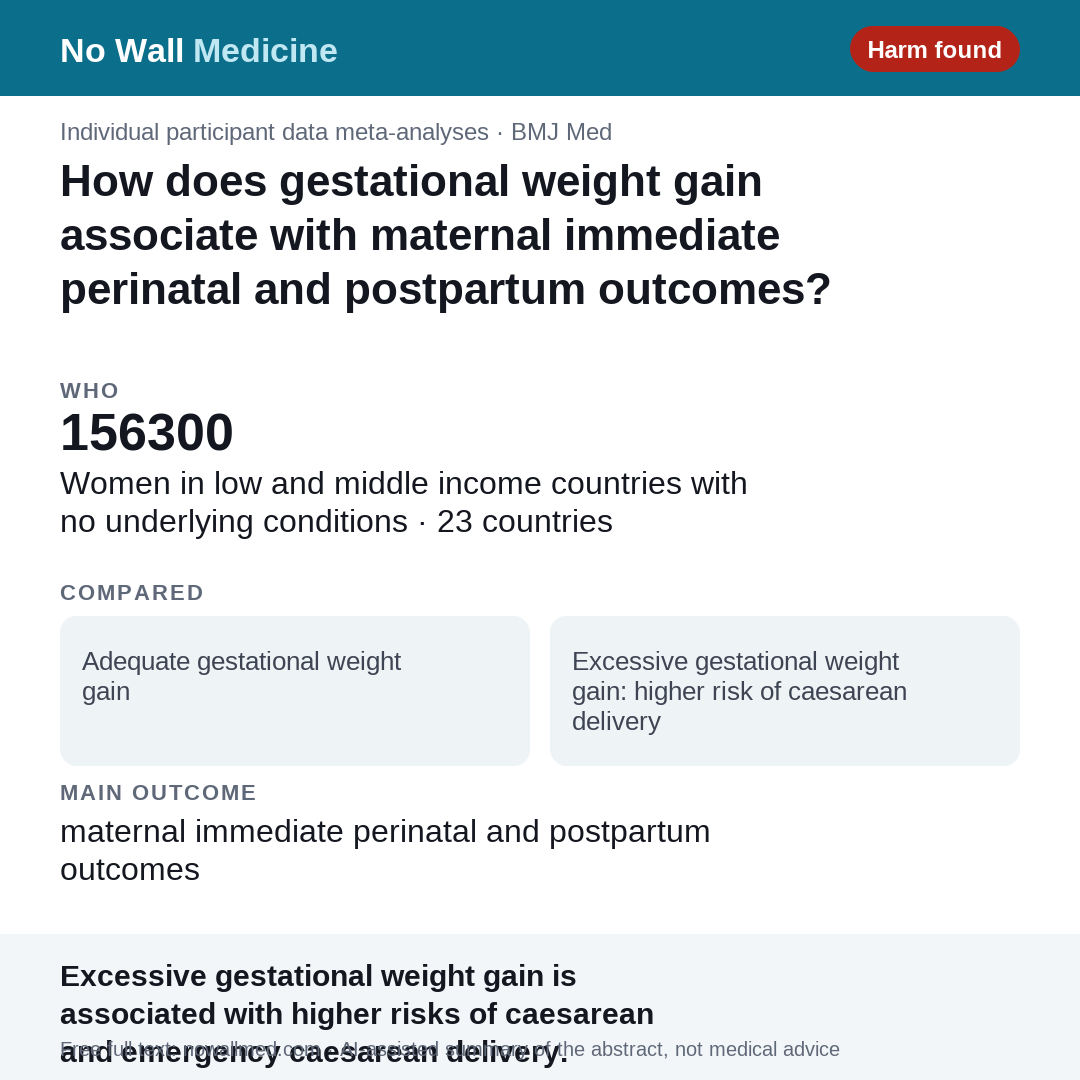
How does gestational weight gain associate with maternal immediate perinatal and postpartum outcomes?
Who
156300
Women in low and middle income countries with no underlying conditions · 23 countries
Compared
Adequate gestational weight gain
Excessive gestational weight gain: higher risk of caesarean delivery
Main outcome
maternal immediate perinatal and postpartum outcomes
Result: risk ratio 1.10 (95% confidence interval 1.06 to 1.13)
Bottom line: Excessive gestational weight gain is associated with higher risks of caesarean and emergency caesarean delivery.
BMJ Med · 2026-07-06Download image
Clinical question: How does gestational weight gain associate with maternal immediate perinatal and postpartum outcomes?
Why it matters: There is a need to understand how weight gain during pregnancy affects maternal health outcomes in low and middle income countries.
Key points
- Researchers analyzed data from 156,300 women across 61 studies in 23 low and middle income countries.
- Women with excessive weight gain over 125% of recommended levels had a higher risk of caesarean delivery (risk ratio 1.10) and emergency caesarean delivery (risk ratio 1.22).
- The study compared outcomes for women with excessive, adequate, or moderate weight gain during pregnancy.
Headline and key points written with AI from the paper’s abstract, with every number checked against it. Read the paper before relying on them.
Abstract
Objective
To estimate the associations between gestational weight gain and maternal immediate perinatal and postpartum outcomes by pooling data from low and middle income countries. Design
Individual participant data meta-analyses. Data sources
PubMed, Embase, Web of Science, and Cochrane Library, based on three searches (Search 1: all prospective studies published from January 2000 to May 2021; Search 2: randomized controlled trials of balanced energy and protein supplementation published until June 2021; Search 3: randomized controlled trials of anti-infectious agents published until August 2021). Eligibility criteria for selecting studies
Prospective studies (randomised controlled trials or observational cohort studies) with measured maternal weight during pregnancy and data available on maternal height, based in populations from low and middle income countries with no underlying conditions. Results
The analyses included 156 300 women from 61 studies and 23 countries, with most participants based in South Asia (n=78 454, 50.2%) and sub-Saharan Africa (n=36 327, 23.2%). Compared with women with adequate (90-125%) gestational weight gain, women with excessive (>125%) gestational weight gain had a higher risk of caesarean delivery (risk ratio 1.10, 95% confidence interval 1.06 to 1.13, τ2=0.000) and emergency caesarean delivery (risk ratio 1.22, 1.03 to 1.43, τ2=0.000). Women with moderately (70% to Conclusions
These findings support the association between suboptimal gestational weight gain and adverse maternal outcomes in the immediate perinatal and postpartum periods. Further research examining the consequences of suboptimal gestational weight gain in low and middle income countries would be valuable to inform potential strategies to improve long term maternal health. Review registration
PROSPERO CRD42023432836.
Abstract reproduced under the article’s CC BY licence.
Spotted a mistake? Suggest a correction