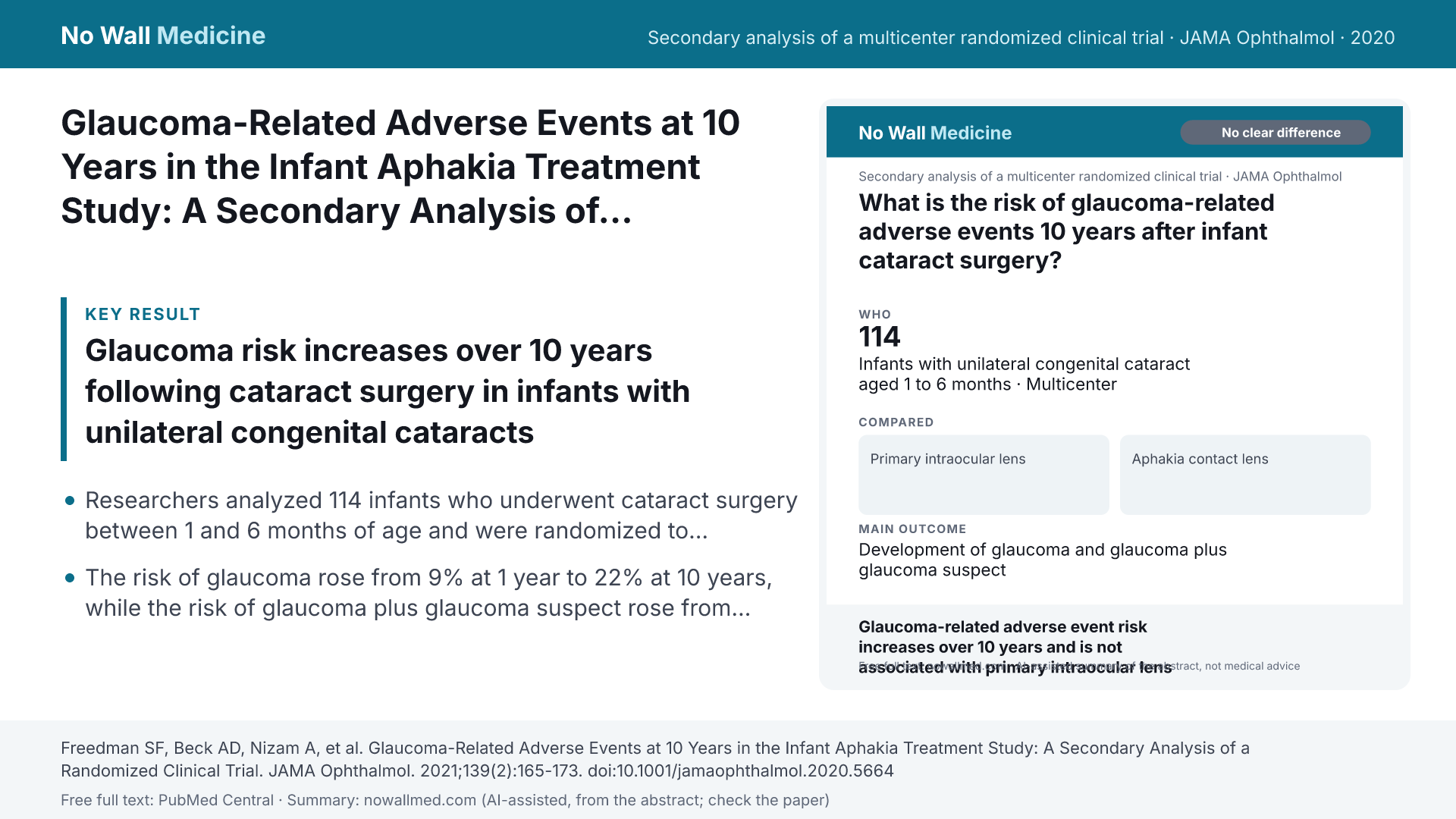
Glaucoma risk increases over 10 years following cataract surgery in infants with unilateral congenital cataracts
Glaucoma-Related Adverse Events at 10 Years in the Infant Aphakia Treatment Study: A Secondary Analysis of a Randomized Clinical Trial
Secondary analysis of a multicenter randomized clinical trialNo clear difference
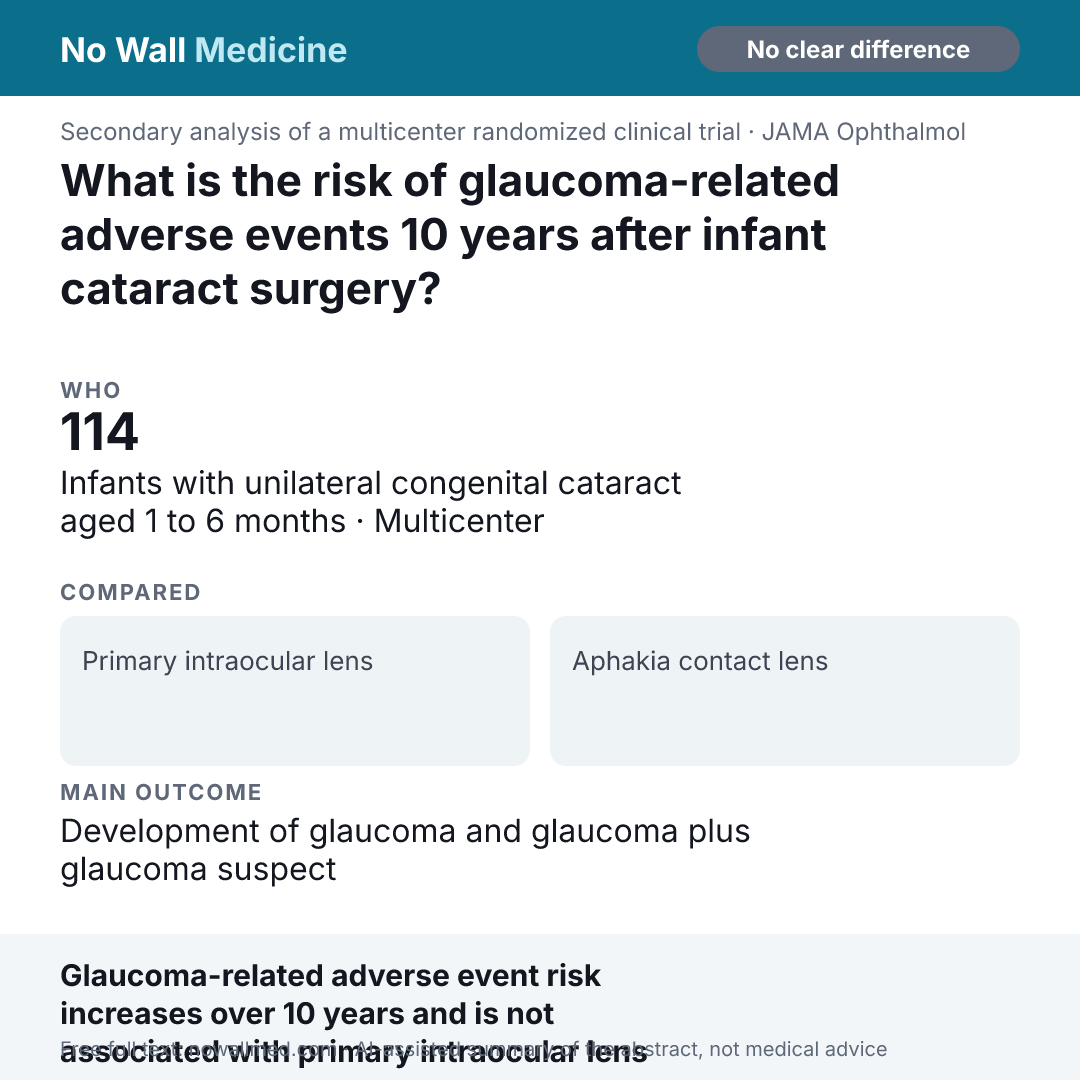
What is the risk of glaucoma-related adverse events 10 years after infant cataract surgery?
Who
114
Infants with unilateral congenital cataract aged 1 to 6 months · Multicenter
Compared
Primary intraocular lens
Aphakia contact lens
Main outcome
Development of glaucoma and glaucoma plus glaucoma suspect
Result: 40% (95% CI, 32%-50%) risk of glaucoma plus glaucoma suspect at 10 years
Bottom line: Glaucoma-related adverse event risk increases over 10 years and is not associated with primary intraocular lens implantation.
JAMA Ophthalmol · 2020-12-18 · Save PNG
Same trial (NCT00212134)
Papers we list that report this registered trial, oldest first. Read a secondary analysis alongside the main results.
- Secondary analysis No clear difference
This paper JAMA Ophthalmol 2020-12 - Secondary analysis Key finding
Shallower anterior chamber depth predicts glaucoma risk in infants after congenital cataract surgery Am J Ophthalmol 2025-12
Clinical question: What is the risk of glaucoma-related adverse events 10 years after infant cataract surgery?
Why it matters: Long-term data on the incidence and visual outcomes of glaucoma-related complications following cataract removal in infancy remain lacking.
Key points
- Researchers analyzed 114 infants who underwent cataract surgery between 1 and 6 months of age and were randomized to receive either a primary intraocular lens or aphakia with contact lenses.
- The risk of glaucoma rose from 9% at 1 year to 22% at 10 years, while the risk of glaucoma plus glaucoma suspect rose from 12% at 1 year to 40% at 10 years.
- At 10 years of age, the risk of glaucoma or glaucoma suspect was not significantly different between the intraocular lens and contact lens groups.
Headline and key points written with AI from the paper’s abstract, with every number checked against it. Read the paper before relying on them.
Was this summary helpful?
Subject terms
Headline, design, result, key points, caveat and citation as plain text.
Cite this article
Freedman SF, Beck AD, Nizam A, et al. Glaucoma-Related Adverse Events at 10 Years in the Infant Aphakia Treatment Study: A Secondary Analysis of a Randomized Clinical Trial. JAMA Ophthalmol. 2021;139(2):165-173. doi:10.1001/jamaophthalmol.2020.5664
Spotted a mistake? Suggest a correction