Task-shifting and task-sharing linked to 27% lower mortality in multimorbidity
Global evidence on the effectiveness of task-shifting and task-sharing strategies for managing individuals with multimorbidity: systematic review and meta-analysis
Systematic review and meta-analysisBenefit found
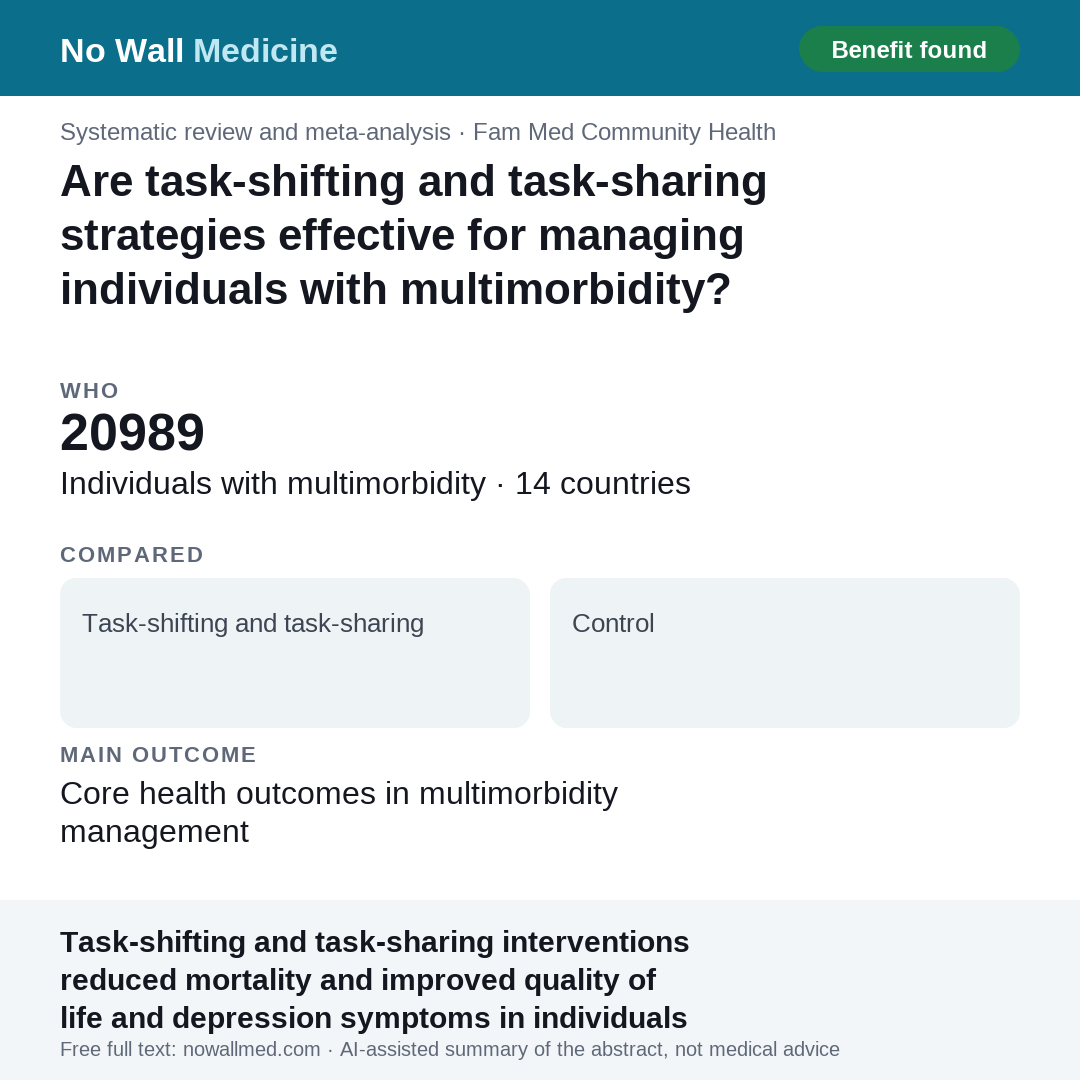
Are task-shifting and task-sharing strategies effective for managing individuals with multimorbidity?
Who
20989
Individuals with multimorbidity · 14 countries
Compared
Task-shifting and task-sharing
Control
Main outcome
Core health outcomes in multimorbidity management
Result: OR: 0.73, 95% CI: 0.55 to 0.97
Bottom line: Task-shifting and task-sharing interventions reduced mortality and improved quality of life and depression symptoms in individuals with multimorbidity.
Limitation: Evidence remains scarce in low-income and middle-income countries.
Fam Med Community Health · 2025-08-12Download image
Clinical question: Are task-shifting and task-sharing strategies effective for managing individuals with multimorbidity?
Why it matters: Effectiveness of task-shifting and task-sharing in multimorbidity management remains unclear
Key points
- 36 studies from 14 countries with 20,989 participants were analyzed.
- Task-shifting and task-sharing were linked to improved quality of life and reduced depression symptoms.
- No significant effect was found on hospitalisation, emergency visits or anxiety-related symptoms.
Limitation the authors note: Most studies were not conducted in low-income and middle-income countries, where evidence remains scarce
Headline and key points written with AI from the paper’s abstract, with every number checked against it. Read the paper before relying on them.
Abstract
Introduction
Task-shifting and task-sharing strategies show promise for managing chronic diseases especially in low-income and middle-income countries (LMICs), though their effectiveness in multimorbidity management remains unclear. This study synthesised evidence on task-shifting and task-sharing strategies globally and assessed the impact on core health outcomes in multimorbidity management. Methods
We conducted a systematic review and meta-analysis of global studies evaluating task-shifting and sharing interventions for individuals with multimorbidity. Six databases, including PubMed, Embase, Web of Science, Ovid (Medline), CINAHL and Cochrane Library, were searched for studies reporting the core outcomes of multimorbidity management in quality of life, mortality, hospitalisation, emergency department visits and symptoms of depression and anxiety. Random-effects models were used to calculate pooled effect sizes with heterogeneity assessed through subgroup and meta-regression analyses. Results
From 8471 records, 36 studies from 14 countries were included, with only 5 conducted in LMICs. Twenty-one studies, encompassing 20 989 participants, were eligible for meta-analysis. More than half of the studies involved nurses as delegates, with some sharing the tasks with health professionals and about 10% of studies involved non-health professionals, including community healthcare workers as delegates to share the responsibility in caring for individuals with multimorbidity. Most studies were multicomponent, with 16.7% addressing all guideline-recommended aspects of multimorbidity management. By pooling the findings, task-shifting and task-sharing interventions were associated with a 27% reduction in mortality (OR: 0.73, 95% CI: 0.55 to 0.97, I²=0%), a modest improvement in quality of life (standardised mean difference (SMD): 0.1, 95% CI: 0.03 to 0.17, I²=47%) and reduced symptoms of depression (SMD: 0.27, 95% CI: -0.52 to -0.02, I²=90%), but showed no significant effect on hospitalisation, emergency visits or anxiety-related symptoms. Conclusions
Some evidence, although limited in existing research, indicates the great potential of task-shifting and task-sharing strategies in supporting management of multimorbidity. Further research is needed to optimise and adopt these interventions, particularly in LMICs where evidence remains scarce. Prospero registration number
CRD42024526845.
Abstract reproduced under the article’s CC BY NC licence.
Topics
Cite this article
Gong E, Long Y, Tong X, Min Htike WY, Wang J, Ni S. Global evidence on the effectiveness of task-shifting and task-sharing strategies for managing individuals with multimorbidity: systematic review and meta-analysis. Fam Med Community Health. 2025. doi:10.1136/fmch-2025-003390
Spotted a mistake? Suggest a correction
Top studies every Monday
The week’s key trials and guidelines in your specialties, by email. Free.
Get the weekly digest