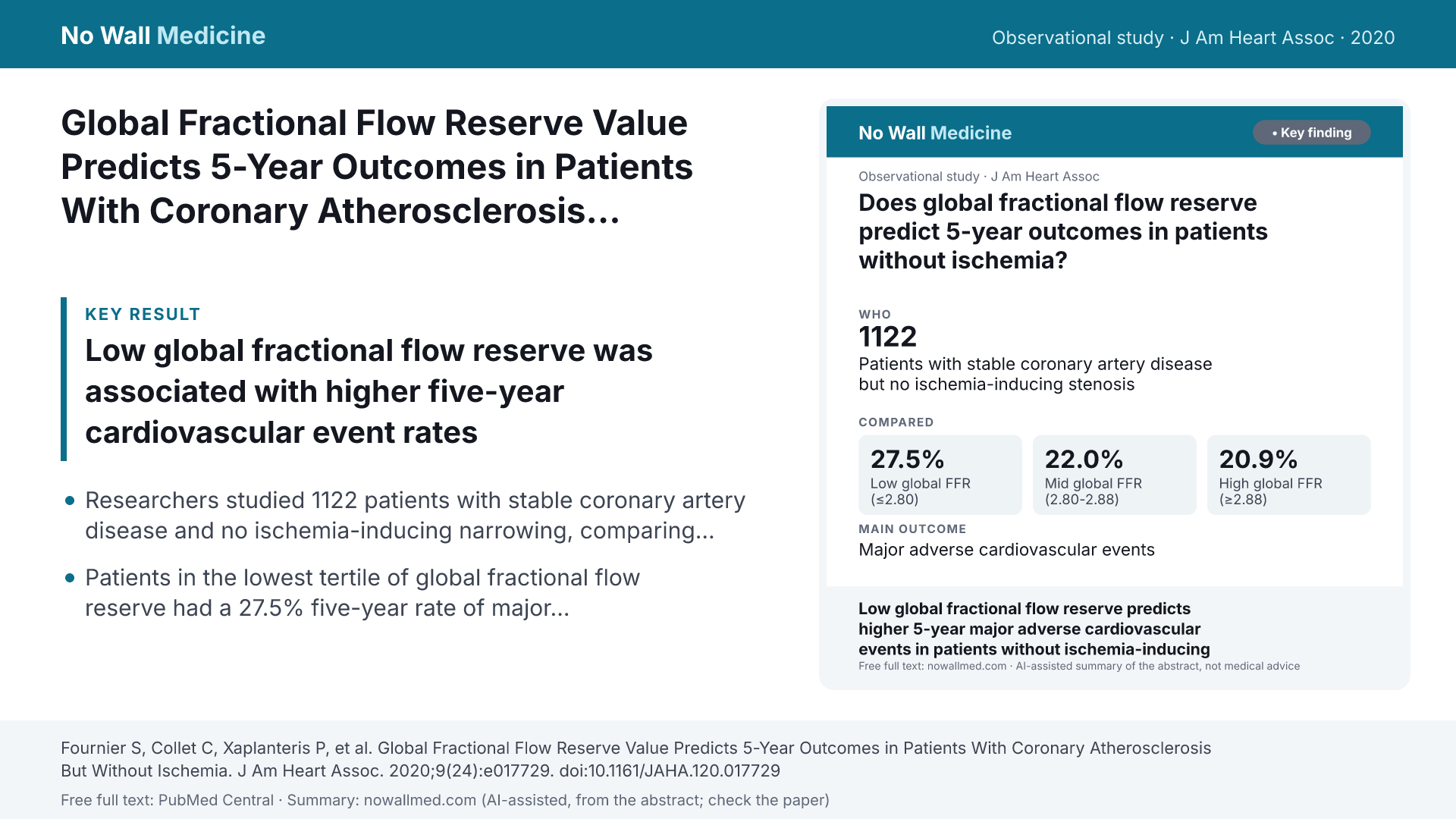
Low global fractional flow reserve was associated with higher five-year cardiovascular event rates
Global Fractional Flow Reserve Value Predicts 5-Year Outcomes in Patients With Coronary Atherosclerosis But Without Ischemia
Observational studyBenefit found
Does global fractional flow reserve predict 5-year outcomes in patients without ischemia?
Who
1122
Patients with stable coronary artery disease but no ischemia-inducing stenosis
Compared
27.5%Low global FFR (≤2.80)
22.0%Mid global FFR (2.80-2.88)
20.9%High global FFR (≥2.88)
Main outcome
Major adverse cardiovascular events
Result: hazard ratio 0.988 (95% CI 0.977-0.998)
Bottom line: Low global fractional flow reserve predicts higher 5-year major adverse cardiovascular events in patients without ischemia-inducing stenosis.
J Am Heart Assoc · 2020-12-07Download image
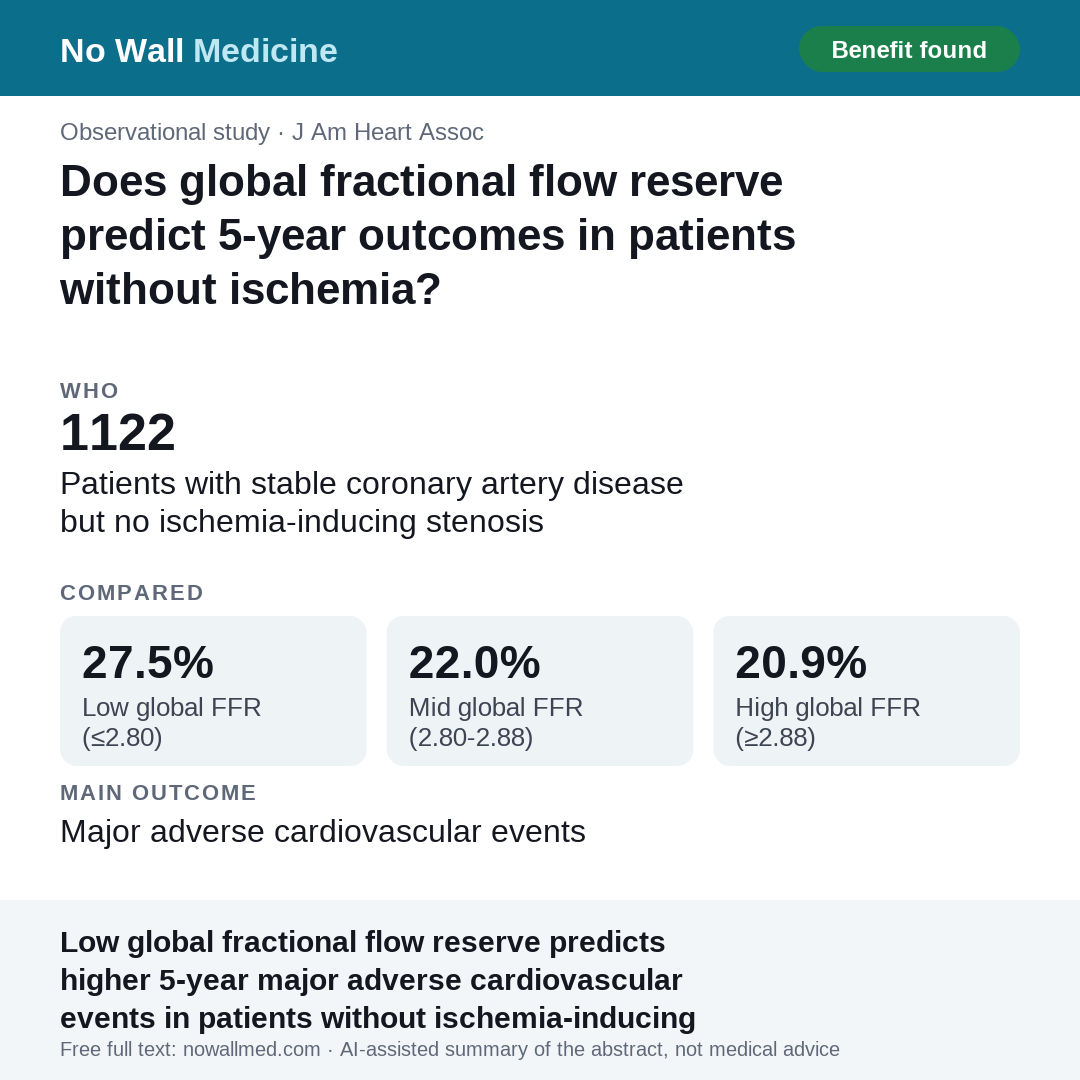
Clinical question: Does global fractional flow reserve predict 5-year outcomes in patients without ischemia?
Why it matters: It was unknown if global fractional flow reserve, a measure of total atherosclerotic burden, could predict long-term outcomes in patients without ischemia-inducing artery narrowing.
Key points
- Researchers studied 1122 patients with stable coronary artery disease and no ischemia-inducing narrowing, comparing outcomes across three groups based on global fractional flow reserve levels.
- Patients in the lowest tertile of global fractional flow reserve had a 27.5% five-year rate of major adverse cardiovascular events compared to 22.0% and 20.9% in higher groups.
- The higher event rate in the lowest group was mainly driven by a 16.4% rate of revascularization, compared to 11.3% and 11.8% in the other groups.
Headline and key points written with AI from the paper’s abstract, with every number checked against it. Read the paper before relying on them.
Was this summary helpful?
Subject terms
Cite this article
Fournier S, Collet C, Xaplanteris P, et al. Global Fractional Flow Reserve Value Predicts 5-Year Outcomes in Patients With Coronary Atherosclerosis But Without Ischemia. J Am Heart Assoc. 2020. doi:10.1161/JAHA.120.017729
Spotted a mistake? Suggest a correction