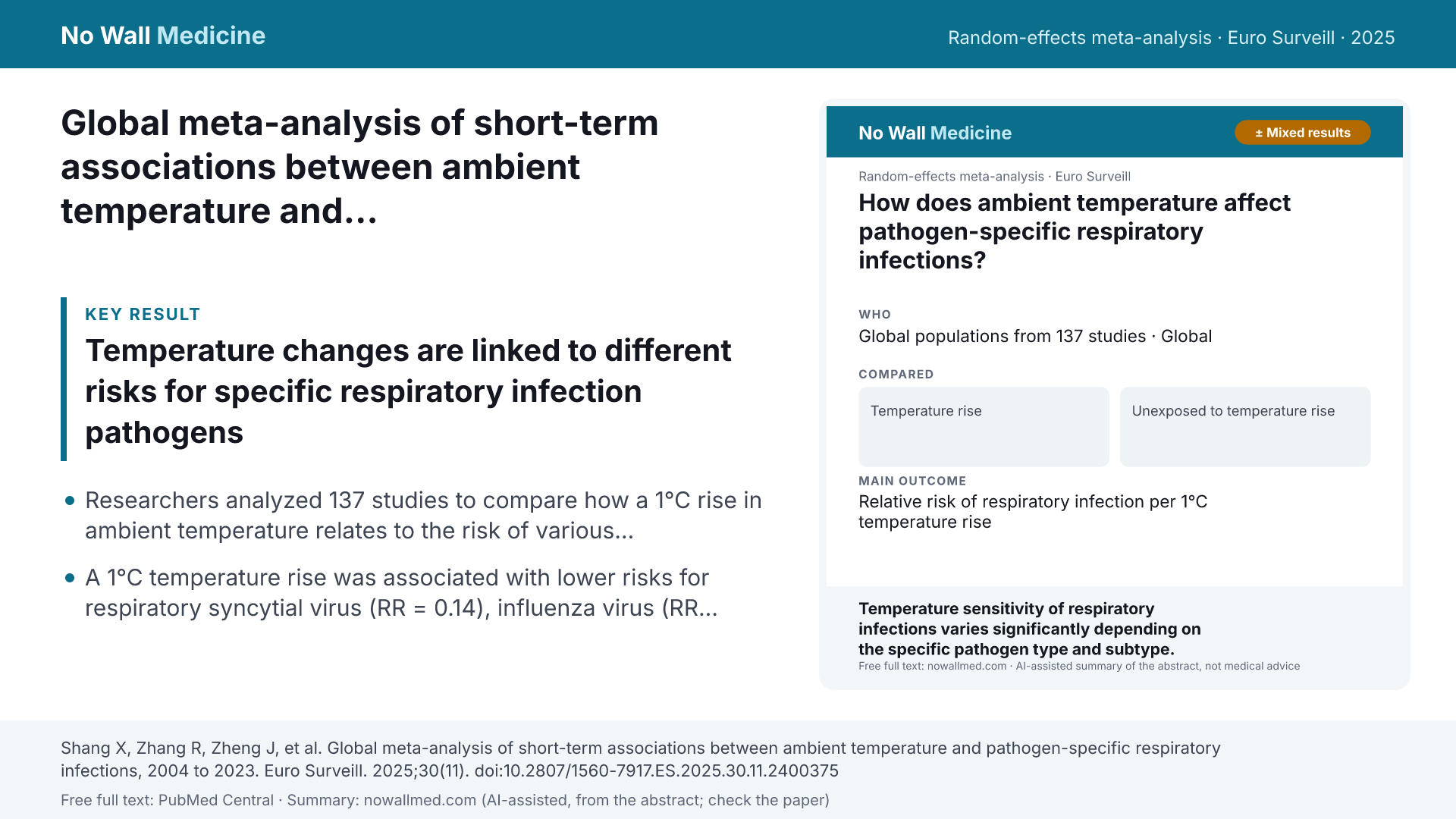
Global meta-analysis of short-term associations between ambient temperature and pathogen-specific respiratory infections, 2004 to 2023
Key result: Temperature changes are linked to different risks for specific respiratory infection pathogens
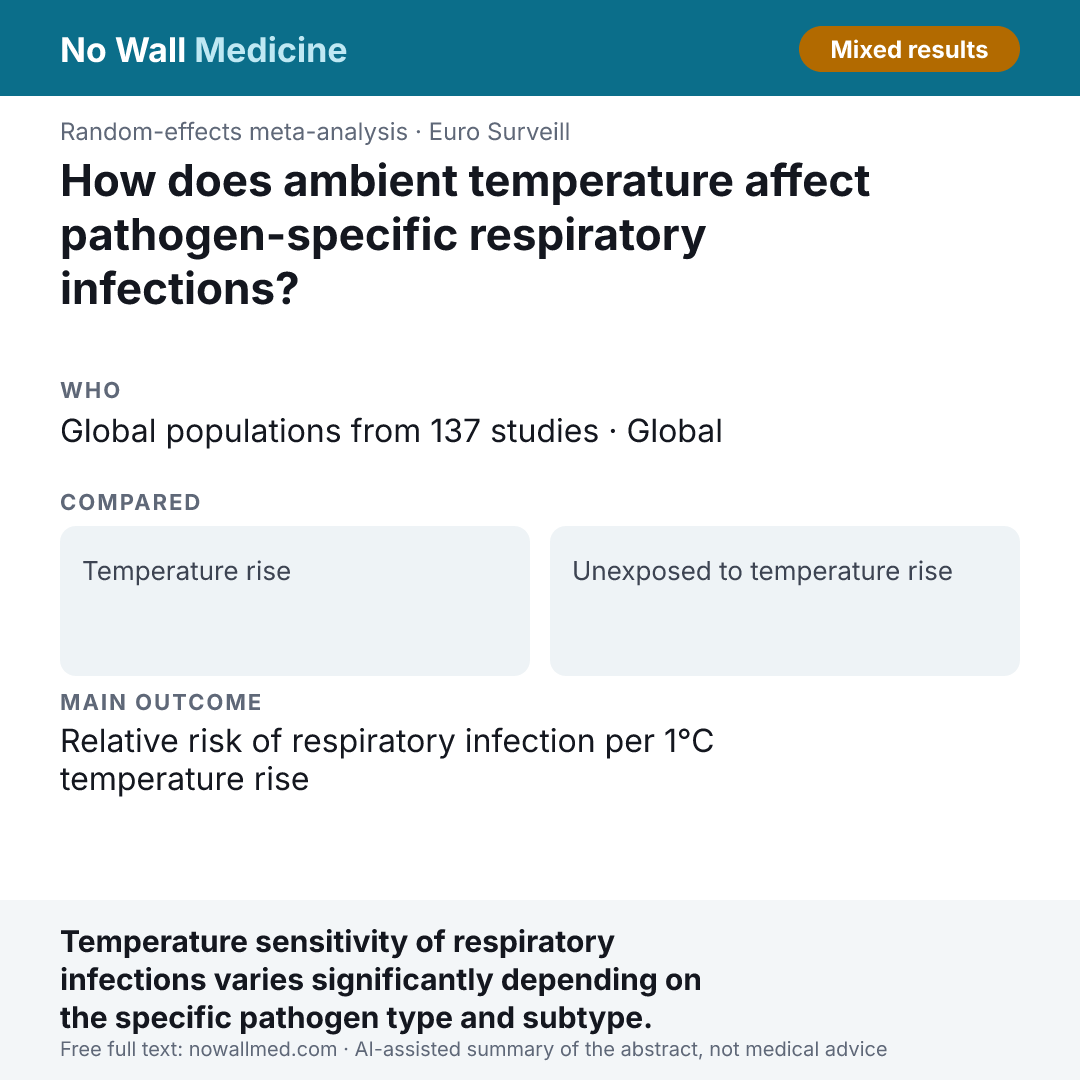
Random-effects meta-analysisMixed results
How does ambient temperature affect pathogen-specific respiratory infections?
Who
Global populations from 137 studies · Global
Compared
Temperature rise
Unexposed to temperature rise
Main outcome
Relative risk of respiratory infection per 1°C temperature rise
Bottom line: Temperature sensitivity of respiratory infections varies significantly depending on the specific pathogen type and subtype.
Euro Surveill · 2025-03-21 · Save PNG
Key points
- Researchers analyzed 137 studies to compare how a 1°C rise in ambient temperature relates to the risk of various respiratory infections.
- A 1°C temperature rise was associated with lower risks for respiratory syncytial virus (RR = 0.14), influenza virus (RR = 0.40), and SARS-CoV-2 (RR = 0.52).
- Higher temperatures were associated with increased risks for human parainfluenza virus (RR = 2.35), human bocavirus (RR = 1.86), and Legionella pneumophila (RR = 2.69).
Discussion prompts
- Would these patients look like yours? Who was left out?
- Is the main outcome one that matters to patients?
- Is the difference large enough to change what you do?
Cite: Shang X, Zhang R, Zheng J, et al. Global meta-analysis of short-term associations between ambient temperature and pathogen-specific respiratory infections, 2004 to 2023. Euro Surveill. 2025;30(11). doi:10.2807/1560-7917.ES.2025.30.11.2400375
Free full text: PubMed Central · Summary and visual abstract: nowallmed.com/a/global-meta-analysis-of-short-term-associations-between-ambient-hejru0/ (AI-assisted from the abstract; check the paper before relying on it).