Glucocorticoid treatment was associated with higher cholesterol but increased body mass loss in sepsis
Glucocorticoid treatment increases cholesterol availability during critical illness: effect on adrenal and muscle function
Secondary analysis of randomized trial and mouse modelMixed results
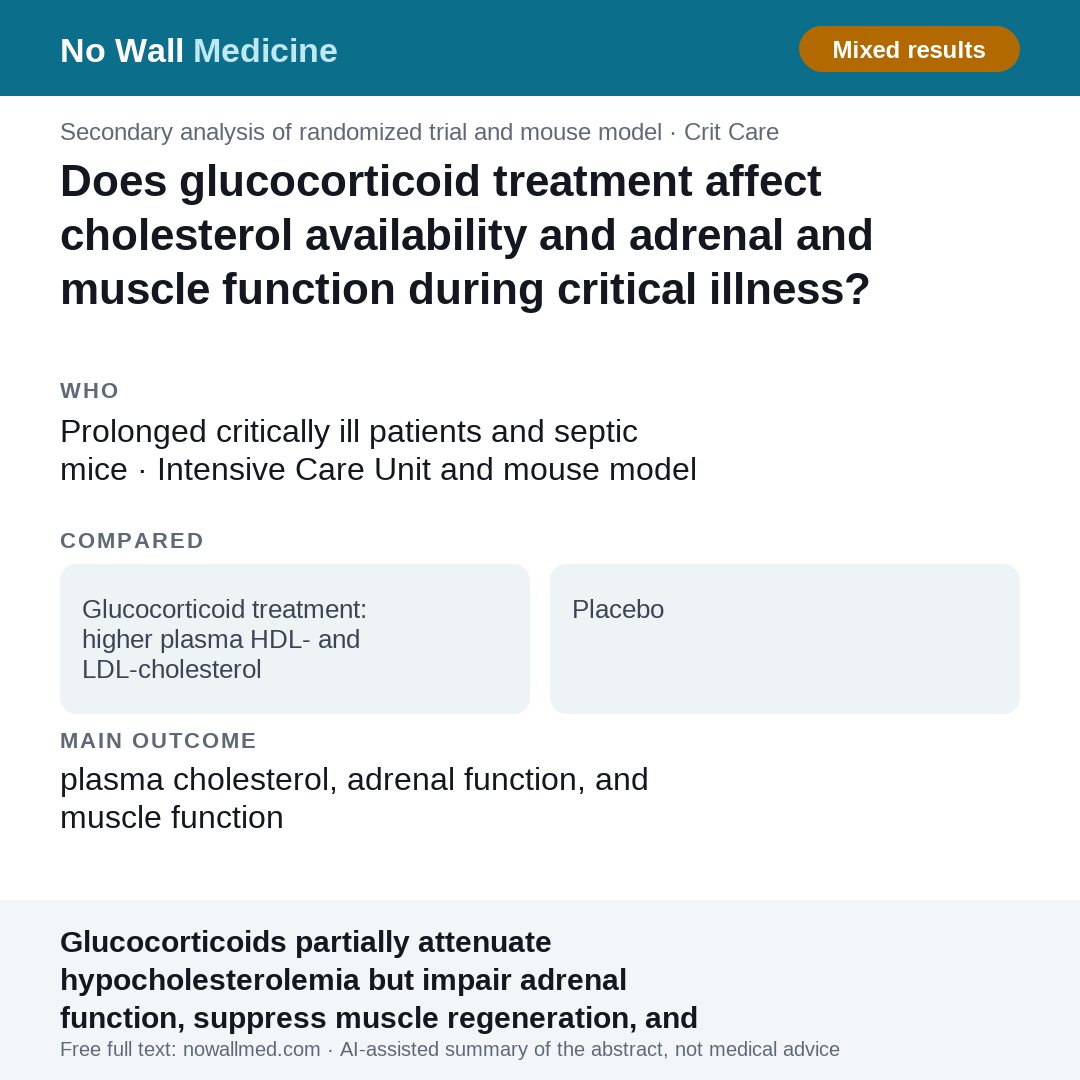
Does glucocorticoid treatment affect cholesterol availability and adrenal and muscle function during critical illness?
Who
Prolonged critically ill patients and septic mice · Intensive Care Unit and mouse model
Compared
Glucocorticoid treatment: higher plasma HDL- and LDL-cholesterol
Placebo
Main outcome
plasma cholesterol, adrenal function, and muscle function
Bottom line: Glucocorticoids partially attenuate hypocholesterolemia but impair adrenal function, suppress muscle regeneration, and exacerbate body mass loss.
Crit Care · 2024-09-05Download image
Clinical question: Does glucocorticoid treatment affect cholesterol availability and adrenal and muscle function during critical illness?
Why it matters: The underlying reasons why cholesterol levels drop during critical illness are not fully understood, specifically whether steroid use affects cholesterol availability and organ function.
Key points
- Researchers analyzed 324 critically ill patients and used mouse models of sepsis to measure how steroid treatment affects cholesterol, adrenal function, and muscle health.
- In humans, glucocorticoid treatment was associated with higher plasma high-density lipoprotein and low-density lipoprotein cholesterol from day two or three through day five.
- In septic mice, hydrocortisone treatment was associated with increased adrenal inflammation, suppressed muscle regeneration, and greater loss of lean body mass and water.
Headline and key points written with AI from the paper’s abstract, with every number checked against it. Read the paper before relying on them.
Topics
Cite this article
De Bruyn L, Téblick A, Van Oudenhove T, Vander Perre S, Derese I, Pauwels L. Glucocorticoid treatment increases cholesterol availability during critical illness: effect on adrenal and muscle function. Crit Care. 2024. doi:10.1186/s13054-024-05079-8
Spotted a mistake? Suggest a correction
Top studies every Monday
The week’s key trials and guidelines in your specialties, by email. Free.
Get the weekly digest