Glutamatergic medications were associated with symptom improvement in obsessive-compulsive and related disorders
Glutamatergic Medications for Obsessive-Compulsive and Related Disorders: A Systematic Review and Meta-Analysis
Meta-analysis of 27 randomized clinical trialsBenefit found
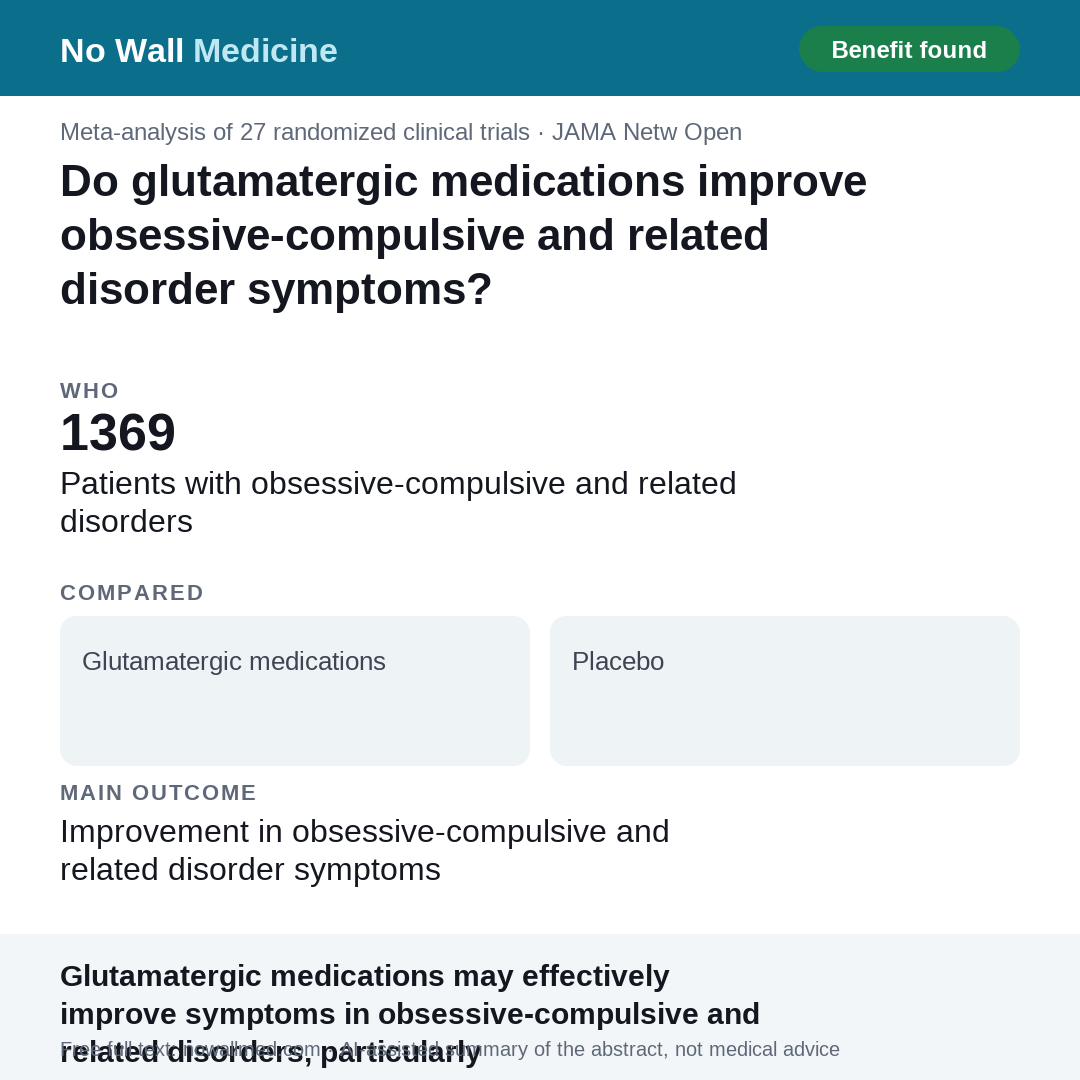
Do glutamatergic medications improve obsessive-compulsive and related disorder symptoms?
Who
1369
Patients with obsessive-compulsive and related disorders
Compared
Glutamatergic medications
Placebo
Main outcome
Improvement in obsessive-compulsive and related disorder symptoms
Result: standardized mean difference -0.80 (95% CI -1.13 to -0.47)
Bottom line: Glutamatergic medications may effectively improve symptoms in obsessive-compulsive and related disorders, particularly obsessive-compulsive disorder.
Limitation: High heterogeneity and potential publication bias necessitate cautious interpretation.
JAMA Netw Open · 2025-01-02Download image
Clinical question: Do glutamatergic medications improve obsessive-compulsive and related disorder symptoms?
Why it matters: Approximately 60% of patients with obsessive-compulsive and related disorders do not respond adequately to standard treatments.
Key points
- Researchers analyzed 27 randomized clinical trials involving 1369 participants with a mean age of 31.5 years to evaluate glutamatergic medications.
- Glutamatergic medications showed a large effect size for improving symptoms of obsessive-compulsive and related disorders with a Cohen d of -0.80.
- In 23 trials specifically for obsessive-compulsive disorder, these medications were associated with a mean reduction in Yale-Brown Obsessive Compulsive Scale scores of -4.17.
Limitation the authors note: The authors noted high heterogeneity and potential publication bias in the included studies.
Headline and key points written with AI from the paper’s abstract, with every number checked against it. Read the paper before relying on them.
Was this summary helpful?
Subject terms
Cite this article
Coelho DRA, Yang C, Suriaga A, Manasa J, Bain PA, Vieira WF. Glutamatergic Medications for Obsessive-Compulsive and Related Disorders: A Systematic Review and Meta-Analysis. JAMA Netw Open. 2025. doi:10.1001/jamanetworkopen.2024.52963
Spotted a mistake? Suggest a correction
Top studies every Monday
The week’s key trials and guidelines in your specialties, plus any topics you follow. By email, free.
Get the weekly digest