Dexmedetomidine was associated with lower risks of delayed graft function and acute kidney injury in transplant recipients
Graft function and renal protection with peritransplant systemic dexmedetomidine in kidney and liver recipients: systematic review and meta-analysis of randomized controlled trials
Systematic review and meta-analysis of randomized controlled trialsBenefit found
Does perioperative systemic dexmedetomidine prevent allograft failure or kidney dysfunction in transplant recipients?
Who
Kidney and liver transplant recipients
Compared
Dexmedetomidine
Control
Main outcome
Delayed graft function and posttransplant acute kidney injury
Bottom line: Dexmedetomidine may reduce delayed graft function and acute kidney injury in certain kidney and liver transplant recipients.
Limitation: Limited long-term follow-up and moderate certainty of evidence.
Int J Surg · 2025-06-12Download image
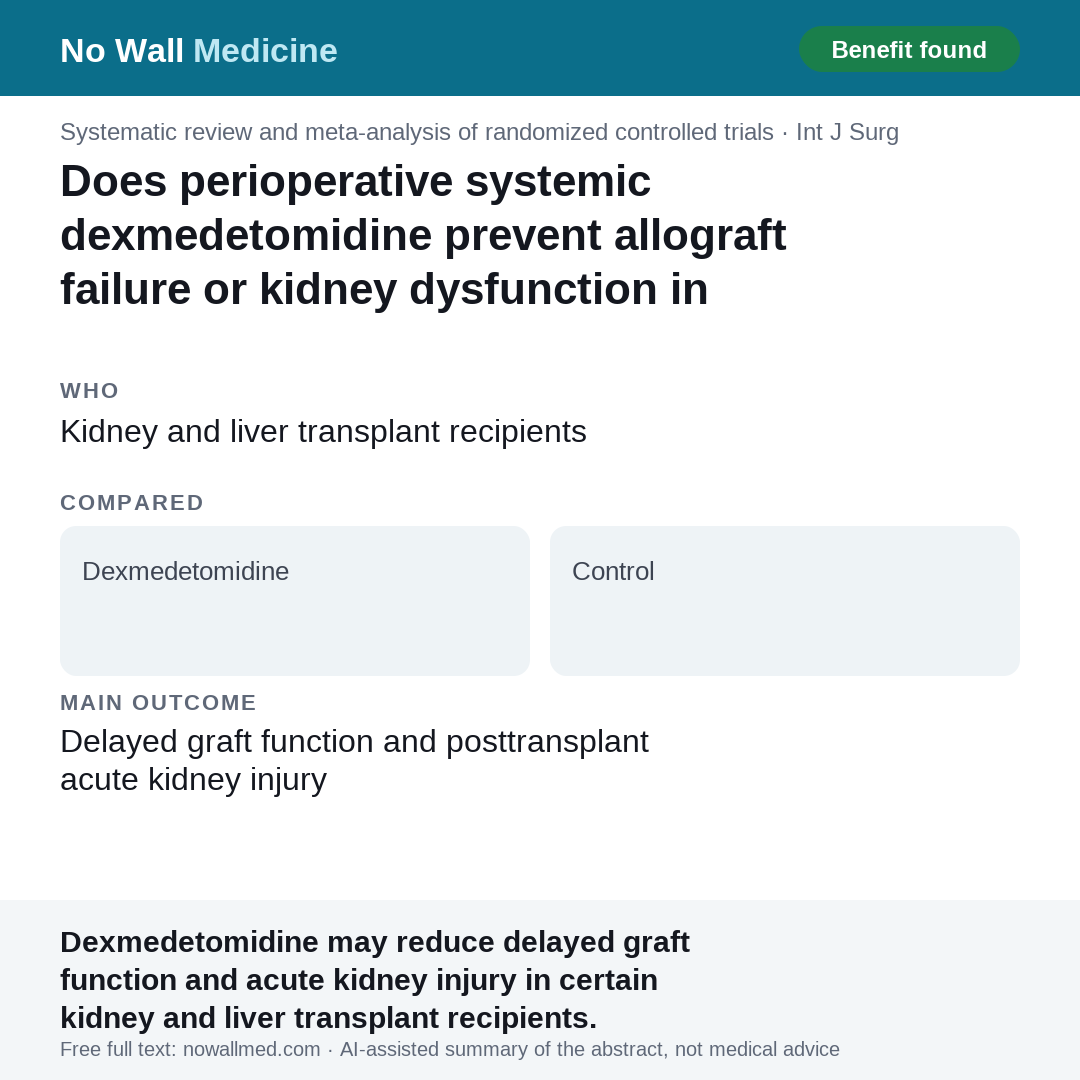
Clinical question: Does perioperative systemic dexmedetomidine prevent allograft failure or kidney dysfunction in transplant recipients?
Why it matters: The potential role of dexmedetomidine as an adjunct in transplant surgery to prevent allograft failure or kidney dysfunction remains to be systematically reviewed.
Key points
- Researchers analyzed ten randomized controlled trials involving kidney and liver transplant recipients from living or deceased donors.
- Dexmedetomidine was associated with a lower risk of delayed graft function after deceased donor kidney transplantation (risk ratio: 0.52 [0.26-1.01]; P = 0.05) and living donor liver transplantation (risk ratio: 0.35 [0.17-0.74]; P = 0.006).
- The medication was associated with lower rates of posttransplant acute kidney injury, which is sudden loss of kidney function, after kidney transplantation (risk ratio: 0.40 [0.18-0.90]; P = 0.03) and liver transplantation (risk ratio: 0.69 [0.50-0.95]; P = 0.02).
Limitation the authors note: The study was limited by moderate certainty of evidence and limited long-term follow-up.
Headline and key points written with AI from the paper’s abstract, with every number checked against it. Read the paper before relying on them.
Topics
Cite this article
Reichert M, Willis F, Koch C, Amati AL, Braun J, Weigand MA. Graft function and renal protection with peritransplant systemic dexmedetomidine in kidney and liver recipients: systematic review and meta-analysis of randomized controlled trials. Int J Surg. 2025. doi:10.1097/JS9.0000000000002725
Spotted a mistake? Suggest a correction
Top studies every Monday
The week’s key trials and guidelines in your specialties, plus any topics you follow. By email, free.
Get the weekly digest