Granulocyte-macrophage colony-stimulating factor neutralisation in patients with axial spondyloarthritis in the UK (NAMASTE): a randomised, double-blind, placebo-controlled, phase 2 trial
Randomised, double-blind, placebo-controlled, phase 2 trialNo clear difference
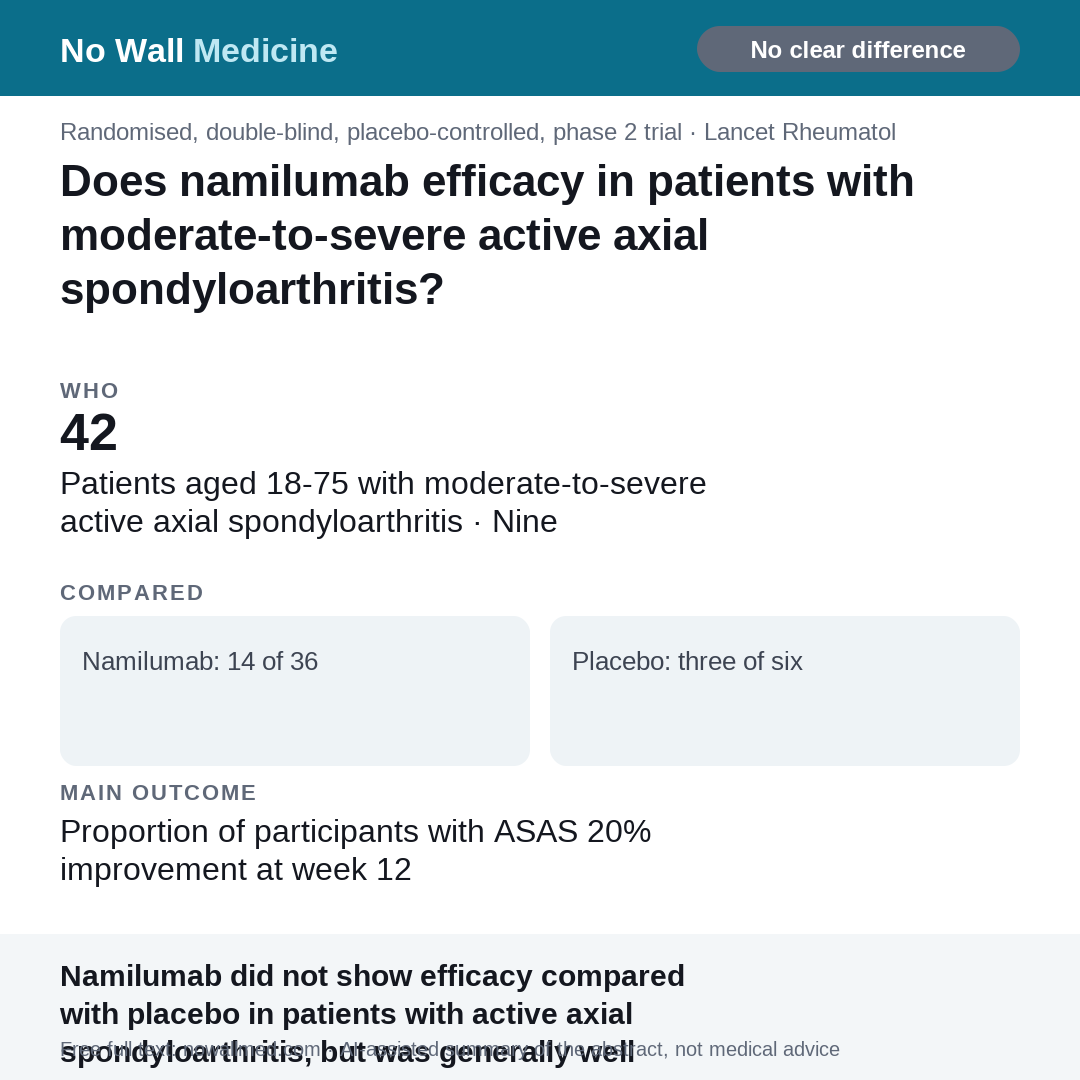
Does namilumab efficacy in patients with moderate-to-severe active axial spondyloarthritis?
Who
42
Patients aged 18-75 with moderate-to-severe active axial spondyloarthritis · Nine hospitals in the United Kingdom
Compared
Namilumab: 14 of 36
Placebo: three of six
Main outcome
Proportion of participants with ASAS 20% improvement at week 12
Result: estimated between-group difference 6·8%
Bottom line: Namilumab did not show efficacy compared with placebo in patients with active axial spondyloarthritis, but was generally well tolerated.
Funded by: Izana Bioscience, NIHR, and Clinical Research Facility
Lancet Rheumatol · 2024-06-25Download image
Clinical question: Does namilumab efficacy in patients with moderate-to-severe active axial spondyloarthritis?
Abstract
Background
Granulocyte-macrophage colony-stimulating factor (GM-CSF) is a proinflammatory cytokine overproduced in several inflammatory and autoimmune diseases, including axial spondyloarthritis. Namilumab is a human IgG1 monoclonal anti-GM-CSF antibody that potently neutralises human GM-CSF. We aimed to assess the efficacy of namilumab in participants with moderate-to-severe active axial spondyloarthritis. Methods
This proof-of-concept, randomised, double-blind, placebo-controlled, phase 2, Bayesian (NAMASTE) trial was done at nine hospitals in the UK. Participants aged 18-75 years with axial spondyloarthritis, meeting the Assessment in SpondyloArthritis international Society (ASAS) criteria and the ASAS-defined MRI criteria, with active disease as defined by a Bath Ankylosing Spondylitis Disease Activity Index (BASDAI), were eligible. Those who had inadequately responded or had intolerance to previous treatment with an anti-TNF agent were included. Participants were randomly assigned (6:1) to receive subcutaneous namilumab 150 mg or placebo at weeks 0, 2, 6, and 10. Participants, site staff (except pharmacy staff), and central study staff were masked to treatment assignment. The primary endpoint was the proportion of participants who had an ASAS ≥20% improvement (ASAS20) clinical response at week 12 in the full analysis set (all randomly assigned participants). This trial is registered with ClinicalTrials.gov (NCT03622658). Findings
From Sept 6, 2018, to July 25, 2019, 60 patients with moderate-to-severe active axial spondyloarthritis were assessed for eligibility and 42 were randomly assigned to receive namilumab (n=36) or placebo (n=six). The mean age of participants was 39·5 years (SD 13·3), 17 were women, 25 were men, 39 were White, and seven had previously received anti-TNF therapy. The primary endpoint was not met. At week 12, the proportion of patients who had an ASAS20 clinical response was lower in the namilumab group (14 of 36) than in the placebo group (three of six; estimated between-group difference 6·8%). The Bayesian posterior probability η was 0·72 (>0·927 suggests high clinical significance). The rates of any treatment-emergent adverse events in the namilumab group were similar to those in the placebo group (31 vs five). Interpretation
Namilumab did not show efficacy compared with placebo in patients with active axial spondyloarthritis, but the treatment was generally well tolerated. Funding
Izana Bioscience, NIHR Oxford Biomedical Research Centre (BRC), NIHR Birmingham BRC, and Clinical Research Facility.
Abstract reproduced under the article’s CC BY licence.
Subject terms
Cite this article
Worth C, Al-Mossawi MH, Macdonald J, Fisher BA, Chan A, Sengupta R. Granulocyte-macrophage colony-stimulating factor neutralisation in patients with axial spondyloarthritis in the UK (NAMASTE): a randomised, double-blind, placebo-controlled, phase 2 trial. Lancet Rheumatol. 2024. doi:10.1016/S2665-9913(24)00099-7
Spotted a mistake? Suggest a correction
Top studies every Monday
The week’s key trials and guidelines in your specialties, plus any topics you follow. By email, free.
Get the weekly digest