Groin Wound Infection after Vascular Exposure (GIVE) Risk Prediction Models: Development, Internal Validation, and Comparison with Existing Risk Prediction Models Identified in a Systematic Literature Review
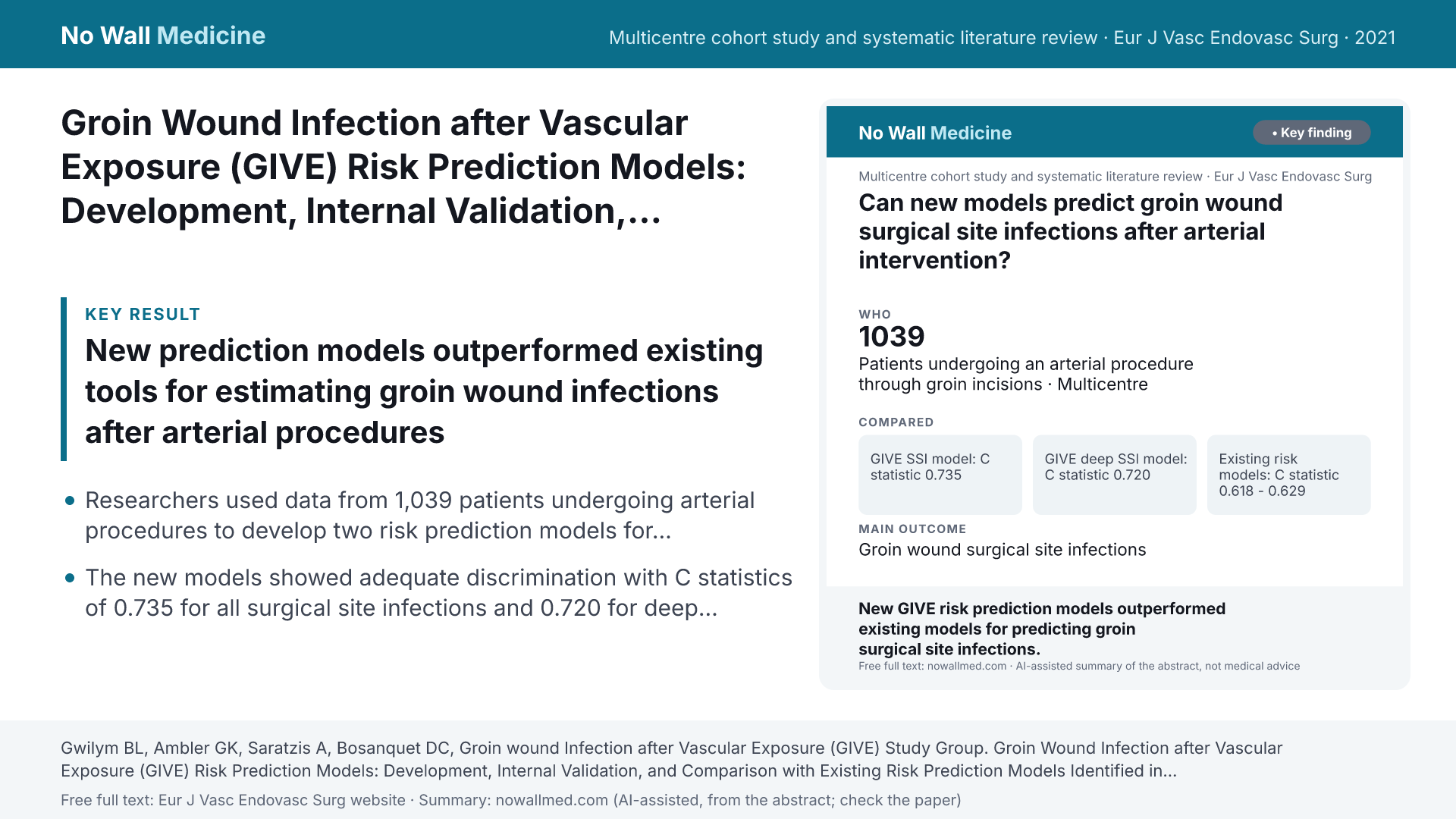
Key result: New prediction models outperformed existing tools for estimating groin wound infections after arterial procedures
Key points
- Researchers used data from 1,039 patients undergoing arterial procedures to develop two risk prediction models for surgical site infections, which are infections occurring at the site of surgery.
- The new models showed adequate discrimination with C statistics of 0.735 for all surgical site infections and 0.720 for deep or organ space infections.
- The GIVE models outperformed three existing risk prediction models that had C statistics ranging from 0.618 to 0.629.
Discussion prompts
- Would these patients look like yours? Who was left out?
- Is the main outcome one that matters to patients?
- Is the difference large enough to change what you do?
Cite: Gwilym BL, Ambler GK, Saratzis A, Bosanquet DC, Groin wound Infection after Vascular Exposure (GIVE) Study Group. Groin Wound Infection after Vascular Exposure (GIVE) Risk Prediction Models: Development, Internal Validation, and Comparison with Existing Risk Prediction Models Identified in a Systematic Literature Review. Eur J Vasc Endovasc Surg. 2021;62(2):258-266. doi:10.1016/j.ejvs.2021.05.009
Free full text: Eur J Vasc Endovasc Surg website · Summary and visual abstract: nowallmed.com/a/groin-wound-infection-after-vascular-exposure-give-risk-prediction-twtxky/ (AI-assisted from the abstract; check the paper before relying on it).