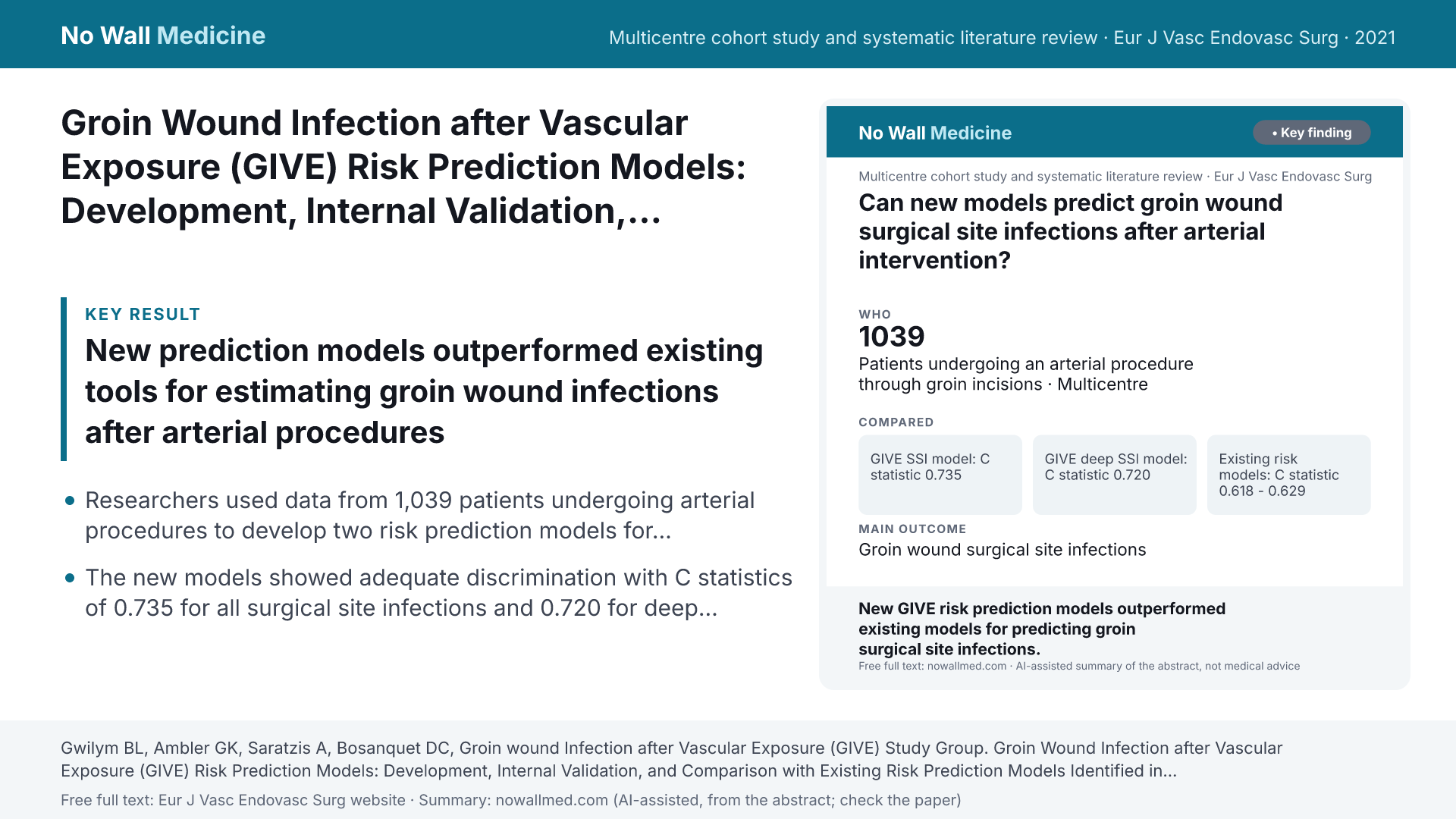
New prediction models outperformed existing tools for estimating groin wound infections after arterial procedures
Groin Wound Infection after Vascular Exposure (GIVE) Risk Prediction Models: Development, Internal Validation, and Comparison with Existing Risk Prediction Models Identified in a Systematic Literature Review
Multicentre cohort study and systematic literature reviewKey finding
Can new models predict groin wound surgical site infections after arterial intervention?
Who
1039
Patients undergoing an arterial procedure through groin incisions · Multicentre
Compared
GIVE SSI model: C statistic 0.735
GIVE deep SSI model: C statistic 0.720
Existing risk models: C statistic 0.618 - 0.629
Main outcome
Groin wound surgical site infections
Bottom line: New GIVE risk prediction models outperformed existing models for predicting groin surgical site infections.
Eur J Vasc Endovasc Surg · 2021-07-08Download image
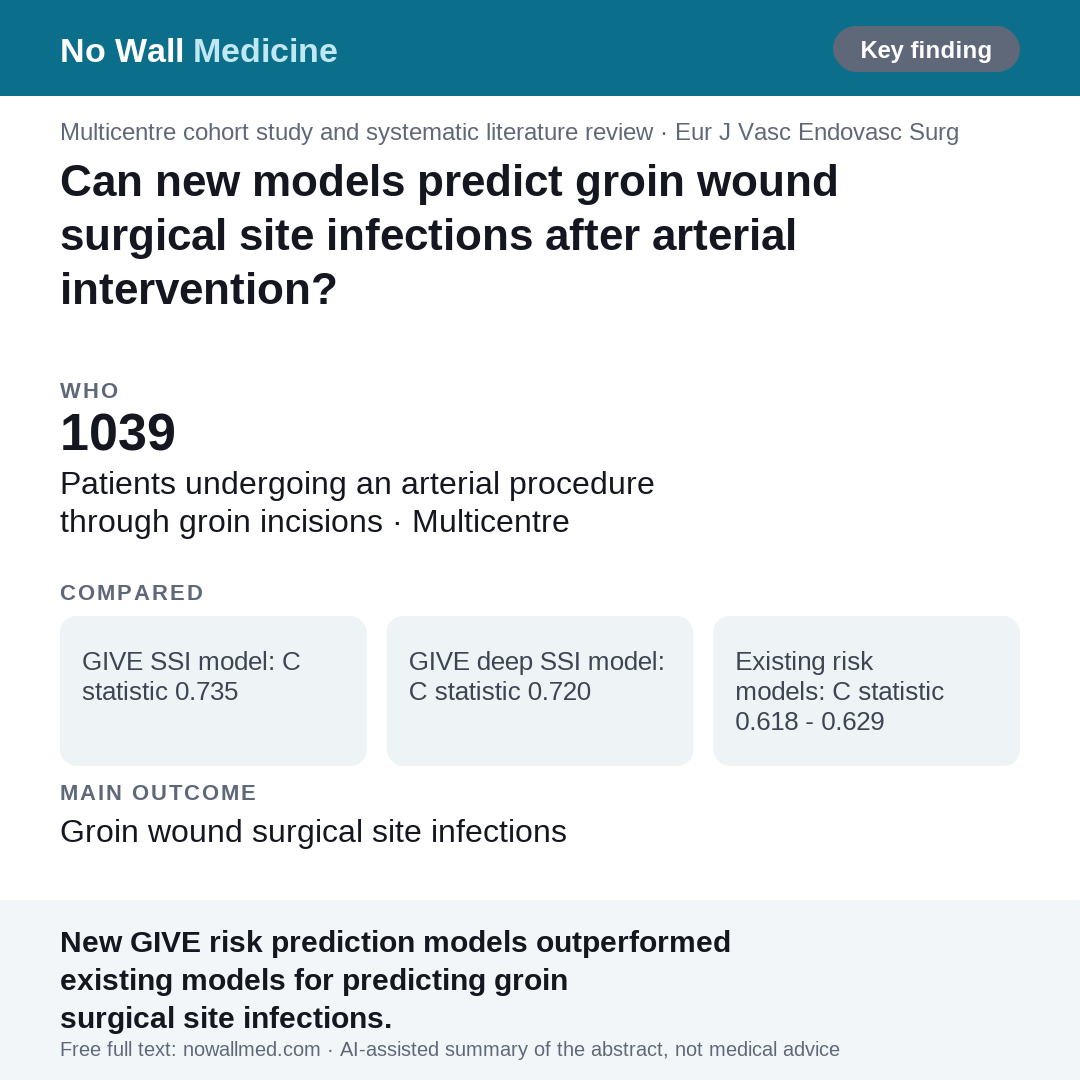
Clinical question: Can new models predict groin wound surgical site infections after arterial intervention?
Key points
- Researchers used data from 1,039 patients undergoing arterial procedures to develop two risk prediction models for surgical site infections, which are infections occurring at the site of surgery.
- The new models showed adequate discrimination with C statistics of 0.735 for all surgical site infections and 0.720 for deep or organ space infections.
- The GIVE models outperformed three existing risk prediction models that had C statistics ranging from 0.618 to 0.629.
Headline and key points written with AI from the paper’s abstract, with every number checked against it. Read the paper before relying on them.
Was this summary helpful?
Subject terms
Headline, design, result, key points, caveat and citation as plain text.
Cite this article
Gwilym BL, Ambler GK, Saratzis A, Bosanquet DC, Groin wound Infection after Vascular Exposure (GIVE) Study Group. Groin Wound Infection after Vascular Exposure (GIVE) Risk Prediction Models: Development, Internal Validation, and Comparison with Existing Risk Prediction Models Identified in a Systematic Literature Review. Eur J Vasc Endovasc Surg. 2021. doi:10.1016/j.ejvs.2021.05.009
Spotted a mistake? Suggest a correction