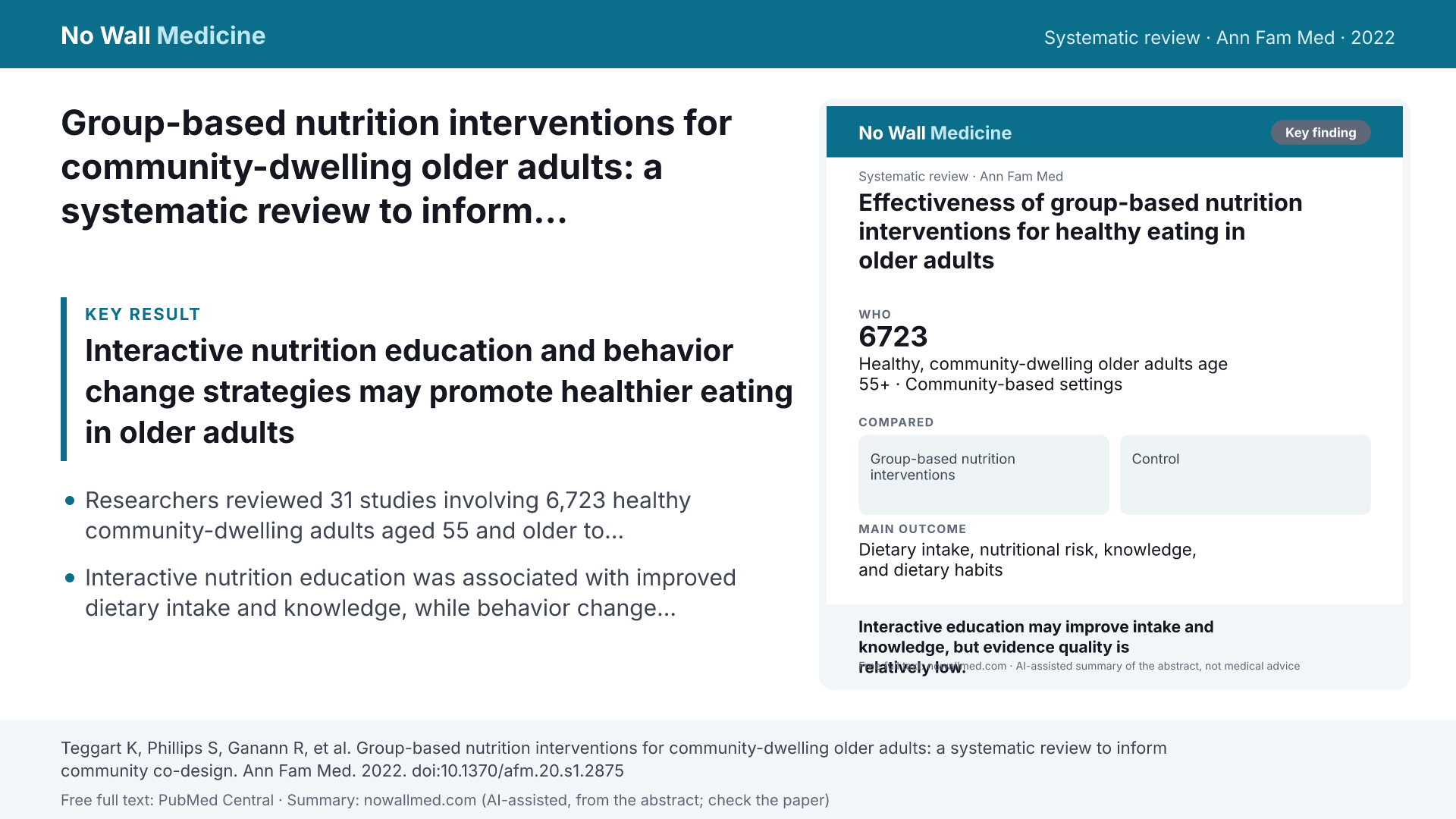
Group-based nutrition interventions for community-dwelling older adults: a systematic review to inform community co-design
Key result: Interactive nutrition education and behavior change strategies may promote healthier eating in older adults
Systematic reviewKey finding
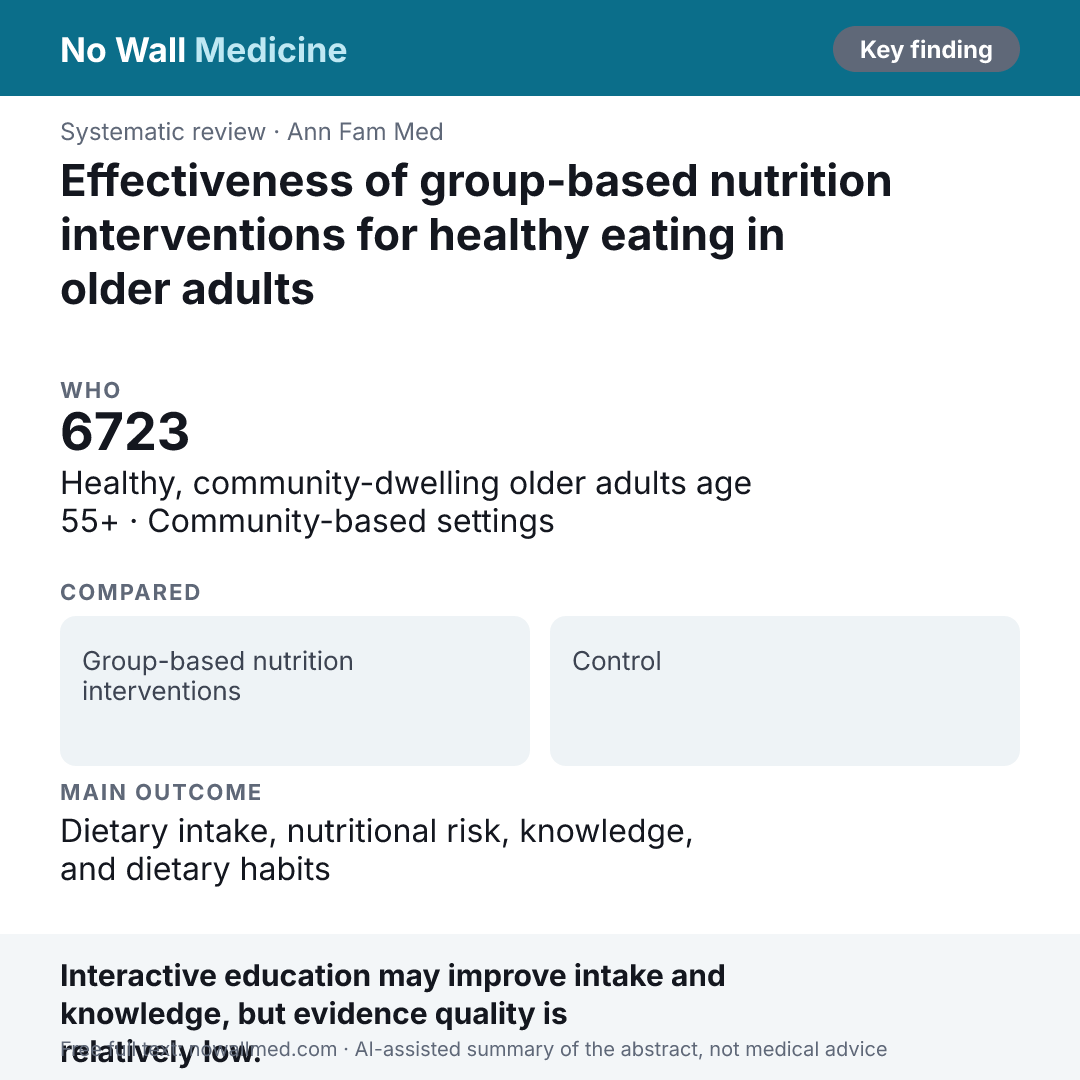
Effectiveness of group-based nutrition interventions for healthy eating in older adults
Who
6723
Healthy, community-dwelling older adults age 55+ · Community-based settings
Compared
Group-based nutrition interventions
Control
Main outcome
Dietary intake, nutritional risk, knowledge, and dietary habits
Bottom line: Interactive education may improve intake and knowledge, but evidence quality is relatively low.
Limitation: Studies had generally unclear or high risk of bias
Ann Fam Med · 2022-04-01 · Save PNG
Key points
- Researchers reviewed 31 studies involving 6,723 healthy community-dwelling adults aged 55 and older to evaluate group-based nutrition programs.
- Interactive nutrition education was associated with improved dietary intake and knowledge, while behavior change strategies were associated with a greater reduction in nutritional risk.
- The included studies generally had an unclear or high risk of bias.
Limitation the authors note: The available evidence was relatively low quality and studies had generally unclear or high risk of bias.
Discussion prompts
- Would these patients look like yours? Who was left out?
- Is the main outcome one that matters to patients?
- Is the difference large enough to change what you do?
Cite: Teggart K, Phillips S, Ganann R, et al. Group-based nutrition interventions for community-dwelling older adults: a systematic review to inform community co-design. Ann Fam Med. 2022. doi:10.1370/afm.20.s1.2875
Free full text: PubMed Central · Summary and visual abstract: nowallmed.com/a/group-based-nutrition-interventions-for-community-dwelling-older-hokmn6/ (AI-assisted from the abstract; check the paper before relying on it).