Growth differentiation factor-15 for prediction of bleeding in cancer patients
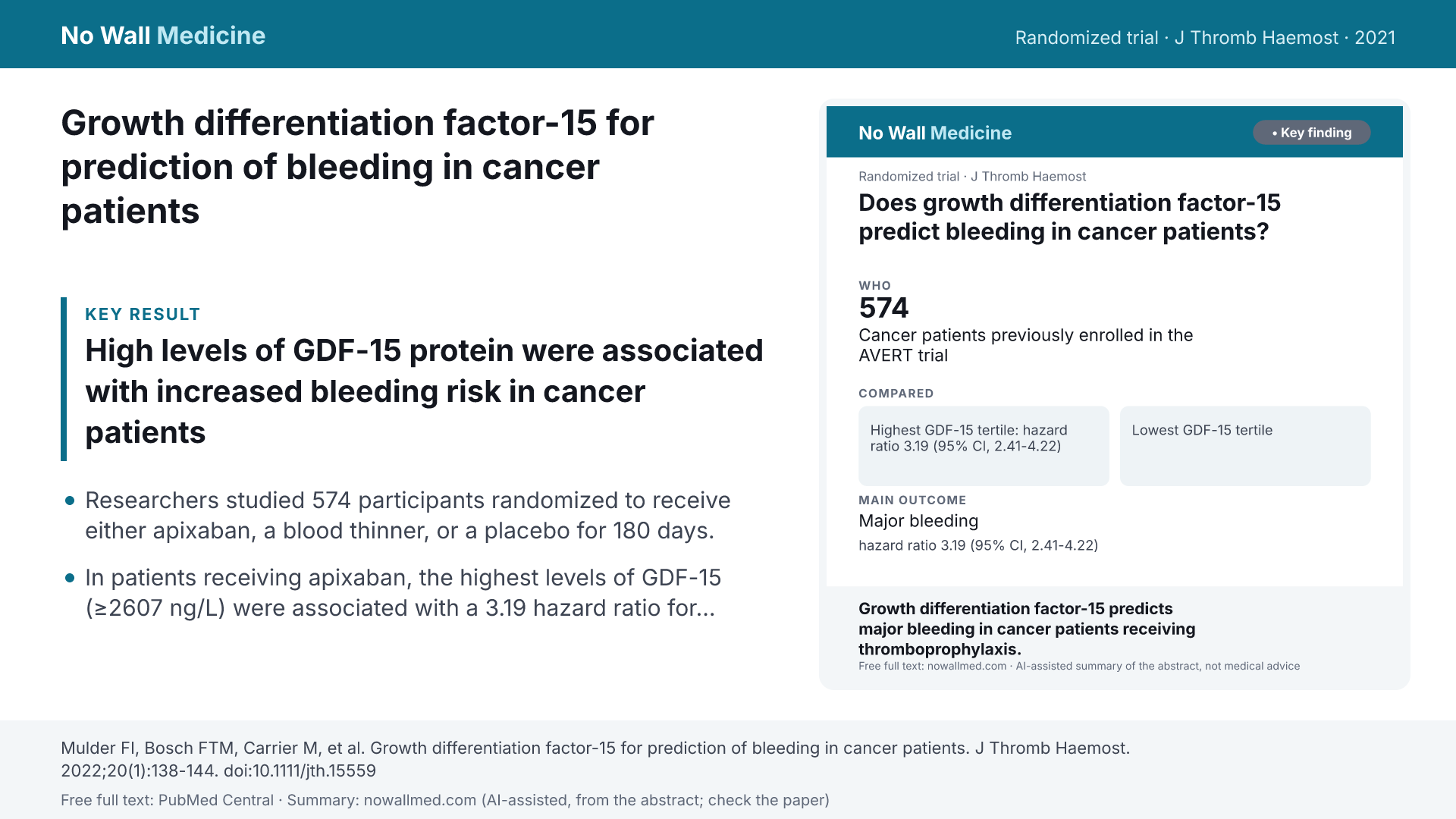
Key result: High levels of GDF-15 protein were associated with increased bleeding risk in cancer patients
Randomized trialKey finding
Does growth differentiation factor-15 predict bleeding in cancer patients?
Who
574
Cancer patients previously enrolled in the AVERT trial
Compared
Highest GDF-15 tertile: hazard ratio 3.19 (95% CI, 2.41-4.22)
Lowest GDF-15 tertile
Main outcome
Major bleeding
Result: hazard ratio 3.19 (95% CI, 2.41-4.22)
Bottom line: Growth differentiation factor-15 predicts major bleeding in cancer patients receiving thromboprophylaxis.
J Thromb Haemost · 2021-11-02
Key points
- Researchers studied 574 participants randomized to receive either apixaban, a blood thinner, or a placebo for 180 days.
- In patients receiving apixaban, the highest levels of GDF-15 (≥2607 ng/L) were associated with a 3.19 hazard ratio for major bleeding compared to the lowest levels.
- Higher GDF-15 levels were also associated with clinically relevant nonmajor bleeding and any bleeding events.
Discussion prompts
- Would these patients look like yours? Who was left out?
- Is the main outcome one that matters to patients?
- Is the difference large enough to change what you do?
Cite: Mulder FI, Bosch FTM, Carrier M, et al. Growth differentiation factor-15 for prediction of bleeding in cancer patients. J Thromb Haemost. 2022;20(1):138-144. doi:10.1111/jth.15559
Free full text: PubMed Central · Summary and visual abstract: nowallmed.com/a/growth-differentiation-factor-15-for-prediction-of-bleeding-in-cancer-eo0g3u/ (AI-assisted from the abstract; check the paper before relying on it).