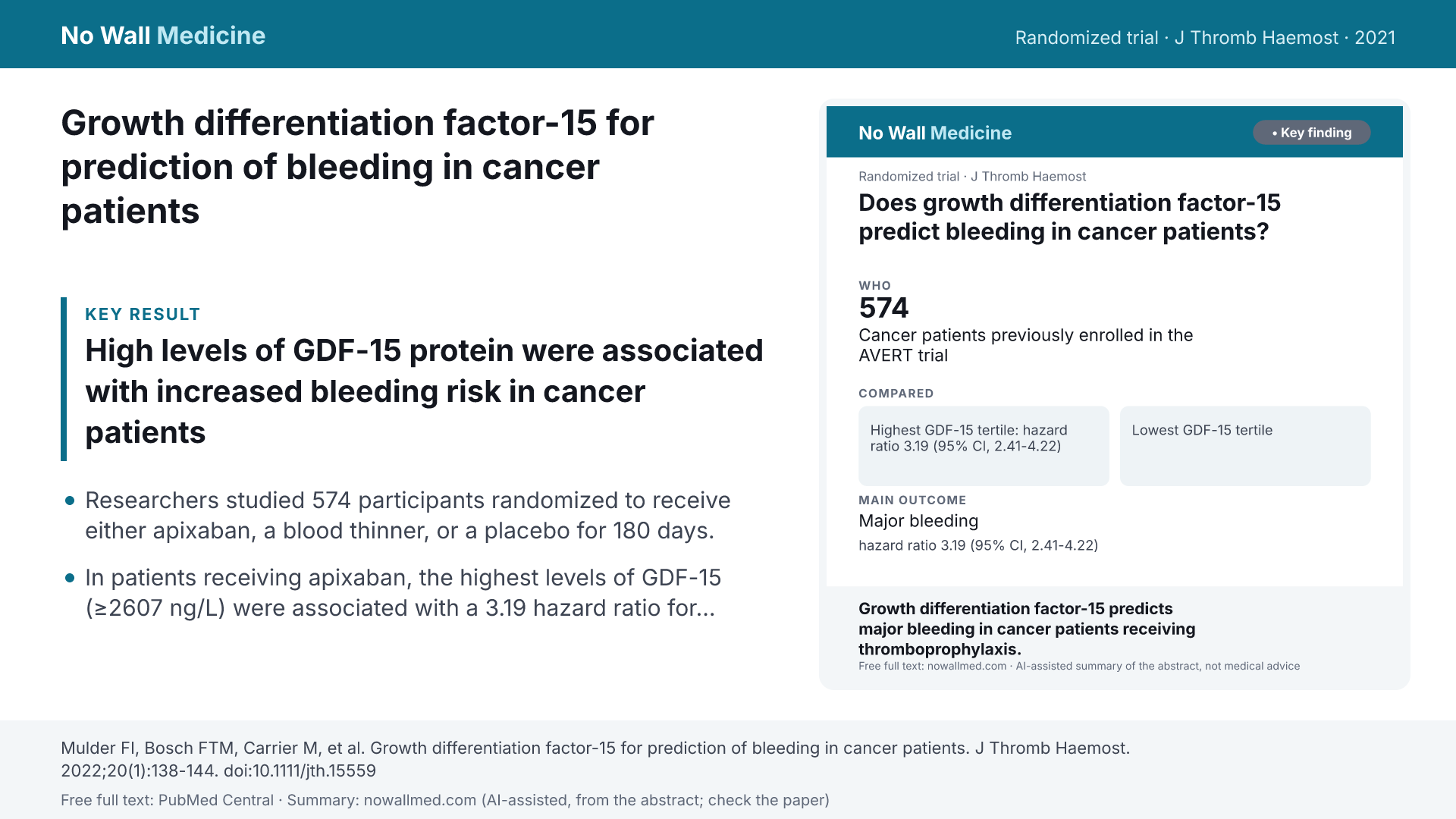
High levels of GDF-15 protein were associated with increased bleeding risk in cancer patients
Growth differentiation factor-15 for prediction of bleeding in cancer patients
Randomized trialKey finding
Does growth differentiation factor-15 predict bleeding in cancer patients?
Who
574
Cancer patients previously enrolled in the AVERT trial
Compared
Highest GDF-15 tertile: hazard ratio 3.19 (95% CI, 2.41-4.22)
Lowest GDF-15 tertile
Main outcome
Major bleeding
Result: hazard ratio 3.19 (95% CI, 2.41-4.22)
Bottom line: Growth differentiation factor-15 predicts major bleeding in cancer patients receiving thromboprophylaxis.
J Thromb Haemost · 2021-11-02Download image
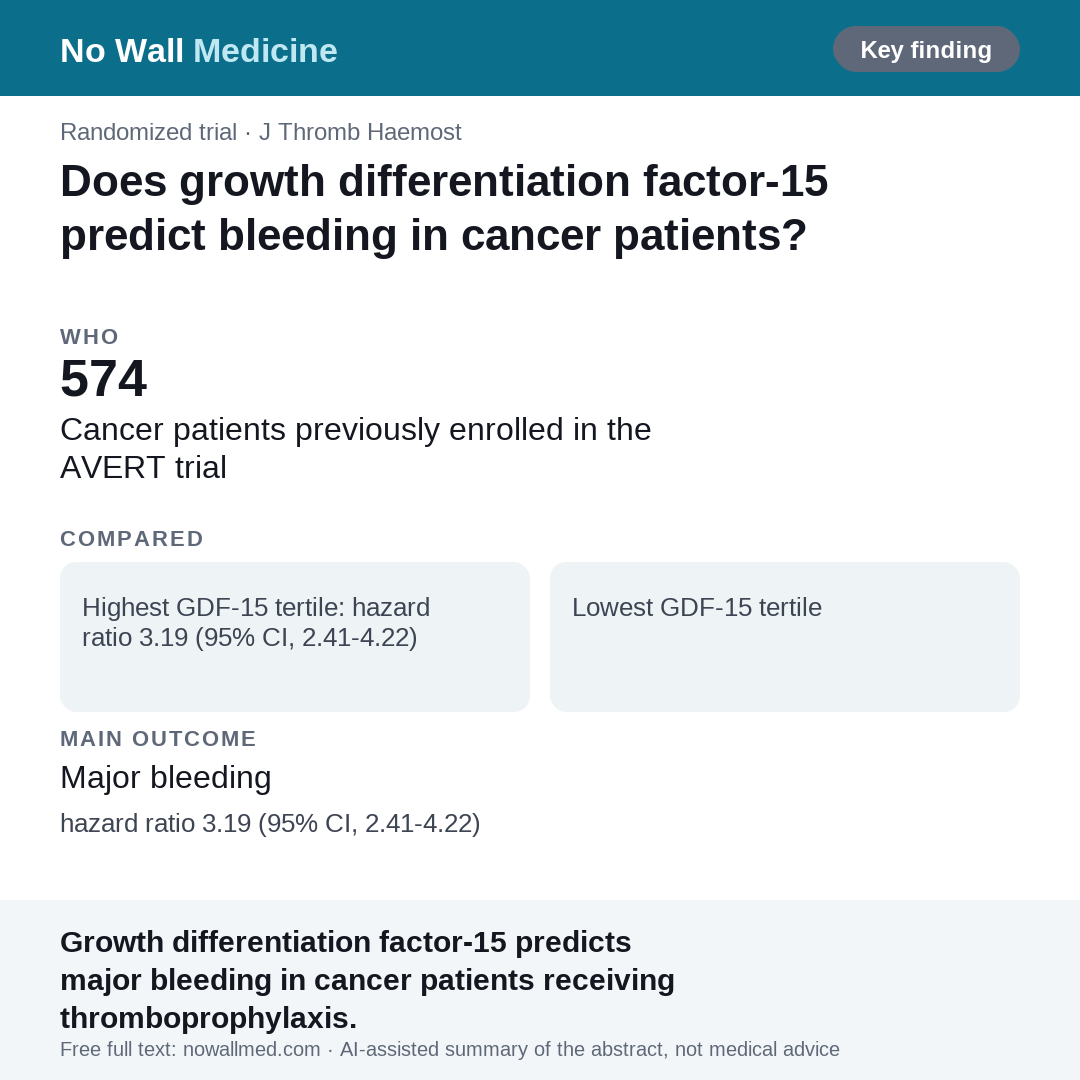
Clinical question: Does growth differentiation factor-15 predict bleeding in cancer patients?
Key points
- Researchers studied 574 participants randomized to receive either apixaban, a blood thinner, or a placebo for 180 days.
- In patients receiving apixaban, the highest levels of GDF-15 (≥2607 ng/L) were associated with a 3.19 hazard ratio for major bleeding compared to the lowest levels.
- Higher GDF-15 levels were also associated with clinically relevant nonmajor bleeding and any bleeding events.
Headline and key points written with AI from the paper’s abstract, with every number checked against it. Read the paper before relying on them.
Was this summary helpful?
Subject terms
Headline, design, result, key points, caveat and citation as plain text.
Cite this article
Mulder FI, Bosch FTM, Carrier M, et al. Growth differentiation factor-15 for prediction of bleeding in cancer patients. J Thromb Haemost. 2021. doi:10.1111/jth.15559
Spotted a mistake? Suggest a correction