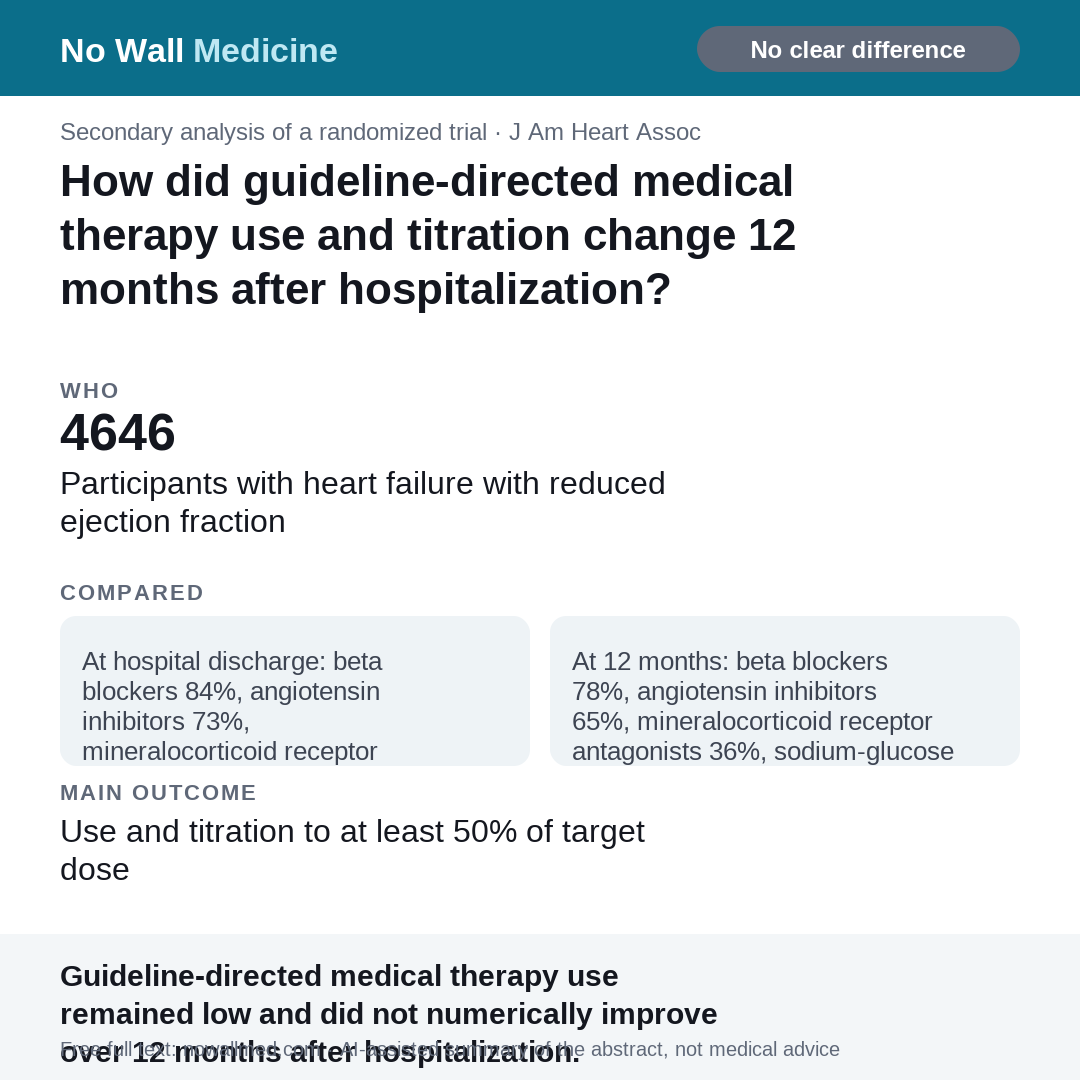
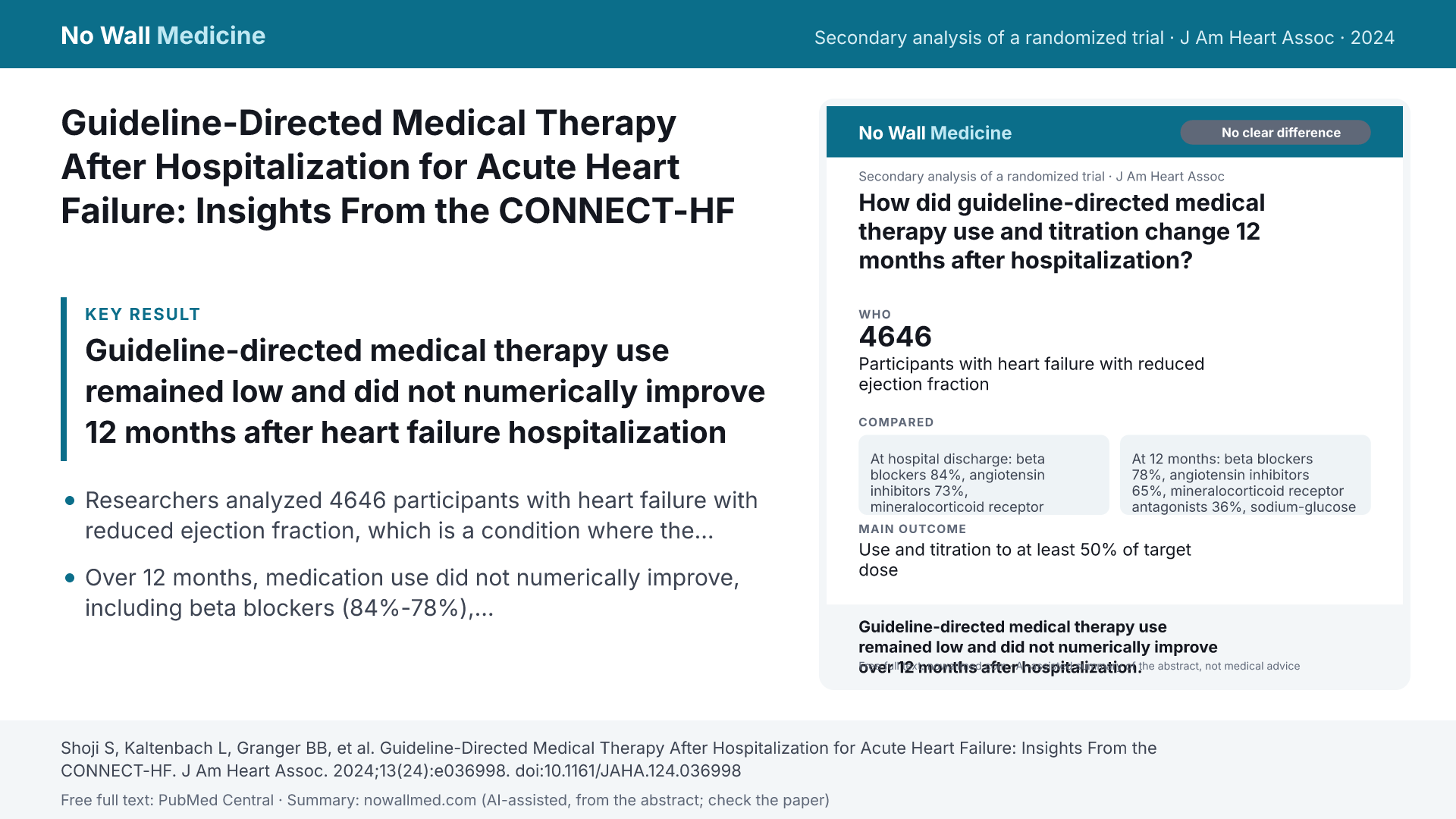
Guideline-directed medical therapy use remained low and did not numerically improve 12 months after heart failure hospitalization
Guideline-Directed Medical Therapy After Hospitalization for Acute Heart Failure: Insights From the CONNECT-HF
Secondary analysis of a randomized trialNo clear difference
How did guideline-directed medical therapy use and titration change 12 months after hospitalization?
Who
4646
Participants with heart failure with reduced ejection fraction
Compared
At hospital discharge: beta blockers 84%, angiotensin inhibitors 73%, mineralocorticoid receptor antagonists 39%, sodium-glucose cotransporter 2 inhibitors 1.5%
At 12 months: beta blockers 78%, angiotensin inhibitors 65%, mineralocorticoid receptor antagonists 36%, sodium-glucose cotransporter 2 inhibitors 2.1%
Main outcome
Use and titration to at least 50% of target dose
Bottom line: Guideline-directed medical therapy use remained low and did not numerically improve over 12 months after hospitalization.
J Am Heart Assoc · 2024-12-10Download image
Clinical question: How did guideline-directed medical therapy use and titration change 12 months after hospitalization?
Why it matters: There is a significant gap in how guideline-directed medical therapy is implemented in patients following a hospitalization for heart failure.
Key points
- Researchers analyzed 4646 participants with heart failure with reduced ejection fraction, which is a condition where the heart muscle cannot pump blood effectively.
- Over 12 months, medication use did not numerically improve, including beta blockers (84%-78%), angiotensin-converting enzyme inhibitors/angiotensin II receptor blockers/angiotensin receptor-neprilysin inhibitors (73%-65%), and mineralocorticoid receptor antagonists (39%-36%).
- Achieving at least 50% of the target dose also showed little change, such as beta blockers (35%-32%) and angiotensin-converting enzyme inhibitors/angiotensin II receptor blockers/angiotensin receptor-neprilysin inhibitors (28%-25%).
Headline and key points written with AI from the paper’s abstract, with every number checked against it. Read the paper before relying on them.
Was this summary helpful?
Subject terms
Cite this article
Shoji S, Kaltenbach L, Granger BB, et al. Guideline-Directed Medical Therapy After Hospitalization for Acute Heart Failure: Insights From the CONNECT-HF. J Am Heart Assoc. 2024. doi:10.1161/JAHA.124.036998
Spotted a mistake? Suggest a correction