Guideline-Directed Medical Therapy After Hospitalization for Acute Heart Failure: Insights From the CONNECT-HF
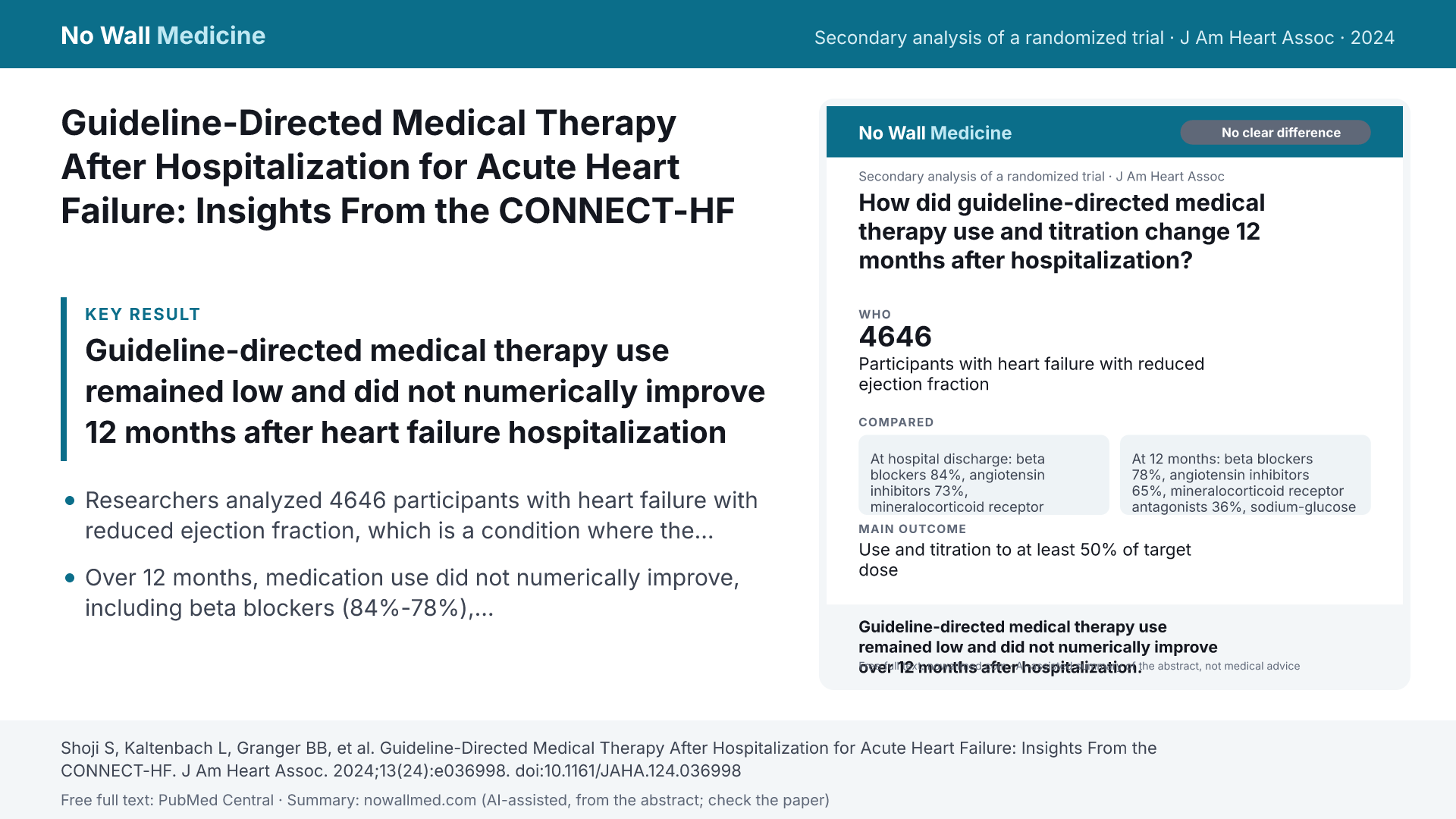
Key result: Guideline-directed medical therapy use remained low and did not numerically improve 12 months after heart failure hospitalization
Secondary analysis of a randomized trialNo clear difference
How did guideline-directed medical therapy use and titration change 12 months after hospitalization?
Who
4646
Participants with heart failure with reduced ejection fraction
Compared
At hospital discharge: beta blockers 84%, angiotensin inhibitors 73%, mineralocorticoid receptor antagonists 39%, sodium-glucose cotransporter 2 inhibitors 1.5%
At 12 months: beta blockers 78%, angiotensin inhibitors 65%, mineralocorticoid receptor antagonists 36%, sodium-glucose cotransporter 2 inhibitors 2.1%
Main outcome
Use and titration to at least 50% of target dose
Bottom line: Guideline-directed medical therapy use remained low and did not numerically improve over 12 months after hospitalization.
J Am Heart Assoc · 2024-12-10
Key points
- Researchers analyzed 4646 participants with heart failure with reduced ejection fraction, which is a condition where the heart muscle cannot pump blood effectively.
- Over 12 months, medication use did not numerically improve, including beta blockers (84%-78%), angiotensin-converting enzyme inhibitors/angiotensin II receptor blockers/angiotensin receptor-neprilysin inhibitors (73%-65%), and mineralocorticoid receptor antagonists (39%-36%).
- Achieving at least 50% of the target dose also showed little change, such as beta blockers (35%-32%) and angiotensin-converting enzyme inhibitors/angiotensin II receptor blockers/angiotensin receptor-neprilysin inhibitors (28%-25%).
Why it matters: There is a significant gap in how guideline-directed medical therapy is implemented in patients following a hospitalization for heart failure.
Discussion prompts
- Would these patients look like yours? Who was left out?
- Is the main outcome one that matters to patients?
- Is the difference large enough to change what you do?
Cite: Shoji S, Kaltenbach L, Granger BB, et al. Guideline-Directed Medical Therapy After Hospitalization for Acute Heart Failure: Insights From the CONNECT-HF. J Am Heart Assoc. 2024;13(24):e036998. doi:10.1161/JAHA.124.036998
Free full text: PubMed Central · Summary and visual abstract: nowallmed.com/a/guideline-directed-medical-therapy-after-hospitalization-for-acute-1texzd2/ (AI-assisted from the abstract; check the paper before relying on it).