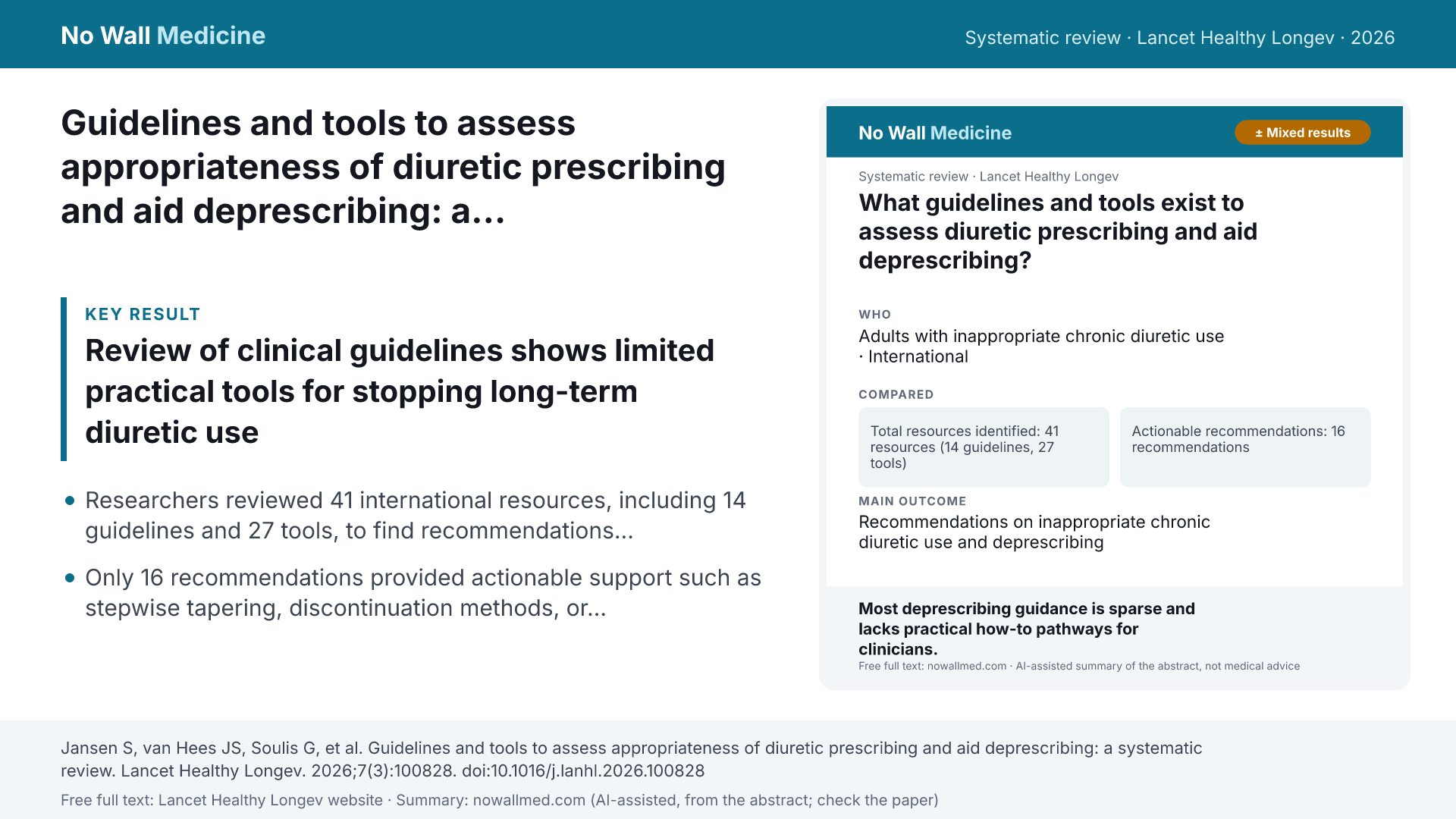
Guidelines and tools to assess appropriateness of diuretic prescribing and aid deprescribing: a systematic review
Key result: Review of clinical guidelines shows limited practical tools for stopping long-term diuretic use
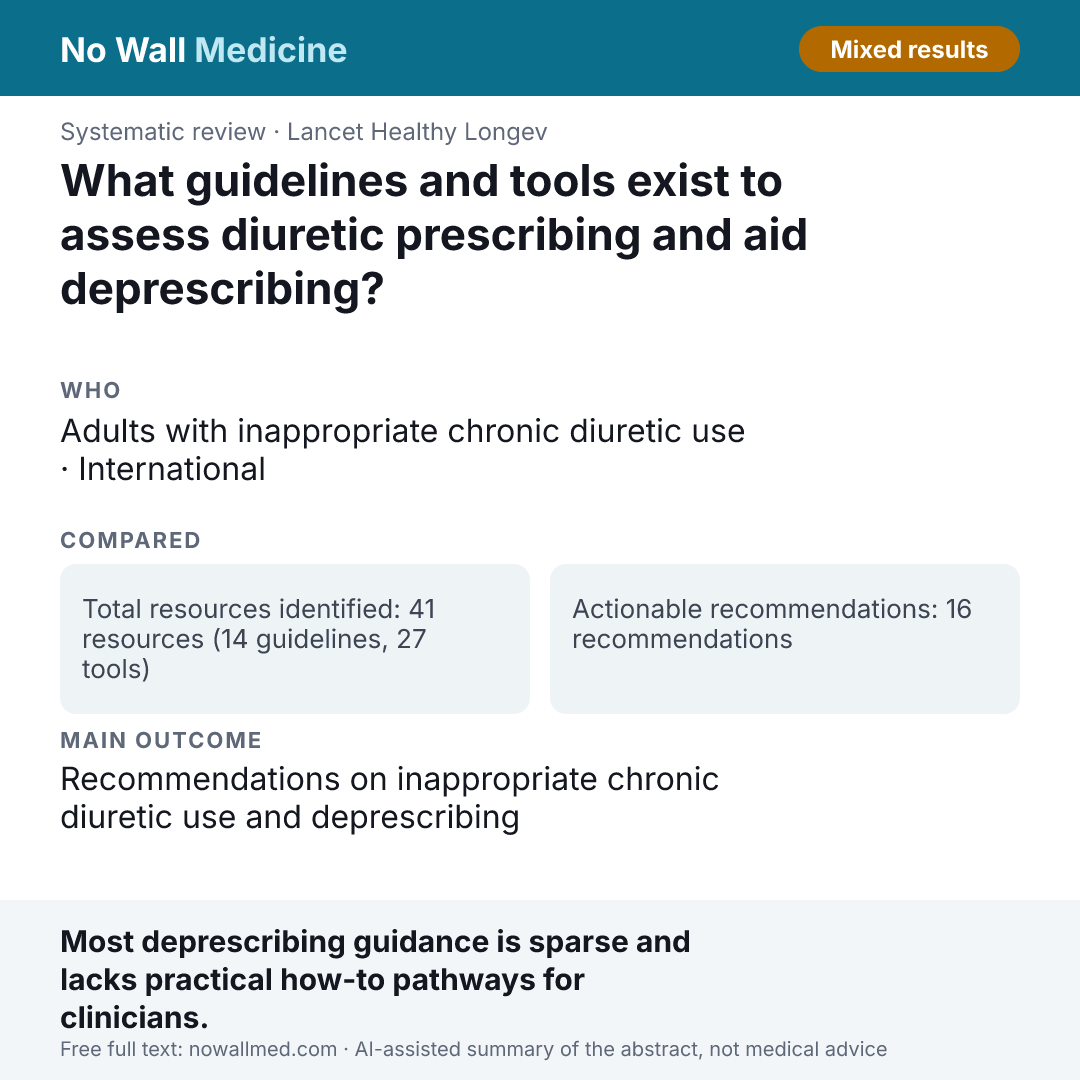
Systematic reviewMixed results
What guidelines and tools exist to assess diuretic prescribing and aid deprescribing?
Who
Adults with inappropriate chronic diuretic use · International
Compared
Total resources identified: 41 resources (14 guidelines, 27 tools)
Actionable recommendations: 16 recommendations
Main outcome
Recommendations on inappropriate chronic diuretic use and deprescribing
Bottom line: Most deprescribing guidance is sparse and lacks practical how-to pathways for clinicians.
Lancet Healthy Longev · 2026-03-10 · Save PNG
Key points
- Researchers reviewed 41 international resources, including 14 guidelines and 27 tools, to find recommendations on inappropriate diuretic use and deprescribing.
- Only 16 recommendations provided actionable support such as stepwise tapering, discontinuation methods, or usable algorithms and flowcharts.
- Most guidance was sparse and functioned as prompts to consider stopping medication rather than providing practical how-to pathways.
Why it matters: Long-term diuretic use without clear indication can increase adverse events like kidney dysfunction, electrolyte disturbances, and falls in older adults.
Discussion prompts
- Would these patients look like yours? Who was left out?
- Is the main outcome one that matters to patients?
- Is the difference large enough to change what you do?
Cite: Jansen S, van Hees JS, Soulis G, et al. Guidelines and tools to assess appropriateness of diuretic prescribing and aid deprescribing: a systematic review. Lancet Healthy Longev. 2026;7(3):100828. doi:10.1016/j.lanhl.2026.100828
Free full text: Lancet Healthy Longev website · Summary and visual abstract: nowallmed.com/a/guidelines-and-tools-to-assess-appropriateness-of-diuretic-1d9dre5/ (AI-assisted from the abstract; check the paper before relying on it).