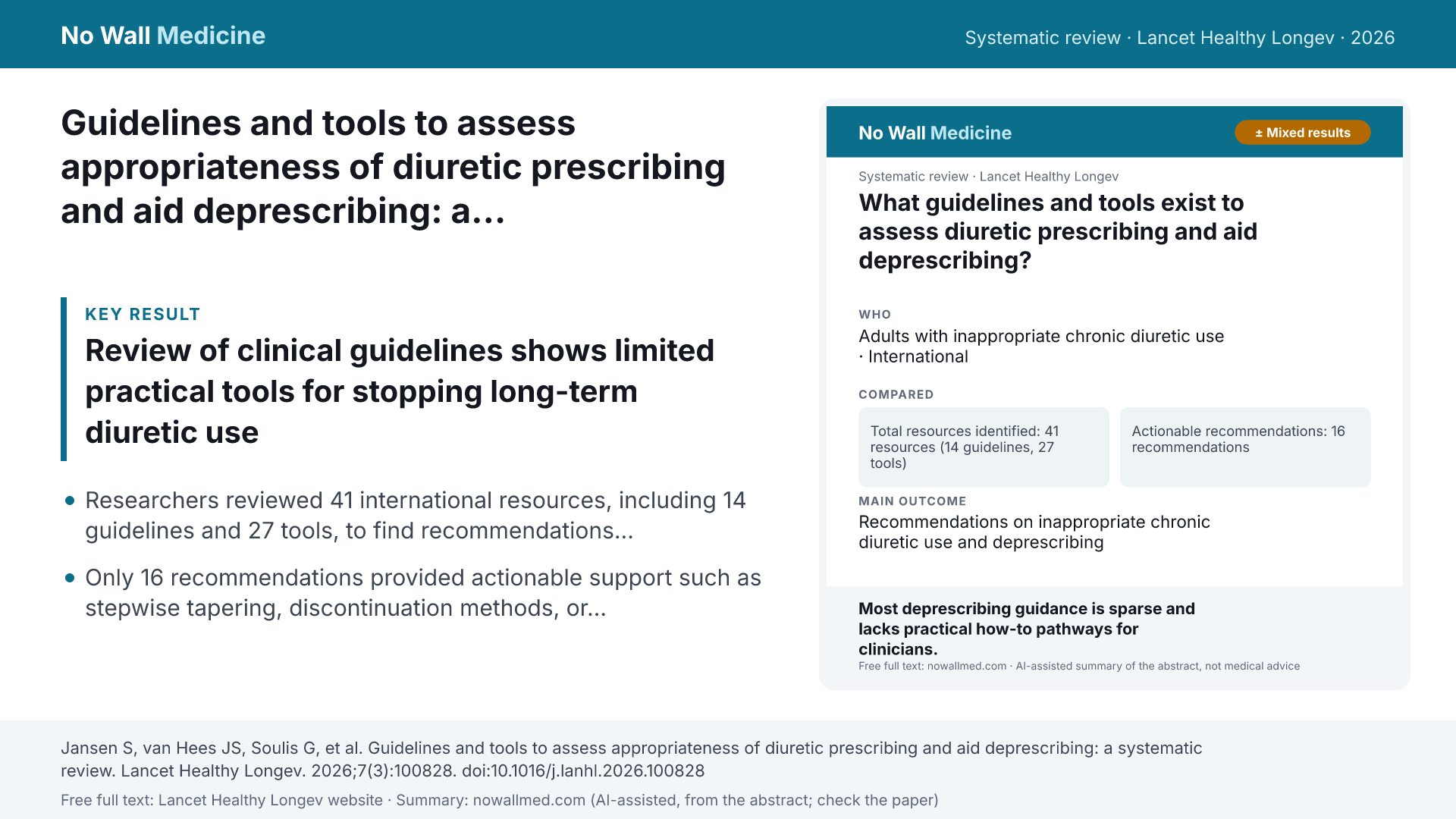
Review of clinical guidelines shows limited practical tools for stopping long-term diuretic use
Guidelines and tools to assess appropriateness of diuretic prescribing and aid deprescribing: a systematic review
Systematic reviewMixed results
What guidelines and tools exist to assess diuretic prescribing and aid deprescribing?
Who
Adults with inappropriate chronic diuretic use · International
Compared
Total resources identified: 41 resources (14 guidelines, 27 tools)
Actionable recommendations: 16 recommendations
Main outcome
Recommendations on inappropriate chronic diuretic use and deprescribing
Bottom line: Most deprescribing guidance is sparse and lacks practical how-to pathways for clinicians.
Lancet Healthy Longev · 2026-03-10Download image
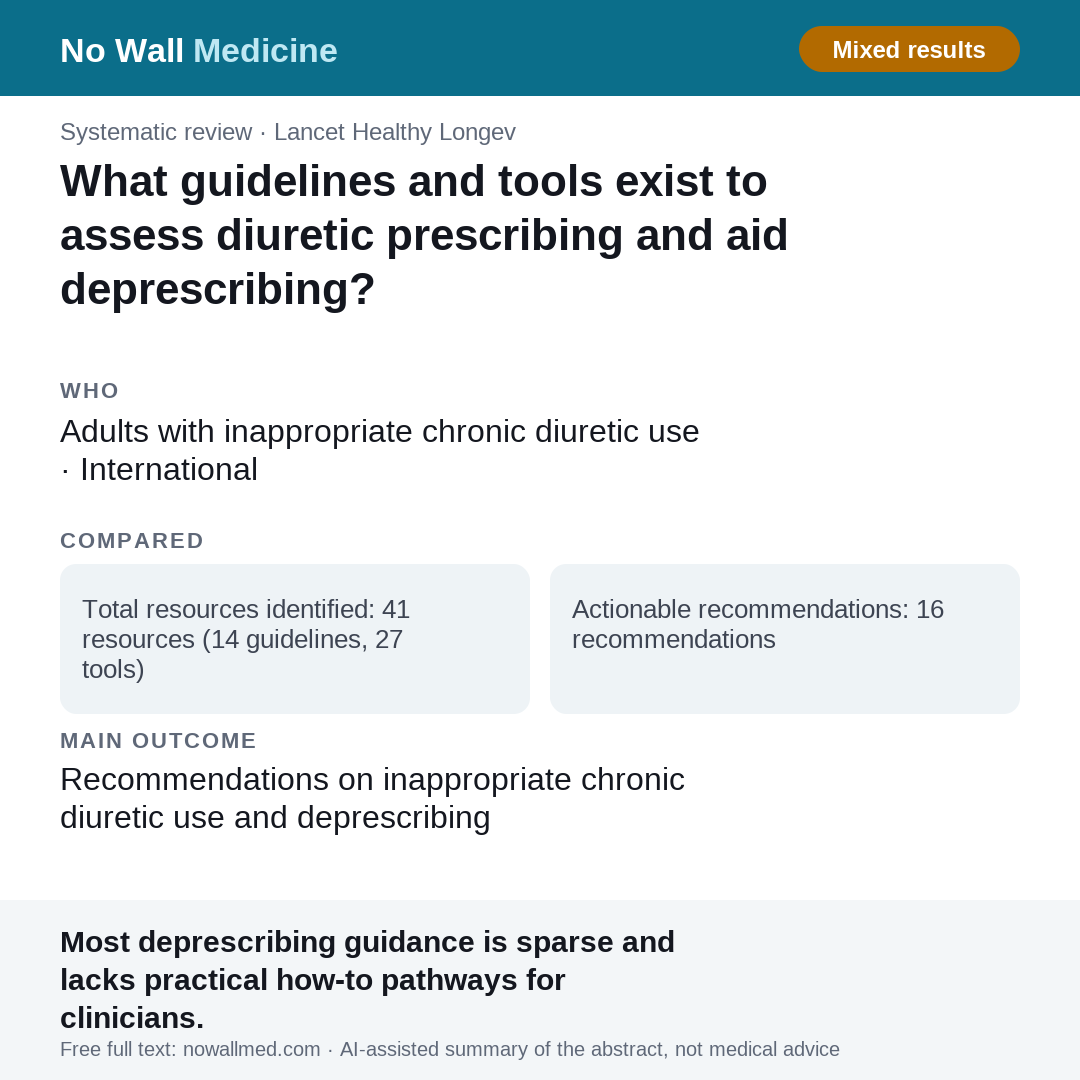
Clinical question: What guidelines and tools exist to assess diuretic prescribing and aid deprescribing?
Why it matters: Long-term diuretic use without clear indication can increase adverse events like kidney dysfunction, electrolyte disturbances, and falls in older adults.
Key points
- Researchers reviewed 41 international resources, including 14 guidelines and 27 tools, to find recommendations on inappropriate diuretic use and deprescribing.
- Only 16 recommendations provided actionable support such as stepwise tapering, discontinuation methods, or usable algorithms and flowcharts.
- Most guidance was sparse and functioned as prompts to consider stopping medication rather than providing practical how-to pathways.
Headline and key points written with AI from the paper’s abstract, with every number checked against it. Read the paper before relying on them.
Was this summary helpful?
Subject terms
Cite this article
Jansen S, van Hees JS, Soulis G, et al. Guidelines and tools to assess appropriateness of diuretic prescribing and aid deprescribing: a systematic review. Lancet Healthy Longev. 2026. doi:10.1016/j.lanhl.2026.100828
Spotted a mistake? Suggest a correction