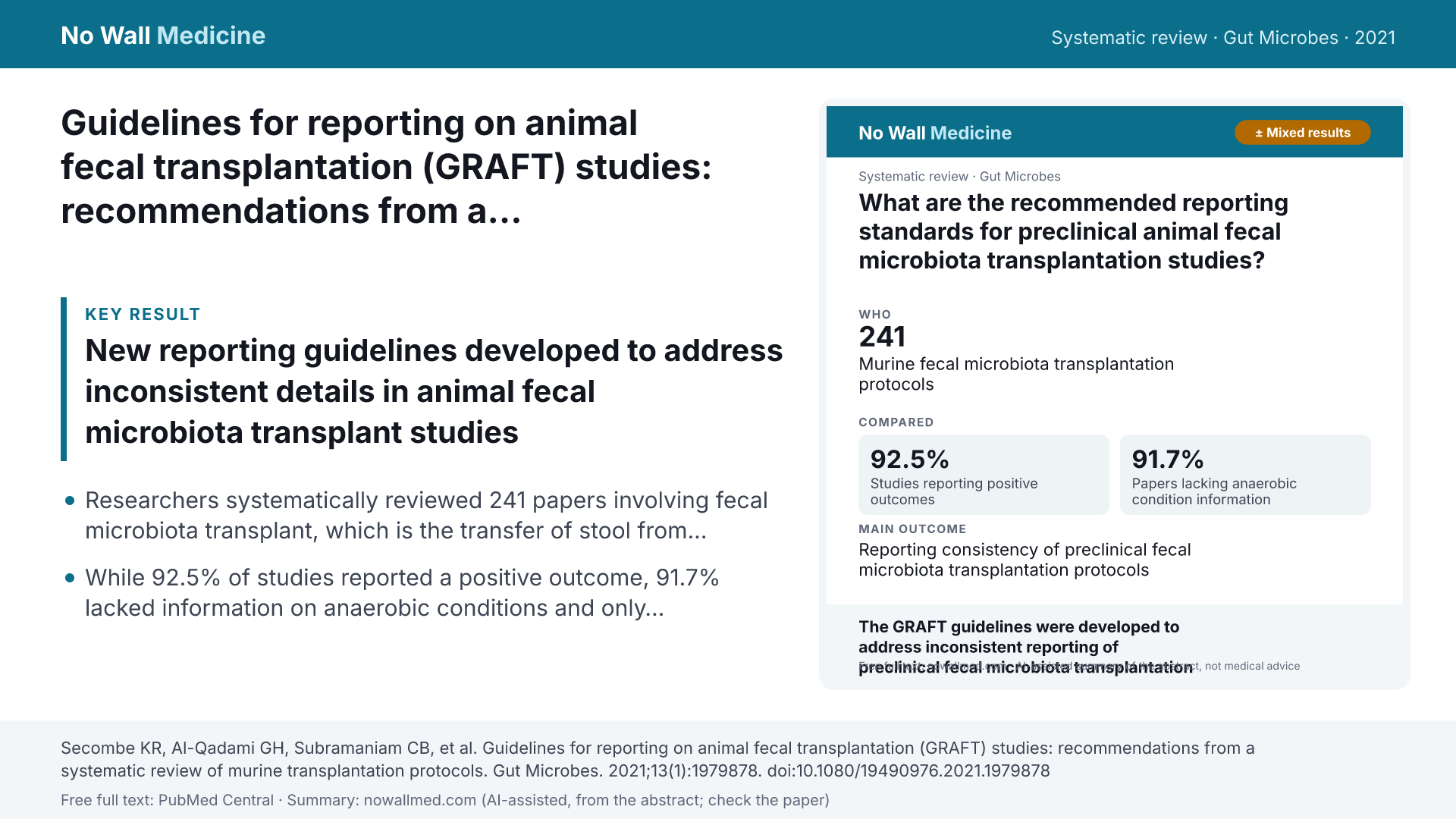
New reporting guidelines developed to address inconsistent details in animal fecal microbiota transplant studies
Guidelines for reporting on animal fecal transplantation (GRAFT) studies: recommendations from a systematic review of murine transplantation protocols
Systematic reviewMixed results
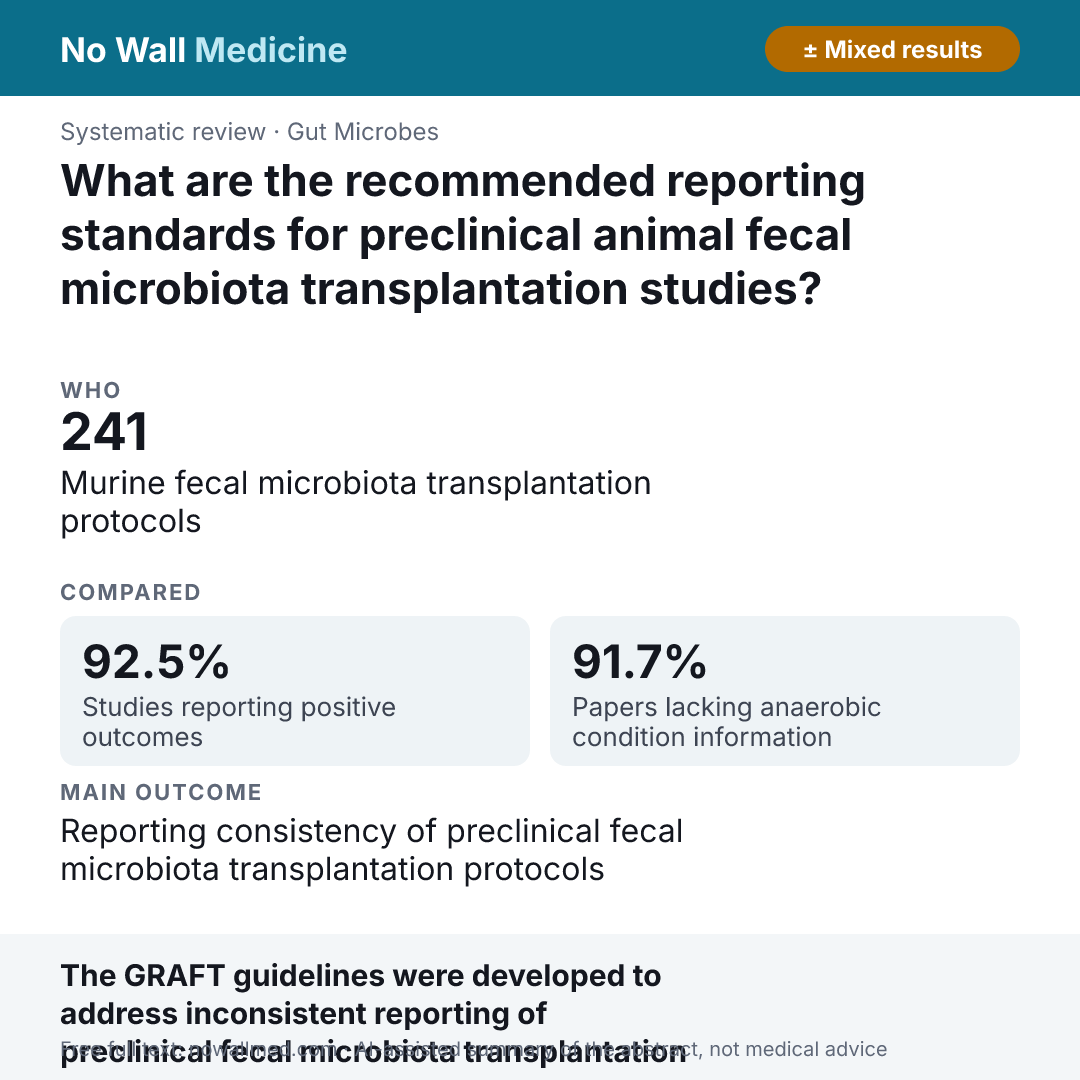
What are the recommended reporting standards for preclinical animal fecal microbiota transplantation studies?
Who
241
Murine fecal microbiota transplantation protocols
Compared
92.5%Studies reporting positive outcomes
91.7%Papers lacking anaerobic condition information
Main outcome
Reporting consistency of preclinical fecal microbiota transplantation protocols
Bottom line: The GRAFT guidelines were developed to address inconsistent reporting of preclinical fecal microbiota transplantation protocols.
Limitation: The vast majority of studies failed to address core methodological aspects.
Gut Microbes · 2021-09-29 · Save PNG
Clinical question: What are the recommended reporting standards for preclinical animal fecal microbiota transplantation studies?
Why it matters: Preclinical fecal microbiota transplant protocols are highly inconsistent or incomplete, which makes it difficult to replicate studies and ensures science is reproducible.
Key points
- Researchers systematically reviewed 241 papers involving fecal microbiota transplant, which is the transfer of stool from a donor to a recipient, in mouse models.
- While 92.5% of studies reported a positive outcome, 91.7% lacked information on anaerobic conditions and only 5.3% reported the administration route.
- The study resulted in the Guidelines for Reporting Animal Fecal Transplant to standardize how preclinical research is documented.
Headline and key points written with AI from the paper’s abstract, with every number checked against it. Read the paper before relying on them.
Was this summary helpful?
Subject terms
Headline, design, result, key points, caveat and citation as plain text.
Cite this article
Secombe KR, Al-Qadami GH, Subramaniam CB, et al. Guidelines for reporting on animal fecal transplantation (GRAFT) studies: recommendations from a systematic review of murine transplantation protocols. Gut Microbes. 2021;13(1):1979878. doi:10.1080/19490976.2021.1979878
Spotted a mistake? Suggest a correction