Healthy donor stool transplants significantly alter gut bacteriophage communities in people with metabolic syndrome
Gut bacteriophage dynamics during fecal microbial transplantation in subjects with metabolic syndrome
Longitudinal pilot studyBenefit found
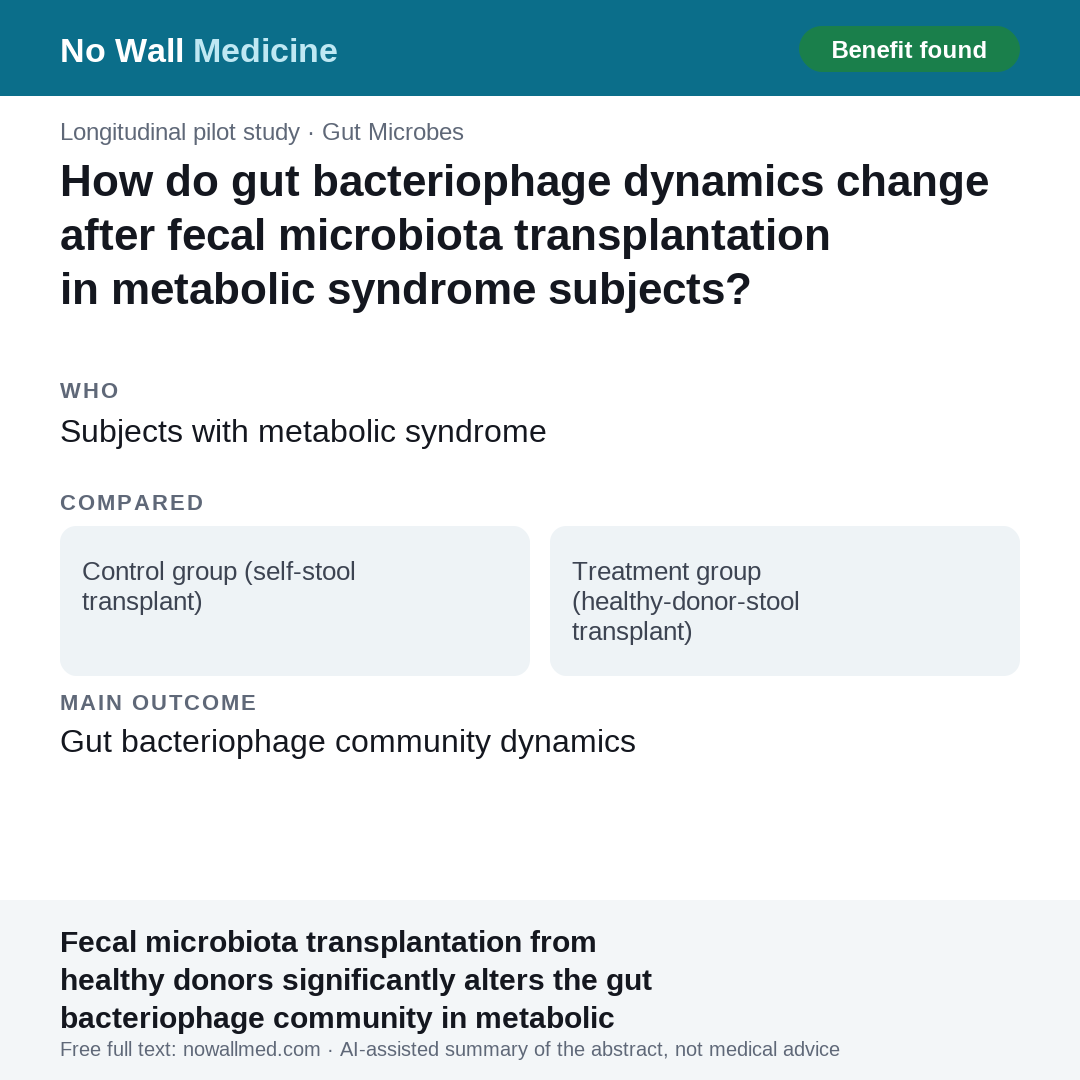
How do gut bacteriophage dynamics change after fecal microbiota transplantation in metabolic syndrome subjects?
Who
Subjects with metabolic syndrome
Compared
Control group (self-stool transplant)
Treatment group (healthy-donor-stool transplant)
Main outcome
Gut bacteriophage community dynamics
Bottom line: Fecal microbiota transplantation from healthy donors significantly alters the gut bacteriophage community in metabolic syndrome subjects.
Limitation: This was a pilot study with a small number of subjects.
Gut Microbes · 2021-04-02Download image
Clinical question: How do gut bacteriophage dynamics change after fecal microbiota transplantation in metabolic syndrome subjects?
Why it matters: The success rate of fecal microbiota transplantation for metabolic syndrome is intermediate and difficult to predict.
Key points
- Researchers studied 6 recipients and 5 donors in a pilot study comparing healthy donor stool transplants to self-stool transplants over 18 weeks.
- Fecal microbiota transplantation, or stool transplant, was found to significantly alter the gut bacteriophage community, which are viruses that infect bacteria.
- Subjects with better clinical outcomes had bacteriophage communities that were more similar to the healthy donor group.
Headline and key points written with AI from the paper’s abstract, with every number checked against it. Read the paper before relying on them.
Was this summary helpful?
Subject terms
Cite this article
Manrique P, Zhu Y, van der Oost J, Herrema H, Nieuwdorp M, de Vos WM. Gut bacteriophage dynamics during fecal microbial transplantation in subjects with metabolic syndrome. Gut Microbes. 2021. doi:10.1080/19490976.2021.1897217
Spotted a mistake? Suggest a correction
Top studies every Monday
The week’s key trials and guidelines in your specialties, plus any topics you follow. By email, free.
Get the weekly digest