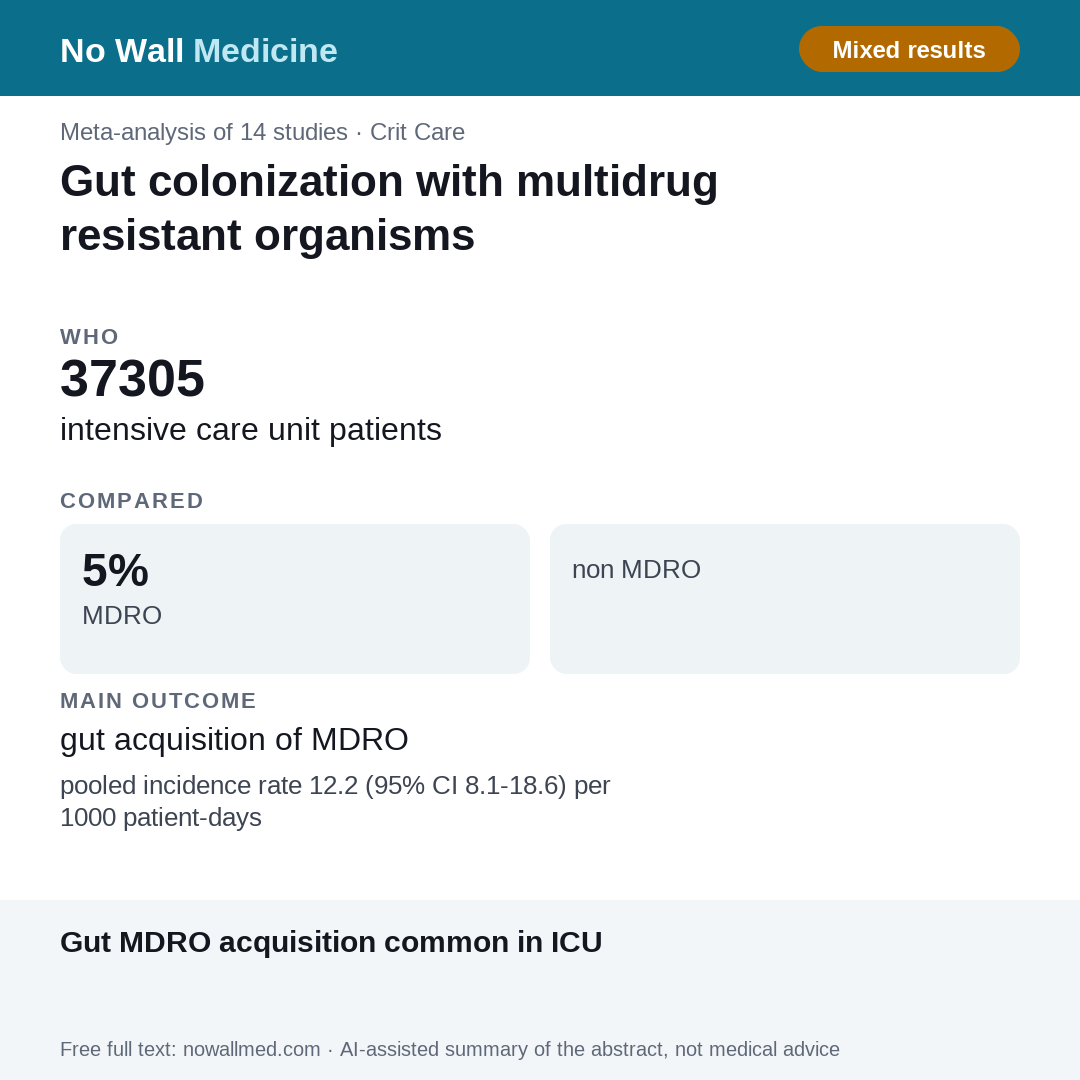
Multidrug resistant organisms were acquired by 5% of intensive care unit patients during hospitalization
Gut colonization with multidrug resistant organisms in the intensive care unit: a systematic review and meta-analysis
Meta-analysis of 14 studiesMixed results
Gut colonization with multidrug resistant organisms
Who
37305
intensive care unit patients
Compared
5%MDRO
non MDRO
Main outcome
gut acquisition of MDRO
Result: pooled incidence rate 12.2 (95% CI 8.1-18.6) per 1000 patient-days
Bottom line: Gut MDRO acquisition common in ICU
Crit Care · 2024-06-28Download image
Why it matters: The dynamics of how multidrug resistant organisms colonize the gut in intensive care unit patients are not completely understood.
Key points
- Researchers analyzed 14 observational studies involving 37,305 patients to measure how often multidrug resistant organisms, such as vancomycin-resistant Enterococcus, colonize the gut in intensive care units.
- The pooled incidence of acquiring these organisms was 5% (range: 1-43%), with a rate of 12.2 (95% CI 8.1-18.6) per 1000 patient-days.
- Gut colonization showed a quasi-linear increase of 1.41% per day that remained stable through 30 days of intensive care unit hospitalization.
Headline and key points written with AI from the paper’s abstract, with every number checked against it. Read the paper before relying on them.
Was this summary helpful?
Subject terms
Cite this article
Heath MR, Fan W, Leu CS, Gomez-Simmonds A, Lodise T, Freedberg DE. Gut colonization with multidrug resistant organisms in the intensive care unit: a systematic review and meta-analysis. Crit Care. 2024. doi:10.1186/s13054-024-04999-9
Spotted a mistake? Suggest a correction
Top studies every Monday
The week’s key trials and guidelines in your specialties, plus any topics you follow. By email, free.
Get the weekly digest