Brain monitoring and oxygen measurement may predict two-year outcomes in infants with brain injury
Haemodynamic and neurophysiological assessments for 2-year outcome prediction in neonates with hypoxic-ischaemic encephalopathy treated with therapeutic hypothermia: a systematic review and meta-analysis
Systematic review and meta-analysisBenefit found
How accurate are aEEG, cNIRS, and TnECHO for predicting 2-year outcomes in HIE infants?
Who
2721
Infants at least 35 weeks gestation with hypoxic-ischaemic encephalopathy treated with therapeutic hypothermia
Compared
Abnormal amplitude-integrated electroencephalography background at 36 hours: AUC 0.88
Absence of sleep-wake cycling: AUC 0.88
Abnormal cerebral near-infrared spectroscopy at 36 hours: AUC 0.86
Acute pulmonary hypertension: AUC 0.40
Main outcome
2-year neurodevelopment and/or death
Bottom line: Abnormal amplitude-integrated electroencephalography background at 36 hours provides reliable bedside prognostic information for 2-year outcomes.
Limitation: Right ventricular dysfunction showed substantial heterogeneity.
BMJ Paediatr Open · 2026-10-03Download image
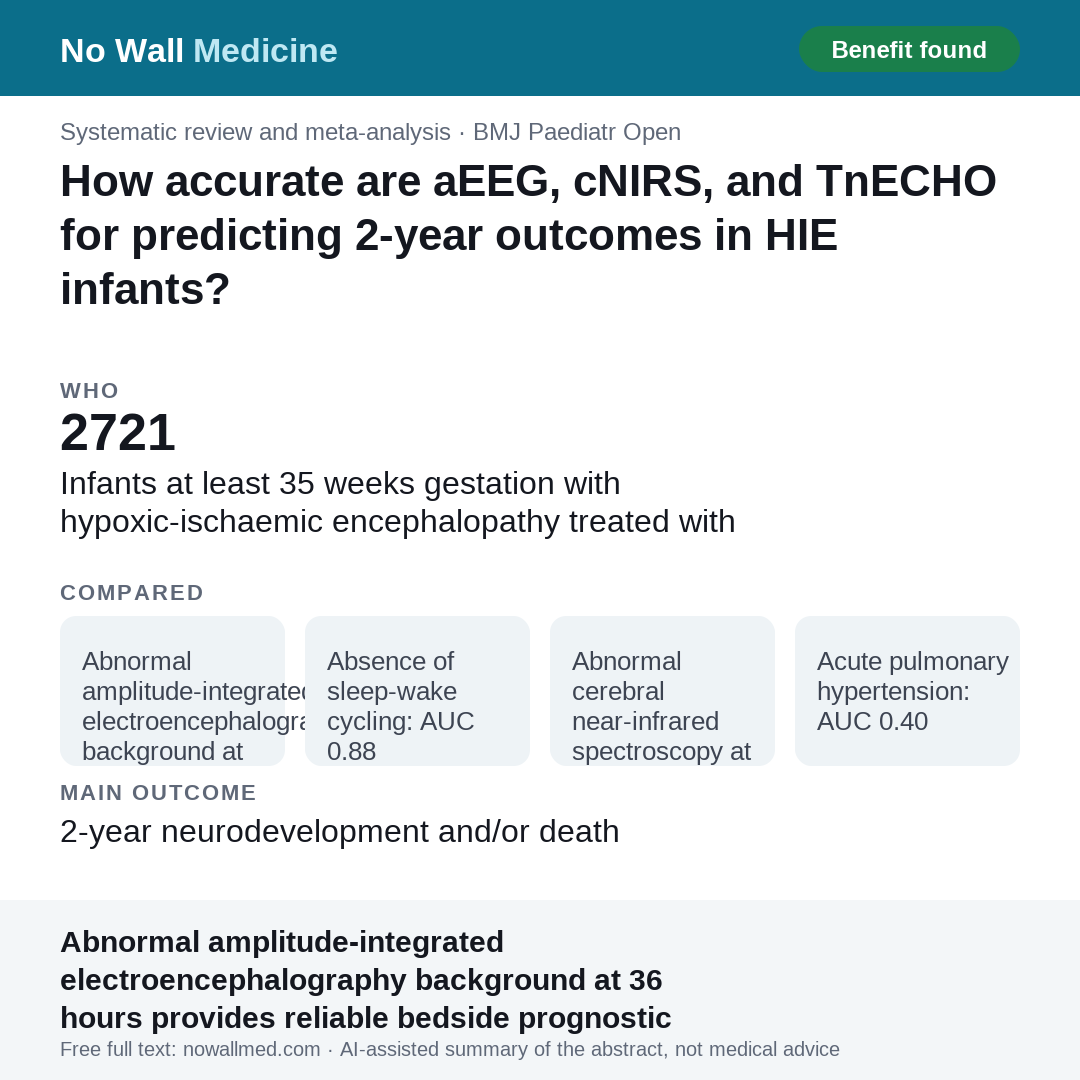
Clinical question: How accurate are aEEG, cNIRS, and TnECHO for predicting 2-year outcomes in HIE infants?
Why it matters: Clinicians need accurate ways to predict long-term neurodevelopmental outcomes and death in infants treated with therapeutic hypothermia for brain injury.
Key points
- Researchers analyzed 37 studies involving 2,721 infants with hypoxic-ischaemic encephalopathy treated with therapeutic hypothermia to evaluate various monitoring tools.
- Abnormal amplitude-integrated electroencephalography, a type of brain wave monitoring, at 36 hours predicted adverse outcomes with an area under the curve of 0.88.
- Cerebral near-infrared spectroscopy, which measures brain oxygenation, showed potential prognostic value with an area under the curve of 0.86 at 36 hours.
Headline and key points written with AI from the paper’s abstract, with every number checked against it. Read the paper before relying on them.
Abstract
Objective
To evaluate the prognostic accuracy of amplitude-integrated electroencephalography (aEEG), cerebral near-infrared spectroscopy (cNIRS) and targeted neonatal echocardiography (TnECHO) for predicting 2-year outcomes (neurodevelopment and/or death) in infants with hypoxic-ischaemic encephalopathy (HIE) treated with therapeutic hypothermia (TH). Design
Systematic review and meta-analysis. Data sources
MEDLINE, Embase, CINAHL and the Cochrane Library (2002-16 April 2025). PROSPERO registration: CRD42023387592. Eligibility criteria
Prognostic studies including infants ≥35 weeks' gestation with HIE treated with whole-body TH and reporting neurodevelopmental impairment at 18-24 months and/or death. Data extraction and synthesis
Data were extracted independently. Risk of bias was assessed using Quality in Prognosis Studies. Pooled sensitivity, specificity, diagnostic ORs (DORs) and area under the curve (AUC) estimates were calculated using random-effects models. Results
37 studies (n=2721) were included; 24 (n=1989) contributed to meta-analysis. Abnormal aEEG background at 36 hours predicted adverse 2-year outcomes with sensitivity 0.83 (95% CI 0.70 to 0.92), specificity 0.88 (95% CI 0.79 to 0.93), DOR 33.06 (95% CI 12.87 to 84.94), AUC (0.88). Absence of sleep-wake cycling had high specificity 0.93 (95% CI 0.88 to 0.96), DOR 30.19 (95% CI 14.47 to 63.01) and AUC 0.88. Abnormal cNIRS demonstrated potential prognostic value at 36-48 hours with specificity 0.97 (95% CI 0.13-1.00), DOR 26.74 (95% CI 4.55 to 157.14) and AUC (0.86) at 36 hours. Acute pulmonary hypertension showed low overall discrimination, DOR 2.17 (95% CI 1.35 to 3.47) and (AUC 0.40). Right ventricular dysfunction showed higher specificity but substantial heterogeneity. Conclusions
Abnormal aEEG background at 36 hours provides reliable bedside prognostic information for 2-year outcomes in HIE. cNIRS may offer complementary value, whereas there is limited evidence supporting the utility of TnECHO alone. Multimodal methods may improve early prognostication.
Abstract reproduced under the article’s CC BY NC licence.
Topics
Cite this article
Noureldein M, So V, Hayawi LM, Saker A, Renesme L, Tsampalieros A. Haemodynamic and neurophysiological assessments for 2-year outcome prediction in neonates with hypoxic-ischaemic encephalopathy treated with therapeutic hypothermia: a systematic review and meta-analysis. BMJ Paediatr Open. 2026. doi:10.1136/bmjpo-2026-004810
Spotted a mistake? Suggest a correction