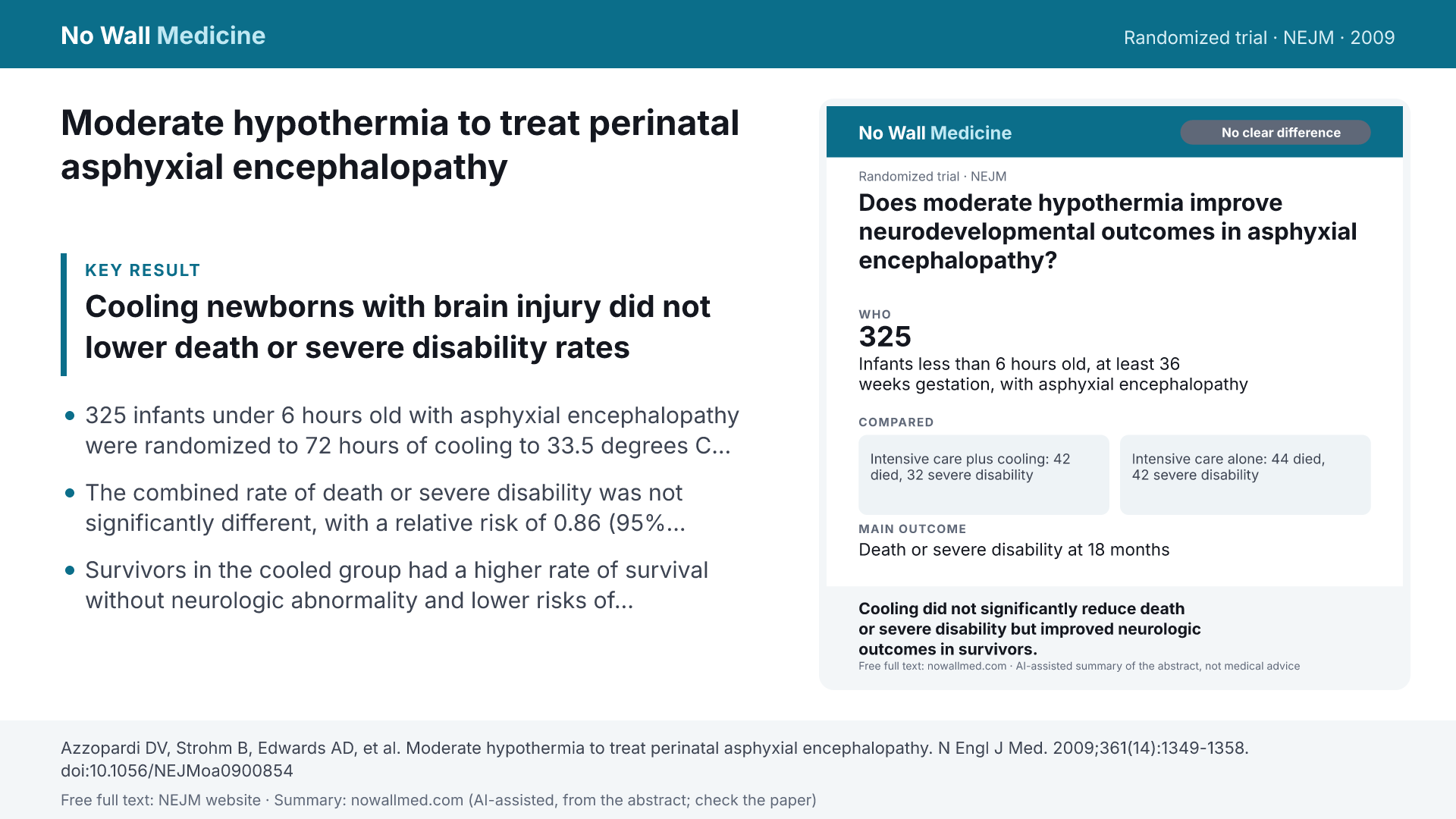
Cooling newborns with brain injury did not lower death or severe disability rates
Moderate hypothermia to treat perinatal asphyxial encephalopathy
Why it matters: Supported therapeutic hypothermia for newborns with perinatal asphyxial encephalopathy.
Related landmark trials: NICHD hypothermia
Context written by the No Wall Medicine team.
Trial at a glance
Bottom line: Hypothermia did not reduce death or severe disability, but improved neurologic outcomes in survivors.
Clinical question
Does hypothermic therapy improve neurodevelopmental outcomes in newborn infants with asphyxial encephalopathy?
Design
Randomized trial
Who was studied
325 infants with perinatal asphyxial encephalopathy, less than 6 hours of age
Key inclusion criteria
- less than 6 hours of age
- gestational age of at least 36 weeks
- perinatal asphyxial encephalopathy
Interventions
- cooled group: intensive care plus cooling to 33.5 degrees C for 72 hours
- noncooled group: intensive care alone
Primary outcome
death or severe disability at 18 months of age. relative risk 0.86, 95% confidence interval 0.68 to 1.07, P=0.17
Secondary outcomes
- cerebral palsy: relative risk 0.67, 95% confidence interval 0.47 to 0.96, P=0.03
- Mental Developmental Index: P=0.03
- Psychomotor Developmental Index: P=0.03
Harms
adverse events were mostly minor and not associated with cooling
Written with AI from the abstract; every number was checked against it. Details such as eligibility criteria may be missing because the abstract does not give them. Read the paper before relying on it.
Key points
- 325 infants under 6 hours old with asphyxial encephalopathy were randomized to 72 hours of cooling to 33.5 degrees C or standard care.
- The combined rate of death or severe disability was not significantly different, with a relative risk of 0.86 (95% CI, 0.68 to 1.07).
- Survivors in the cooled group had a higher rate of survival without neurologic abnormality and lower risks of cerebral palsy.
Headline and key points written with AI from the paper’s abstract, with every number checked against it. Read the paper before relying on them.
Was this summary helpful?
Subject terms
Headline, design, result, key points, caveat and citation as plain text.
Cite this article
Azzopardi DV, Strohm B, Edwards AD, et al. Moderate hypothermia to treat perinatal asphyxial encephalopathy. N Engl J Med. 2009;361(14):1349-1358. doi:10.1056/NEJMoa0900854
Spotted a mistake? Suggest a correction