Blood biomarkers on day 2 of life predicted cerebral palsy and cognitive delay in infants
Blood-Based Biomarkers Predict Cerebral Palsy and Cognitive Delay in Hypoxic-Ischemic Encephalopathy: A Secondary Analysis of the High-Dose Erythropoietin for Asphyxia and Encephalopathy Randomized Controlled Trial
Secondary analysis of a randomized controlled trialBenefit found
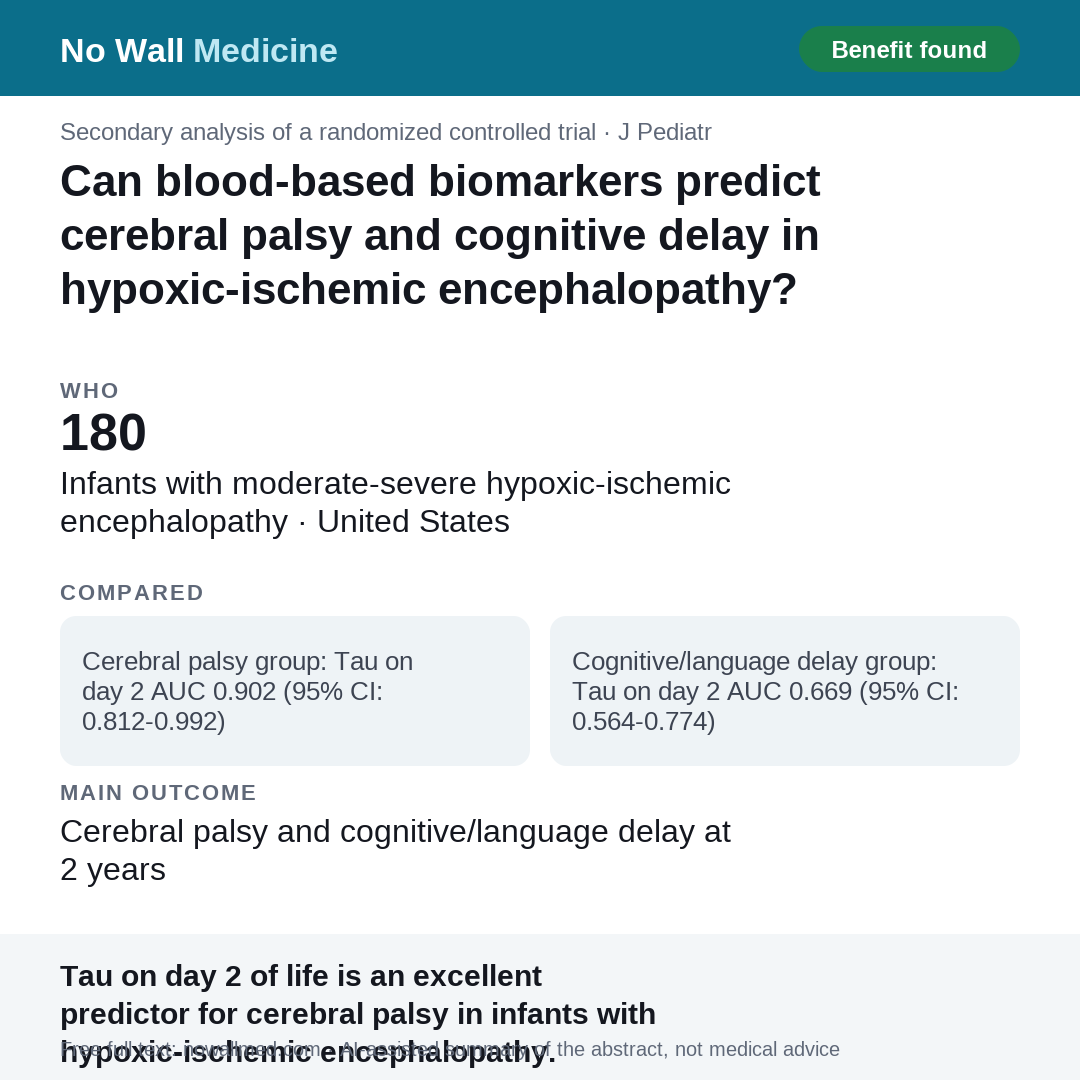
Can blood-based biomarkers predict cerebral palsy and cognitive delay in hypoxic-ischemic encephalopathy?
Who
180
Infants with moderate-severe hypoxic-ischemic encephalopathy · United States
Compared
Cerebral palsy group: Tau on day 2 AUC 0.902 (95% CI: 0.812-0.992)
Cognitive/language delay group: Tau on day 2 AUC 0.669 (95% CI: 0.564-0.774)
Main outcome
Cerebral palsy and cognitive/language delay at 2 years
Bottom line: Tau on day 2 of life is an excellent predictor for cerebral palsy in infants with hypoxic-ischemic encephalopathy.
J Pediatr · 2026-07-01Download image
Clinical question: Can blood-based biomarkers predict cerebral palsy and cognitive delay in hypoxic-ischemic encephalopathy?
Why it matters: Doctors need to know if blood-based biomarkers in the first days of life can specifically predict cerebral palsy and cognitive or language delay in infants with brain injury.
Key points
- Researchers analyzed 180 infants with moderate-to-severe hypoxic-ischemic encephalopathy, a type of brain injury caused by lack of oxygen, to see if blood markers could predict outcomes.
- On day 2 of life, the protein Tau predicted cerebral palsy with a sensitivity of 88% and specificity of 91%, performing similarly to brain imaging scores.
- Tau on day 2 also provided the best prediction for cognitive or language delay, though it had a sensitivity of 40% and specificity of 92%.
Headline and key points written with AI from the paper’s abstract, with every number checked against it. Read the paper before relying on them.
Topics
Cite this article
Clifford D, Vaughan CL, Costelloe SJ, Walsh BH, Numis A, Juul SE. Blood-Based Biomarkers Predict Cerebral Palsy and Cognitive Delay in Hypoxic-Ischemic Encephalopathy: A Secondary Analysis of the High-Dose Erythropoietin for Asphyxia and Encephalopathy Randomized Controlled Trial. J Pediatr. 2026. doi:10.1016/j.jpeds.2026.115216
Spotted a mistake? Suggest a correction