Haloperidol may help treat delirium in intensive care patients but does not prevent it
Haloperidol in treating delirium, reducing mortality, and preventing delirium occurrence: Bayesian and frequentist meta-analyses
Bayesian and frequentist meta-analysis of randomized controlled trialsMixed results
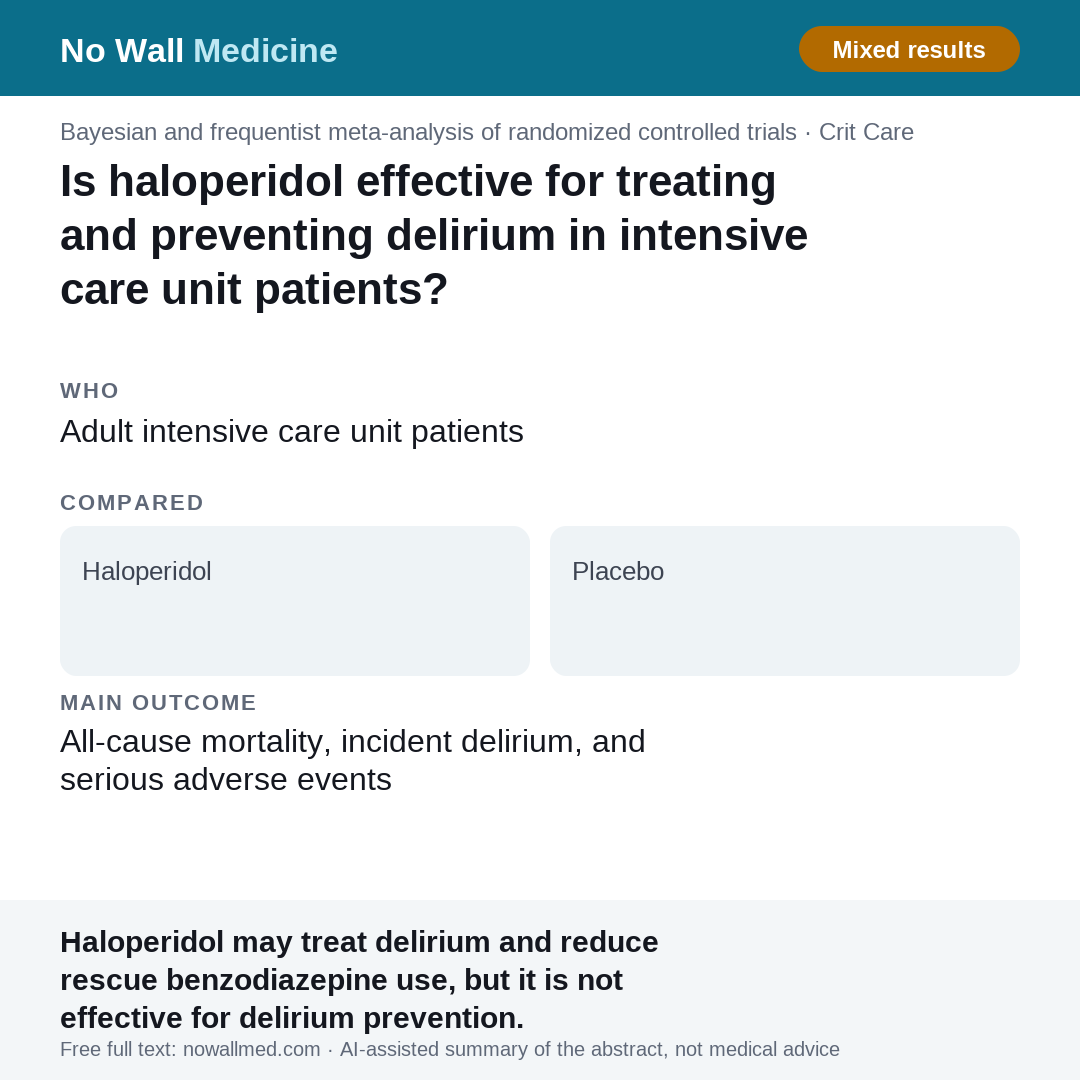
Is haloperidol effective for treating and preventing delirium in intensive care unit patients?
Who
Adult intensive care unit patients
Compared
Haloperidol
Placebo
Main outcome
All-cause mortality, incident delirium, and serious adverse events
Bottom line: Haloperidol may treat delirium and reduce rescue benzodiazepine use, but it is not effective for delirium prevention.
Crit Care · 2025-03-20Download image
Clinical question: Is haloperidol effective for treating and preventing delirium in intensive care unit patients?
Why it matters: Evidence remains inconclusive regarding whether haloperidol is effective and safe for treating or preventing delirium in intensive care unit patients.
Key points
- Researchers analyzed seven randomized controlled trials involving 1767 patients for delirium treatment and five trials involving 2509 patients for delirium prevention.
- For treating delirium, haloperidol had a 68% probability of clinically important benefit in reducing all-cause mortality and a 78% probability of reducing rescue benzodiazepine use.
- For preventing delirium, haloperidol had a 65% probability of causing clinically important harm regarding QTc prolongation, a heart rhythm issue.
Headline and key points written with AI from the paper’s abstract, with every number checked against it. Read the paper before relying on them.
Topics
Cite this article
Cheng SL, Hsu TW, Kao YC, Yu CL, Thompson T, Carvalho AF. Haloperidol in treating delirium, reducing mortality, and preventing delirium occurrence: Bayesian and frequentist meta-analyses. Crit Care. 2025. doi:10.1186/s13054-025-05342-6
Spotted a mistake? Suggest a correction
Top studies every Monday
The week’s key trials and guidelines in your specialties, by email. Free.
Get the weekly digest