Haloperidol was associated with lower one-year mortality in intensive care patients with delirium
Long-term outcomes with haloperidol versus placebo in acutely admitted adult ICU patients with delirium
Randomized trialBenefit found
What are the long-term outcomes of haloperidol versus placebo in ICU patients with delirium?
Who
1000
Acutely admitted adult intensive care unit patients with delirium
Compared
haloperidol: 224/501 (44.7%)
placebo: 251/486 (51.6%)
Main outcome
One-year mortality and health-related quality of life
Result: adjusted absolute risk difference of -6.4%-points (95% CI -12.8%-points to -0.2%-points)
Bottom line: Haloperidol reduced mortality at 1-year follow-up but did not significantly improve health-related quality of life.
Intensive Care Med · 2024-01-03Download image
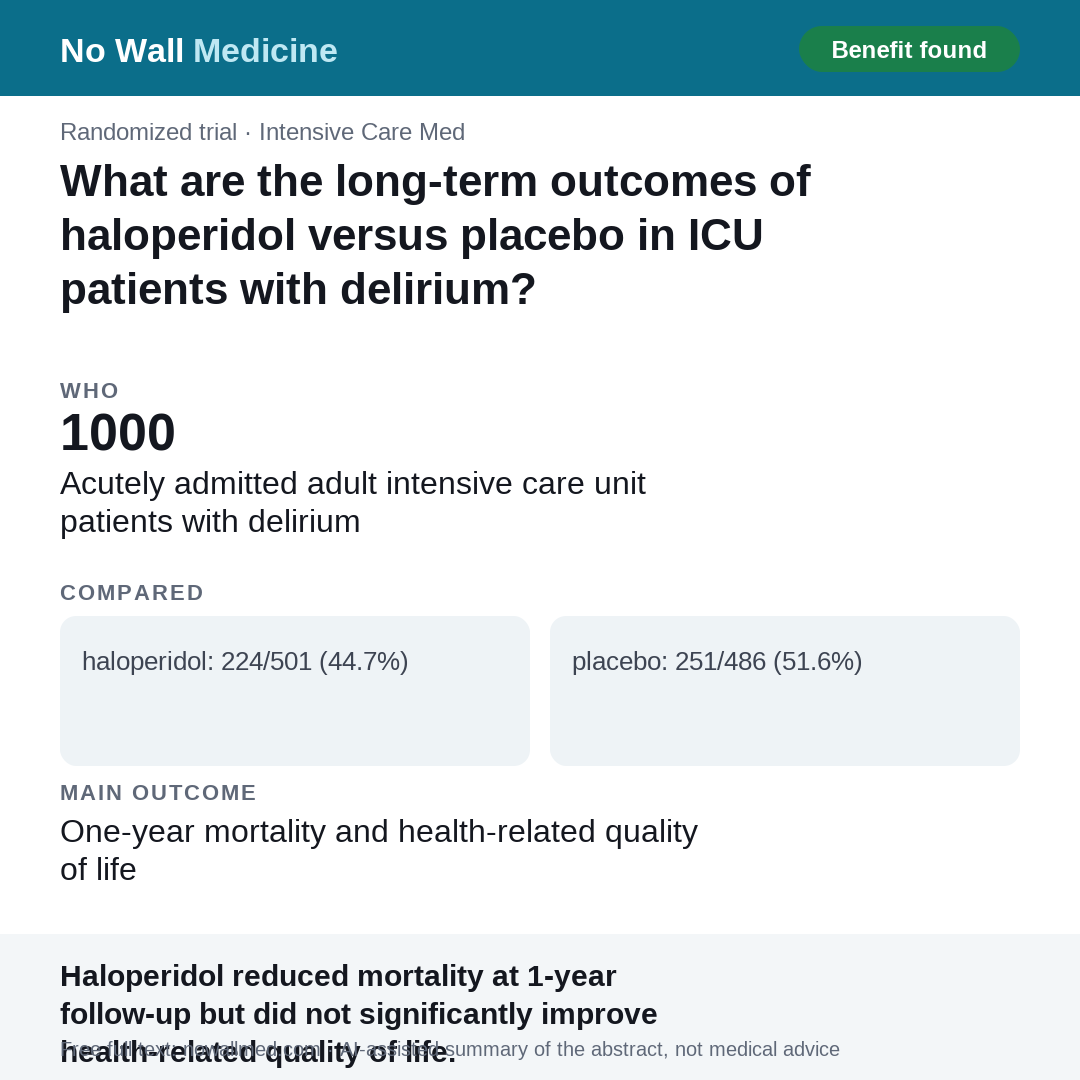
Clinical question: What are the long-term outcomes of haloperidol versus placebo in ICU patients with delirium?
Why it matters: It was unknown how haloperidol treatment affects long-term mortality and health-related quality of life in adults with delirium in the intensive care unit.
Key points
- Researchers analyzed 1000 randomized patients in the intensive care unit to compare haloperidol against a placebo for delirium.
- At one-year follow-up, mortality was 44.7% in the haloperidol group compared to 51.6% in the placebo group.
- Haloperidol was not linked to statistically significant changes in health-related quality of life scores.
Headline and key points written with AI from the paper’s abstract, with every number checked against it. Read the paper before relying on them.
Was this summary helpful?
Subject terms
Cite this article
Mortensen CB, Andersen-Ranberg NC, Poulsen LM, Granholm A, Rasmussen BS, Kjær MN. Long-term outcomes with haloperidol versus placebo in acutely admitted adult ICU patients with delirium. Intensive Care Med. 2024. doi:10.1007/s00134-023-07282-7
Spotted a mistake? Suggest a correction
Top studies every Monday
The week’s key trials and guidelines in your specialties, plus any topics you follow. By email, free.
Get the weekly digest