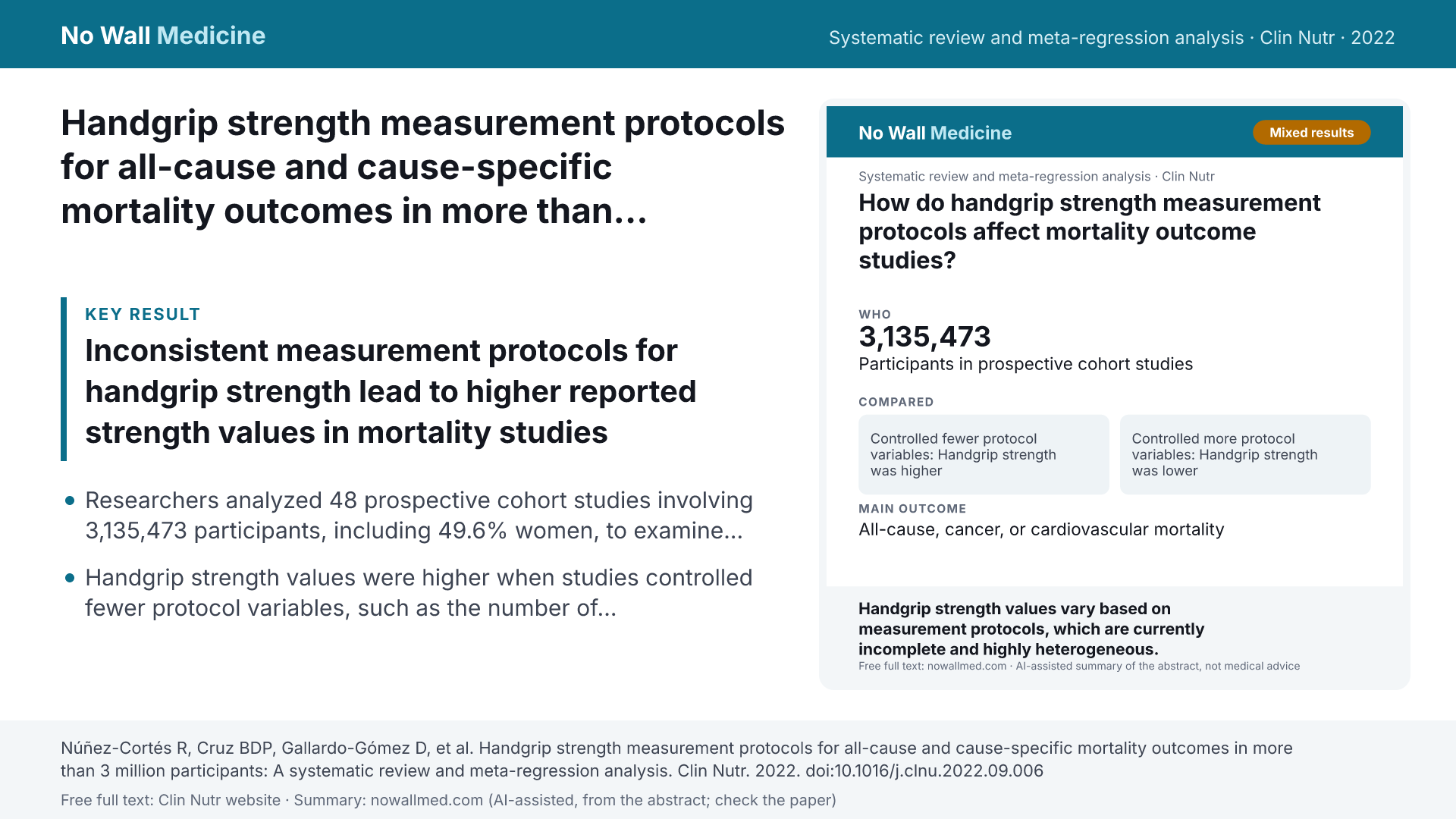
Inconsistent measurement protocols for handgrip strength lead to higher reported strength values in mortality studies
Handgrip strength measurement protocols for all-cause and cause-specific mortality outcomes in more than 3 million participants: A systematic review and meta-regression analysis
Systematic review and meta-regression analysisMixed results
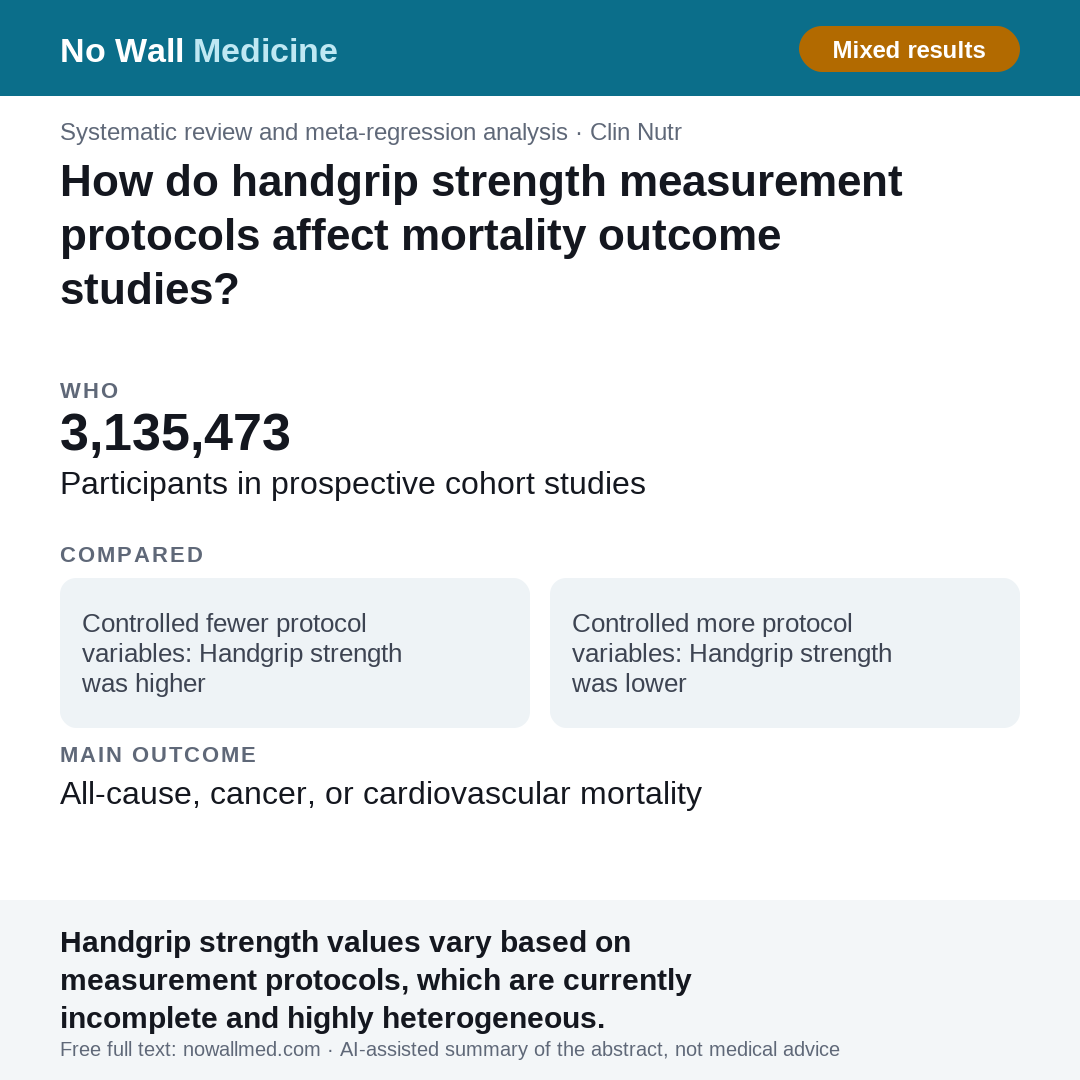
How do handgrip strength measurement protocols affect mortality outcome studies?
Who
3,135,473
Participants in prospective cohort studies
Compared
Controlled fewer protocol variables: Handgrip strength was higher
Controlled more protocol variables: Handgrip strength was lower
Main outcome
All-cause, cancer, or cardiovascular mortality
Bottom line: Handgrip strength values vary based on measurement protocols, which are currently incomplete and highly heterogeneous.
Limitation: The number of measurements, laterality, and estimation methods varied considerably between study protocols.
Clin Nutr · 2022-09-16Download image
Clinical question: How do handgrip strength measurement protocols affect mortality outcome studies?
Why it matters: The specific methods used to measure handgrip strength vary widely, making it unclear how these different protocols affect the accuracy of mortality risk estimates.
Key points
- Researchers analyzed 48 prospective cohort studies involving 3,135,473 participants, including 49.6% women, to examine how different handgrip strength measurement protocols relate to mortality.
- Handgrip strength values were higher when studies controlled fewer protocol variables, such as the number of measurements per hand or the position of the arm.
- Lower handgrip strength values were associated with not controlling elbow position or not providing verbal encouragement during the test.
Headline and key points written with AI from the paper’s abstract, with every number checked against it. Read the paper before relying on them.
Was this summary helpful?
Subject terms
Cite this article
Núñez-Cortés R, Cruz BDP, Gallardo-Gómez D, et al. Handgrip strength measurement protocols for all-cause and cause-specific mortality outcomes in more than 3 million participants: A systematic review and meta-regression analysis. Clin Nutr. 2022. doi:10.1016/j.clnu.2022.09.006
Spotted a mistake? Suggest a correction